

Protecting Your LLC: Insurance Essentials for Business Owners
If you’re searching for information about business insurance for LLC, here’s what you need to know:
- LLC Structure: Protects personal assets but not business assets
- Essential Coverages: General liability, professional liability, property insurance
- Average Annual Cost: $700-$3,800 depending on business type and size
- Legal Requirements: Workers’ compensation (if you have employees) in most states
- Recommended: Business Owner’s Policy (BOP) to bundle coverage at lower cost
Starting a limited liability company (LLC) is an important first step in protecting your personal assets, but it’s only half the solution. Business insurance for LLC entities is crucial because your LLC structure alone won’t shield your business assets from lawsuits, property damage, or other unexpected events. While your LLC separates your personal finances from your business, it doesn’t protect the business itself from financial risks that can threaten its survival.
Think of it this way: your LLC is like the foundation of a house, but business insurance is the roof, walls, and security system. You need both to be fully protected.
Without proper insurance, a single lawsuit or catastrophic event could wipe out everything you’ve worked so hard to build. According to data from The Hartford, approximately 40% of small businesses will experience a claim in the next 10 years. Those aren’t odds you want to gamble with.
I’m Jason Miller, and with over 20 years of experience providing business insurance for LLC owners throughout Florida, I’ve seen how proper coverage has saved countless businesses from financial ruin. My team at Florida All Risk Insurance specializes in creating customized insurance solutions that protect your business while keeping costs manageable.
Business insurance for llc terms to remember:
– business general liability insurance
– general liability insurance cost
– what does general liability insurance cover
Business Insurance for LLC: Why Structure Isn’t Enough
“My LLC will protect me from everything” if I had a dollar for every time I heard this from a new business owner, I could retire early! While forming an LLC is a smart first step, it’s just thata first step.
Think of your LLC as a fence around your personal property. It does a great job keeping your personal assets (your home, car, and personal bank accounts) separated from your business. But what about everything inside that fence? Your business equipment, inventory, commercial property, and future income remain completely exposed to risks.
The reality can be sobering. Research cited by Forbes Advisor shows that between 3653% of small businesses get tangled in at least one lawsuit annually. With defense costs ranging from $3,000 to a jawdropping $150,000, even a minor claim can send an uninsured business into a financial tailspin.
What’s particularly concerning is a legal concept called “piercing the corporate veil”. This happens when courts look past your LLC structure and hold you personally responsible for business debts or damages. Courts typically do this when business owners mix personal and business funds, keep sloppy records, underfund their business, or engage in deceptive practices.
Business insurance for LLC entities fills these critical protection gaps by covering legal costs, settlements, property damage, and other losses that your LLC structure simply wasn’t designed to handle.
How business insurance for LLC protects assets
Think of insurance as your business’s financial immune system, creating several layers of defense:
Your insurance responds first when trouble hits, covering legal defense costs, settlements, and damages up to your policy limits. This keeps your business assets intact.
After a covered loss like fire or theft, your insurance provides the funds to replace damaged property and compensates for income lost while you get back on your feet.
Having proper coverage signals financial responsibility, making courts less likely to “pierce the veil” and come after your personal assets.
Many clients, landlords, and lenders won’t even do business with you without seeing proof of specific insurance coverages.
One of our clients, a small landscaping LLC in Tampa, experienced this firsthand. Their employee accidentally damaged an underground irrigation system, causing $45,000 in repairs and water damage. Their general liability policy covered the entire claimwithout insurance, they would have faced selling equipment or taking on significant debt just to stay afloat.
Common consequences of operating without business insurance for LLC
The risks of going without adequate coverage can be severe:
Financial devastation can happen fast. A single lawsuit or major property loss can empty your business accounts and force you to seek loans or even close your doors permanently.
Lost business opportunities occur regularly when you can’t provide the certificates of insurance that many clients and partners require before signing contracts.
Legal penalties can add insult to injury. Some coverages, like workers’ compensation, are legally mandated in most states. Operating without them can result in fines, penalties, and even criminal charges in extreme cases.
Reputation damage in today’s connected world can be impossible to overcome. A poorly handled claim can lead to negative reviews that haunt your business for years.
As one of our clients in St. Petersburg told me after facing an uninsured property loss: “I thought skipping insurance was smart money management. That mistake nearly cost me everything. The few thousand I would have spent on premiums seems like nothing compared to the tens of thousands I paid out of pocket.”
At Florida All Risk Insurance, we’ve seen too many business owners learn these lessons the hard way. Your LLC provides valuable protection, but business insurance for LLC owners provides the complete shield your business deserves.
Core Coverage Types Every LLC Should Know
When it comes to business insurance for LLC protection, there’s no magic bullet that covers everything. But after helping hundreds of Florida business owners, I’ve seen which coverages provide the most protection for most businesses.
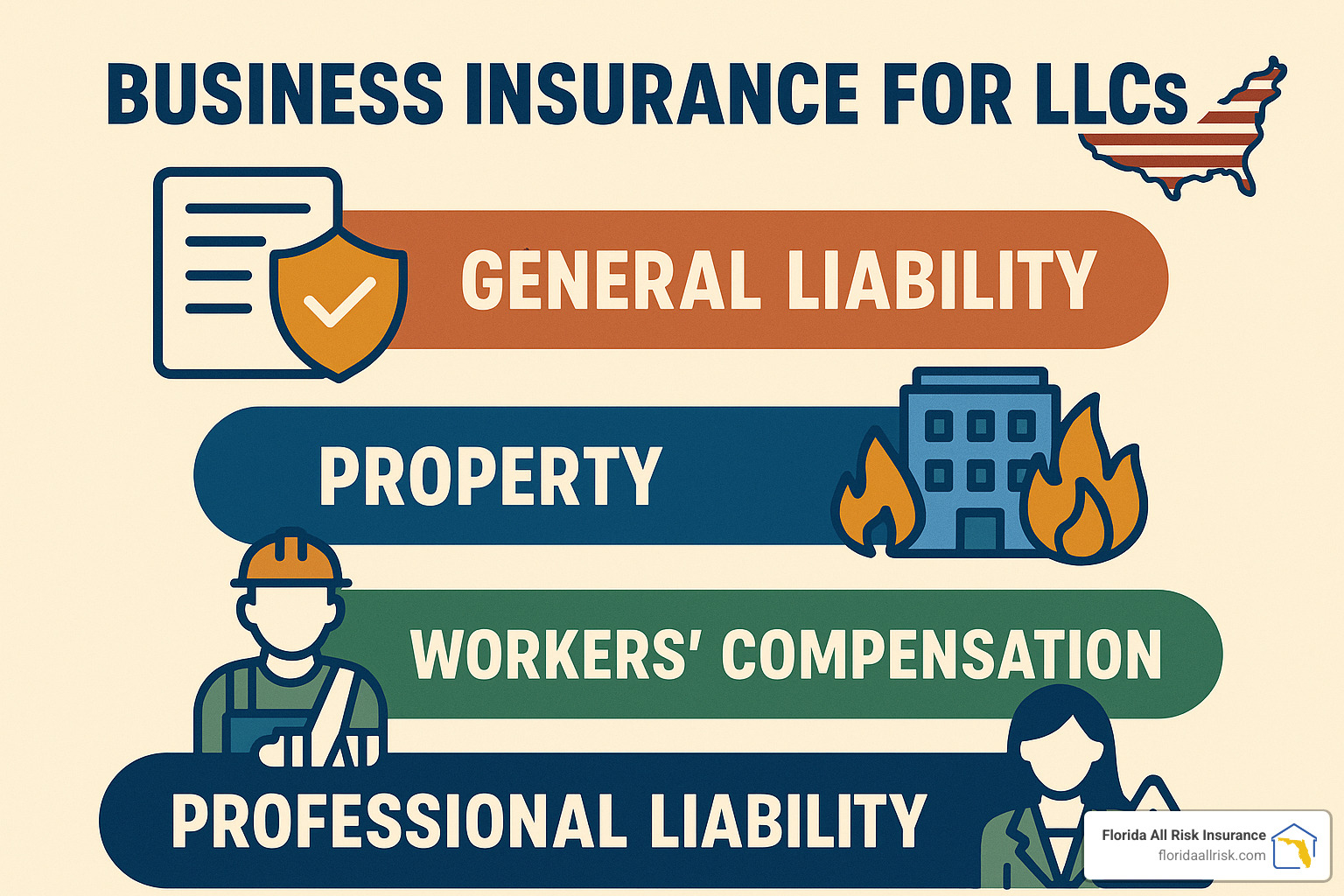
General Liability Insurance for LLCs
Think of general liability as your business’s first line of defense. It’s the foundation everything else builds upon, protecting your LLC when things go sideways with customers, visitors, or the general public.
This coverage steps in when someone claims your business caused them bodily injury (like that customer who tripped over your welcome mat), damaged their property (like when your employee accidentally backed into a client’s fence), or harmed them through advertising (like unknowingly using a trademarked slogan).
Most LLCs will pay between $500-$1,500 annually for this protection—a small price considering a single slip-and-fall claim can easily cost $20,000 or more.
I’ve seen countless situations where clients or landlords won’t even do business with companies that can’t provide a certificate of insurance (COI) proving they have general liability coverage. It’s become the minimum standard for professional operations.
Learn more about General Liability Insurance
Professional Liability (E&O) Insurance for LLCs
While general liability covers physical accidents, professional liability (also called E&O) protects the advice and services you provide. It’s your safety net when someone claims you made a mistake, gave bad advice, or failed to deliver promised services.
This coverage is absolutely essential if your LLC provides professional services of any kind. I’ve worked with accountants whose innocent spreadsheet errors led to five-figure claims, marketing consultants sued when campaigns didn’t perform as expected, and IT professionals facing lawsuits after software recommendations didn’t meet client expectations.
For most small service-based LLCs, professional liability typically runs $500-$1,000 annually, though certain high-risk professions like healthcare providers or attorneys will pay more due to their liftd risk profiles.
Bundled Option: Business Owner’s Policy (BOP)
If you’re looking to simplify your insurance while saving money, a Business Owner’s Policy (BOP) might be your answer. It’s like the value meal of business insurance—combining general liability, property coverage, and business interruption insurance in one convenient package.
The property portion protects your physical assets—your building (if you own it), equipment, inventory, and furniture. Meanwhile, business interruption coverage is the unsung hero that keeps money flowing when disaster forces you to temporarily close.
At around $1,200 per year for many small businesses, a BOP typically saves you 10-15% compared to purchasing these coverages separately. That’s why I recommend it to most of my clients with physical locations.
To qualify for a BOP, your business generally needs fewer than 100 employees, a modest commercial location, revenue under $1 million, and operations in a relatively low-risk industry. If you meet these criteria, it’s usually the most cost-effective option.
Additional Policies LLCs Should Consider
Beyond these core coverages, your specific business operations might require additional protection:
Workers’ Compensation Insurance isn’t optional if you have employees—it’s required by law in most states, including Florida. This coverage pays for medical expenses and lost wages when employees get hurt on the job. Costs typically range from $40-$70 monthly per employee, varying significantly based on your industry and safety record.
Commercial Auto Insurance becomes essential the moment your business owns vehicles or when employees use their personal vehicles for business purposes. Your personal auto policy likely excludes business use, creating a dangerous coverage gap. The average cost runs about $142 monthly ($1,700 annually) for most small businesses.
Cyber Liability Insurance has quickly moved from “nice to have” to “necessary” for most businesses. If you store customer data, process credit cards, or simply use email, you’re vulnerable to cyber attacks. I’ve seen small businesses face devastating costs after data breaches—costs this coverage would have handled.
Equipment/Inland Marine Insurance protects your tools and equipment that move between locations. Contractors, photographers, landscapers, and other mobile businesses find this coverage invaluable when expensive equipment is damaged, lost, or stolen while away from your primary location.
At Florida All Risk Insurance, we help St. Petersburg businesses and LLCs throughout Florida find the right mix of coverages for their specific needs. We believe in protection that’s comprehensive without being wasteful—exactly what you need, nothing you don’t.
What Business Insurance for LLC Costs & What Drives the Price

When business owners ask me about the cost of business insurance for LLC protection, I always tell them it’s like asking how much a car costs – it depends on what you’re looking for and your specific situation.
Most LLCs can expect to pay between $700 and $3,800 annually for comprehensive coverage. That’s quite a range, right? Let me break down why prices vary so much.
Your industry plays perhaps the biggest role in determining your premium. If you’re running a consulting firm from a home office, you’ll pay far less than a construction company with heavy equipment and multiple job sites. It’s all about risk – the higher the chance of something going wrong, the more you’ll pay.
Location matters too, especially here in Florida. Our beautiful sunshine state comes with unique challenges like hurricane and flood risks that affect insurance pricing. Even within Florida, rates can vary significantly between Miami, Orlando, and our home base of St. Petersburg.
The size of your operation directly impacts your costs as well. A one-person LLC will pay much less than a company with 20 employees and $2 million in annual revenue. More employees and higher revenue mean more exposure to potential claims.
Your claims history tells insurers a lot about your risk management. If you’ve had several claims in the past few years, expect to pay more than a business with a spotless record. Think of it like your driving record – accidents tend to raise your rates.
Here’s a simple breakdown of what typical Florida businesses might expect to pay:
| Policy Type | Median Monthly Cost | Median Annual Cost | Typically Required by Law |
|---|---|---|---|
| General Liability | $42-60 | $500-720 | No, but often contractually required |
| Professional Liability | $60-85 | $720-1,020 | No, but recommended for service businesses |
| Business Owner’s Policy | $100 | $1,200 | No |
| Workers’ Compensation | $40-70 | $480-840 | Yes, in most states with employees |
| Commercial Auto | $142 | $1,704 | Yes, for business-owned vehicles |
| Cyber Liability | $145 | $1,740 | No, but increasingly important |
| Commercial Property | $60 | $720 | No, but required by mortgage lenders |
Ways to Save on business insurance for LLC
The good news? There are plenty of ways to save on your business insurance for LLC protection without sacrificing coverage quality.
Bundling policies is one of the easiest ways to save. When you purchase multiple policies from the same insurer, you’ll often receive a 5-10% discount. It’s like buying in bulk at Costco – the more you get, the better the deal.
Consider adjusting your deductibles. A higher deductible means lower premiums, but make sure you have enough cash reserves to cover that deductible if you need to file a claim. I’ve seen too many business owners choose deductibles they couldn’t actually afford when disaster struck.
Safety programs aren’t just good business practice – they can save you money too. Many insurers offer discounts to businesses that implement formal safety protocols and training programs. It shows you’re serious about preventing claims before they happen.
Paying your premium annually instead of monthly typically saves you 2-5%. It’s a bigger upfront cost, but the savings can be substantial over time.
As an independent agency, we at Florida All Risk Insurance can shop multiple carriers to find you the best combination of coverage and price. Unlike captive agents who can only offer one company’s products, we have access to dozens of insurance providers.
Tax Deductibility & Accounting Tips for LLC Insurance
Here’s a silver lining that many new business owners don’t realize – the cost of business insurance for LLC entities is generally tax-deductible as a business expense! This effectively reduces your true cost of coverage.
How you deduct these premiums depends on your LLC’s tax structure. If you’re a single-member LLC, you’ll report these deductions on Schedule C of your personal tax return. Multi-member LLCs report on Form 1065, while LLCs taxed as S-corporations use Form 1120S.
I always recommend keeping detailed records of all premium payments throughout the year. Create a dedicated folder (physical or digital) for insurance documents and receipts. This simple habit will save you hours of frustration when tax time rolls around.
Make sure you’re clearly separating business insurance from personal insurance. Mixing the two can create headaches during an audit and potentially disqualify legitimate deductions.
Consider timing large premium payments strategically for tax planning. If you’re having a particularly profitable year, paying annual premiums in December rather than January might help offset some of that taxable income.
While we’re insurance experts, not tax professionals, we’re happy to work with your accountant to provide the documentation they need to maximize your legitimate deductions. That’s part of the personalized service we provide to our Florida clients.
How to Choose & Secure the Right Policy
Selecting the right business insurance for LLC coverage isn’t just about checking a box—it’s about finding protection that truly fits your business like a well-custom suit.

Step-by-Step Process to Buy Business Insurance for LLC
Finding the right coverage doesn’t have to be overwhelming. Think of it as a journey we’ll walk through together:
First, take a good look at what makes your business unique. What keeps you up at night? Maybe it’s the expensive equipment in your shop, or perhaps it’s the advice you give clients. These specific risks are your guideposts for insurance shopping.
Before reaching out for quotes, gather your business details—having this information ready makes the process so much smoother. You’ll need your legal name, EIN, business address, a clear description of what you do, revenue figures, payroll information, employee count, property values, and any previous claims history.
Working with an independent agent (like us at Florida All Risk Insurance) gives you a significant advantage. Rather than getting one quote from one company, we can shop your coverage needs across multiple carriers to find the best fit for both protection and price. It’s like having a personal shopper for insurance!
When reviewing potential policies, don’t just look at the premium. Coverage limits, deductibles, and exclusions tell the real story of what you’re buying. I’ve seen too many business owners find gaps in coverage only after a claim—let’s make sure that doesn’t happen to you.
Once you’ve found the right policy, the final steps are straightforward: sign the necessary forms, make your initial payment, and request certificates of insurance for anyone who needs proof of your coverage (landlords, clients, or lenders often require these).
As your St. Petersburg neighbors, we at Florida All Risk Insurance understand the unique challenges Florida businesses face. We’re not just selling policies—we’re building relationships that help protect what you’ve worked so hard to build.
Reviewing and Updating Coverage Annually
Your business isn’t static, and your insurance shouldn’t be either. Think of your annual insurance review as a regular health check-up for your business protection.
The best times to review your coverage include:
- Your annual renewal date
- When launching new products or services
- After purchasing major equipment
- When hiring your first employee (or significantly expanding your team)
- Before signing contracts with specific insurance requirements
- When opening new locations
During these reviews, we’ll look at how your business has evolved. Has your revenue grown significantly? This might mean you need higher coverage limits. Added new employees? Time to revisit workers’ compensation. Purchased new equipment? Let’s update your property coverage accordingly.
One of our construction clients recently added three new employees and purchased $50,000 in new equipment. During our annual review, we adjusted his coverage to reflect these changes—which turned out to be perfect timing when one of those new pieces of equipment was damaged just two months later. Because we’d updated his policy, the claim process was smooth and fully covered.
Regular reviews ensure you’re never overinsured (paying for coverage you don’t need) or underinsured (leaving yourself vulnerable to losses). It’s about right-sizing your protection as your business grows and changes.
More information about Business Insurance for Small Businesses
Frequently Asked Questions about Business Insurance for LLCs
Does an LLC legally require insurance?
The short answer? It depends on your situation. While simply forming an LLC doesn’t automatically mean you need insurance, several common scenarios make insurance a must-have:
If you have employees, most states (including our home state of Florida) require workers’ compensation insurance. Here in Florida, construction businesses need workers’ comp with just one employee (and yes, that includes you as an owner-member), while non-construction businesses need it once they hit four employees.
Own business vehicles? Then you’ll need commercial auto insurance to meet state minimum requirements—your personal auto policy won’t cover business use.
Many professional licenses also require insurance coverage. Contractors, healthcare providers, and other licensed professionals often must carry liability insurance to maintain their licenses.
And then there’s the practical reality: many clients, landlords, and lenders will require proof of insurance before they’ll do business with you. While not technically a “legal” requirement, these contractual obligations make insurance essentially mandatory if you want your business to grow.
How does LLC insurance differ from sole proprietorship or corporation policies?
When it comes to insurance across different business structures, there are some important distinctions worth understanding:
LLC vs. Sole Proprietorship:
The biggest difference? A sole proprietorship has no legal separation between you and your business. This means without insurance, your personal assets (home, savings, etc.) are completely exposed to business risks. While your LLC provides some personal asset protection, you still need business insurance for LLC entities to protect your business assets. Both business types need similar coverage types, but sole proprietors often need higher liability limits since their personal assets are at stake.
LLC vs. Corporation:
Both LLCs and corporations create legal separation between owners and the business, but corporations (especially larger ones) typically need more complex insurance programs with higher coverage limits. Corporations often require additional policies like Directors and Officers (D&O) liability insurance to protect board members. Your premium calculations might also differ based on your ownership structure and how risk is distributed in your organization.
What real-world claims show the value of LLC insurance?
Nothing illustrates the importance of business insurance for LLC protection like real stories from business owners who’ve faced challenging situations. Here are three actual claims we’ve seen (with names and details changed for privacy):
A small boutique owner in St. Petersburg experienced every retailer’s nightmare when a customer tripped over a display stand and broke her hip. The resulting claim totaled $75,000 between medical expenses and pain and suffering. Thanks to a solid general liability policy, the entire claim was covered—including legal defense costs that would have otherwise come straight from the business’s bank account.
In another case, a marketing consultant provided campaign recommendations that a client implemented, only to see disappointing results. When the unhappy client sued for $75,000 in “wasted marketing spend,” the consultant’s professional liability insurance covered both the $15,000 settlement and $22,000 in legal fees—a total of $37,000 that would have otherwise devastated the small consulting firm.
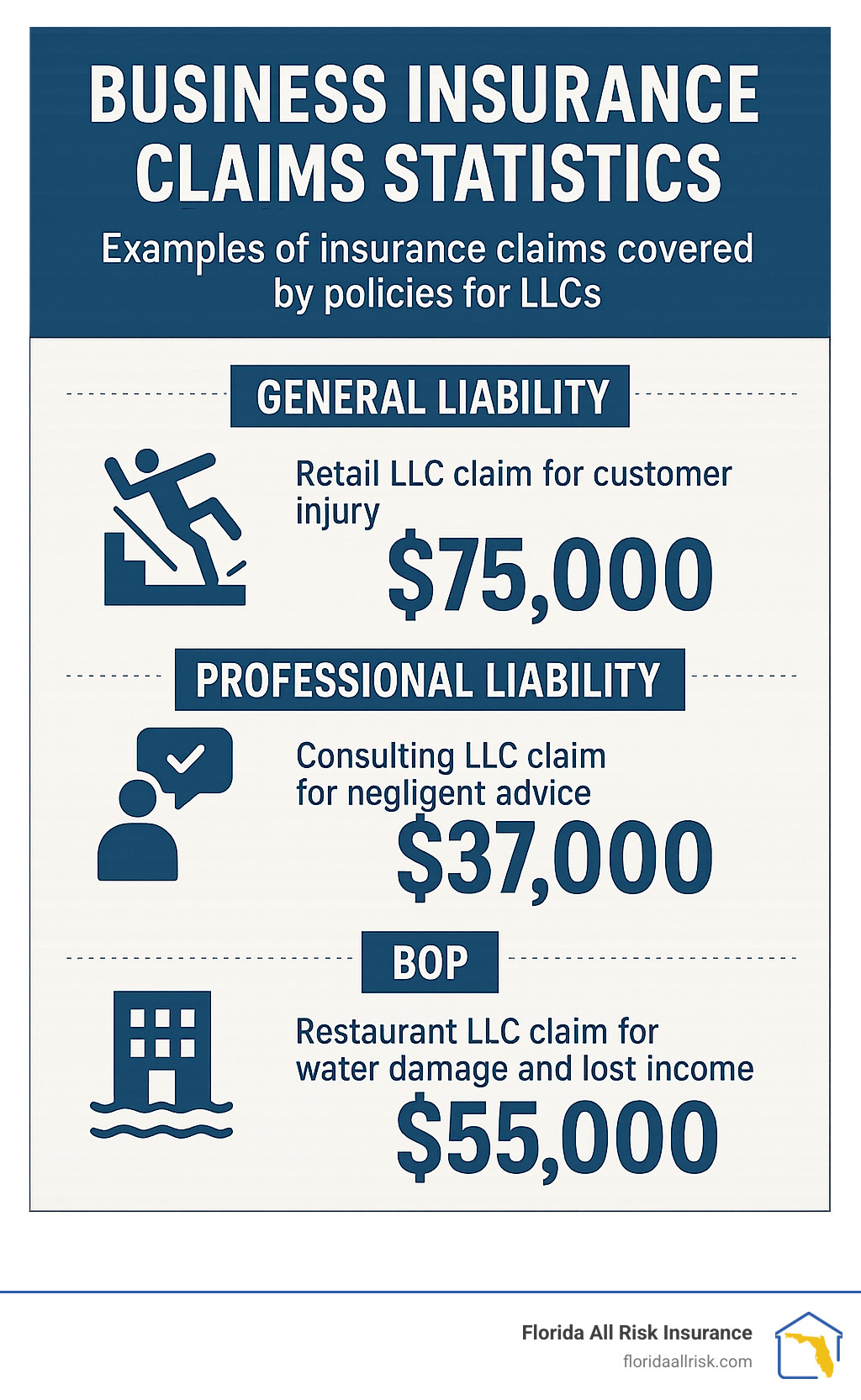
These aren’t just cautionary tales—they’re reminders that proper insurance can be the difference between a manageable setback and a business-ending disaster. At Florida All Risk Insurance, we’ve seen how the right coverage has saved our clients from financial catastrophe, allowing them to focus on what they do best: running their businesses.
Conclusion
Running a successful LLC is about more than just delivering great products or services – it’s about protecting what you’ve built. While your LLC structure gives you that crucial separation between personal and business assets, business insurance for LLC companies fills the protection gaps that your legal structure simply can’t address.
I’ve seen how proper insurance has saved Florida businesses from disaster. Just last year, one of our clients – a small retail LLC in Tampa – faced a $65,000 liability claim that would have crippled their operation without insurance. Instead, they paid their $1,000 deductible and continued serving customers without missing a beat.
The peace of mind that comes with comprehensive coverage is invaluable. When you’re not lying awake at night worrying about potential lawsuits or property damage, you can focus your energy on growing your business and serving your customers better.
At Florida All Risk Insurance, we understand that each LLC has unique needs and challenges. That’s why we take the time to understand your business before recommending coverage options. As an independent agency serving St. Petersburg and communities throughout Florida, we can shop multiple carriers to find the perfect balance of protection and affordability.
The average annual investment of $700-$3,800 for proper business insurance for LLC protection is minimal compared to the potential six or seven-figure costs of facing a claim uninsured. Think of it as one of the smartest business expenses you’ll make – one that could literally save everything you’ve worked for.
Don’t wait for a crisis to find gaps in your protection. Our team at Florida All Risk Insurance is ready to help you create a comprehensive insurance program custom to your specific LLC needs. We’ll help identify your unique risks, explain your coverage options in plain English, and ensure you have the right protection at competitive rates.
Your business deserves the best protection possible. Let’s make sure it has exactly that.

