Understanding Health Insurance Options for Your Small Business
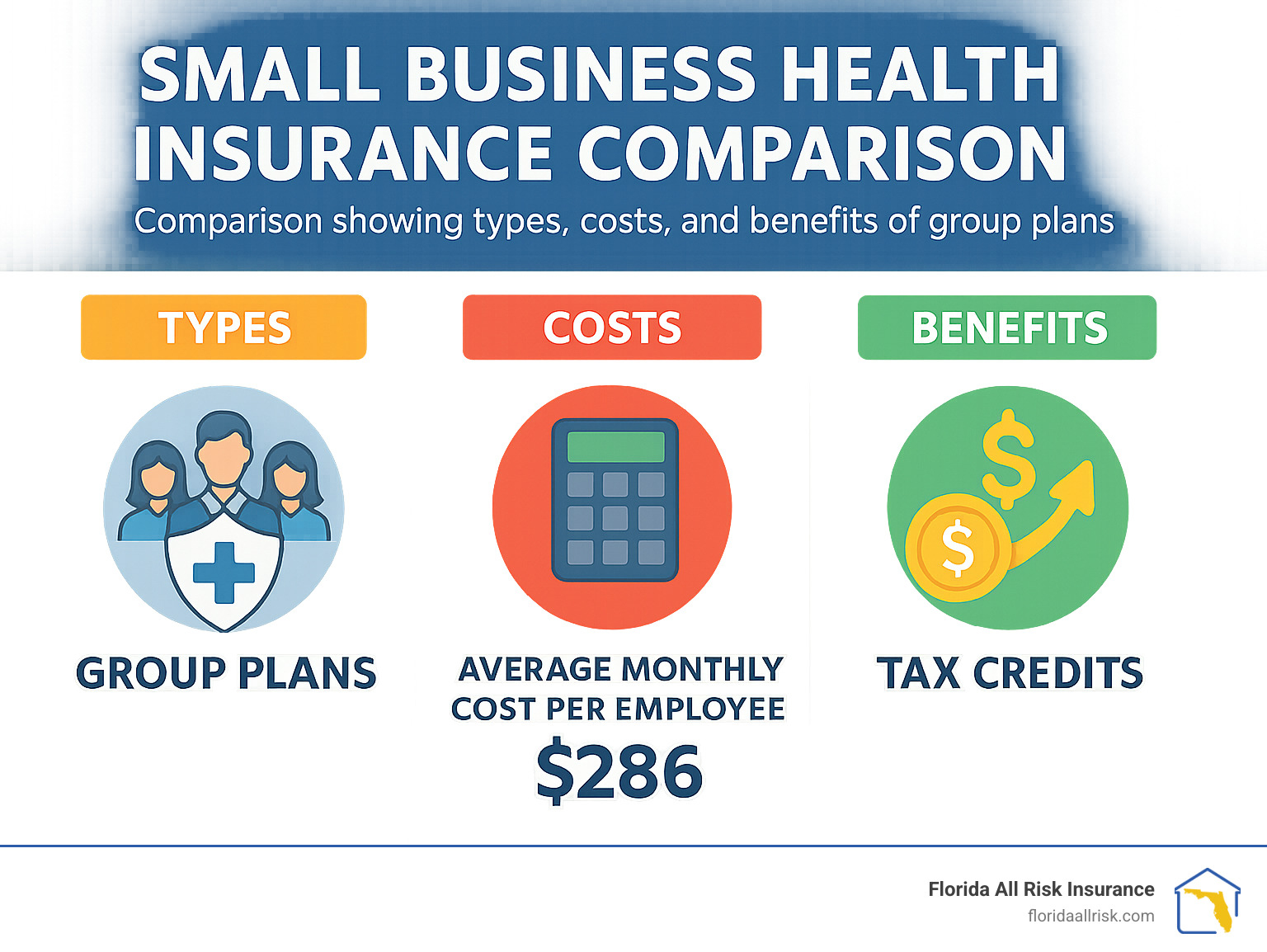
Small business health insurance provides coverage for companies with typically 1-50 employees, helping attract and retain talent while potentially qualifying for tax benefits. Here’s what you need to know:
- Not mandatory for businesses under 50 employees – Unlike larger employers, small businesses aren’t legally required to offer health insurance
- Cost-sharing structure – Employers typically cover at least 50% of employee premiums
- Average cost – An average small business plan covers 5 people and costs approximately $1,432 per month ($286 per person)
- Tax credit available – Businesses with fewer than 25 employees may qualify for a tax credit worth up to 50% of premium costs
- Year-round enrollment – Unlike individual plans, there’s no special enrollment period for small business health insurance
Finding the right small business health insurance can seem overwhelming, but it’s one of the most important decisions you’ll make as a business owner. The health benefits you provide not only affect your employees’ wellbeing but also your company’s ability to attract top talent and maintain productivity.
In today’s competitive job market, health insurance has become a critical factor for small businesses. According to research, offering quality health coverage can significantly improve employee retention and satisfaction while potentially reducing absenteeism due to illness.
I’m Jason Miller, a second-generation insurance professional with over 20 years of experience helping Florida businesses steer small business health insurance options that balance comprehensive coverage with cost control.
Must-know business health insurance small terms:
– Florida group health insurance
– how to choose a group health insurance plan
– benefits of health benefits
Understanding the Fundamentals of Small-Business Health Coverage
When you’re running a small business, health insurance might seem like a complex puzzle with too many pieces. Let me break it down for you in simple terms.
Small business health insurance is essentially a group health plan custom for businesses with typically 1-50 full-time equivalent employees. Think of it as strength in numbers – by pooling resources, your team gets better coverage options often at more stable rates than they might find individually.
One of the best parts? Thanks to the Affordable Care Act, these plans are “guaranteed issue” – which means insurance companies can’t turn you down or charge more because someone on your team has health problems. That’s a huge win for small business owners trying to take care of their employees.
To qualify for a small group plan, you’ll need:
– At least one W-2 employee who isn’t you (the owner) or your spouse
– A physical business location in Florida (or whatever state you’re seeking coverage)
– Employees working at least 30 hours weekly to be considered full-time
– Usually around 70% of your eligible employees participating
Unlike individual health insurance with its limited enrollment windows, you can start business health insurance small plans anytime during the year. This flexibility lets you implement benefits when it makes the most sense for your company’s timeline and budget.
Who Qualifies as “Small” for Business Health Insurance Small?
The definition of “small” is pretty straightforward in most places:
The federal government defines small businesses as those with 1-50 full-time equivalent employees (FTEs). Some states extend this up to 100 employees, but here in Florida, we stick with the standard 1-50 definition.
Calculating your FTEs is simpler than it sounds:
Full-time employees (30+ hours weekly) count as one FTE each. For part-timers, add up their monthly hours and divide by 120. The total gives you your FTE count.
For example, if your St. Petersburg coffee shop has 8 full-timers and 6 part-timers averaging 60 hours monthly, your math would look like:
– 8 full-timers = 8 FTEs
– (6 part-timers × 60 hours) ÷ 120 = 3 FTEs
– Total: 11 FTEs – comfortably within the “small business” definition
Most insurance carriers want to see at least 70% of eligible employees participating, though they typically waive this requirement during a special period from November 15 to December 15 each year.
A note for solo entrepreneurs: If you’re running a one-person show with no employees, group health insurance isn’t available to you. Instead, you’ll need to explore individual coverage options through the Health Insurance Marketplace or directly with private insurers.
Main Plan Types: HMO, PPO, POS, EPO, HDHP
When shopping for small business health insurance, you’ll encounter several plan types that might initially sound like alphabet soup. Each has its own approach to networks, referrals, and costs:
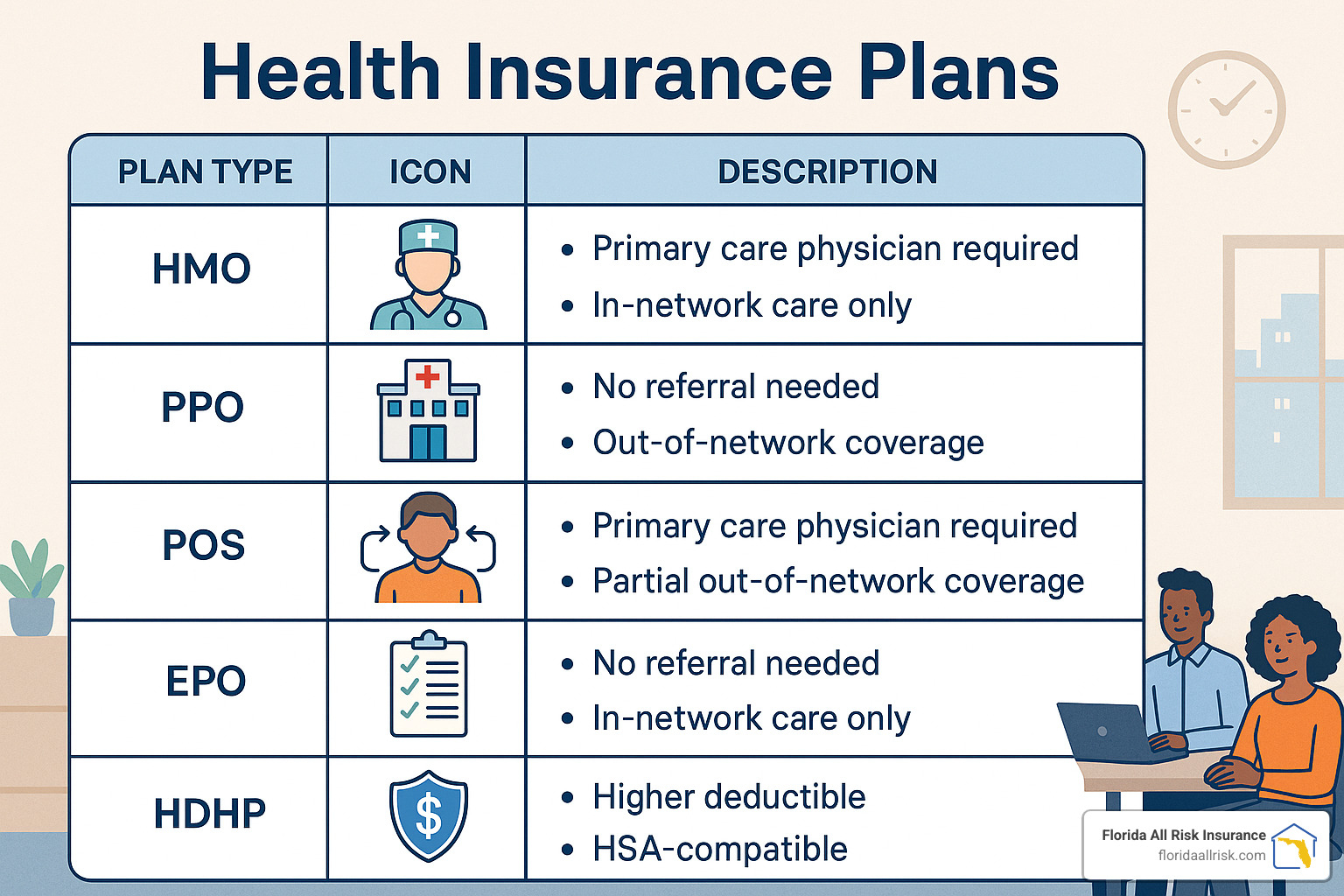
Health Maintenance Organization (HMO) plans are like having a home base for healthcare. Your employees must choose a primary care doctor who coordinates all their care and provides referrals to specialists. They’ll only be covered when seeing providers within the network, but in exchange, they’ll typically enjoy lower premiums and predictable copays. These plans work well for budget-conscious Florida businesses whose team members don’t mind some structure in their healthcare choices.
Preferred Provider Organization (PPO) plans offer more freedom. Your team won’t need to select a primary doctor or get referrals to see specialists. They can even see out-of-network providers (though at a higher cost). This flexibility comes with higher premiums but gives employees greater choice in their healthcare journey – perfect for businesses with team members who prioritize provider options.
Point of Service (POS) plans blend HMO and PPO features. Employees select a primary doctor who provides referrals, but they have some flexibility to see out-of-network providers (with higher costs). These plans hit a middle ground on premiums and work well for businesses wanting some cost control without completely limiting provider options.
Exclusive Provider Organization (EPO) plans require members to stay in-network (like HMOs) but don’t require primary doctors or referrals (like PPOs). They typically cost less than PPOs while still offering some flexibility. They’re great for businesses whose employees want direct specialist access but don’t often need out-of-network care.
High Deductible Health Plans (HDHPs) can be structured with any network type but feature lower premiums paired with higher deductibles. The special benefit? They can be paired with Health Savings Accounts (HSAs), allowing employees to save tax-free dollars for medical expenses. These plans often appeal to companies with younger, healthier workforces or those wanting to offer the tax advantages of HSAs.
At Florida All Risk Insurance, we help St. Petersburg businesses and organizations throughout Florida steer these options to find the right balance of coverage, flexibility, and affordability. We understand that choosing business health insurance small plans isn’t just about numbers – it’s about taking care of the people who make your business successful.
Benefits & Legal Requirements for Employers
Offering small business health insurance isn’t just about checking a box for healthcare coverage—it’s an investment that pays dividends in multiple ways for both you and your team.
When you provide health benefits, you’re actually strengthening your business from the inside out. In today’s job market, quality candidates often look at the total package, not just the salary. Health insurance has become that essential benefit that helps you attract and keep your best people. Plus, there’s a nice bonus for your bottom line—those premiums are generally 100% tax-deductible as a business expense.
We’ve seen it time and again with our St. Petersburg clients: businesses that offer health coverage tend to have employees who miss fewer workdays. It makes sense—when people have access to preventive care and can address health concerns early, they stay healthier and more productive. There’s also that unmeasurable but very real boost to company culture when your team feels genuinely cared for.
For your employees, the benefits go beyond just having medical coverage. They gain real financial security against those unexpected health crises that can be devastating without insurance. When premiums come out of their paycheck pre-tax, they’re effectively reducing their taxable income. And that peace of mind that comes from knowing healthcare is covered? That’s priceless.
Learn more about SHOP eligibility
Must You Offer Business Health Insurance Small?
Here’s the straightforward answer: it depends on how big your company is.
If you have fewer than 50 full-time equivalent employees (FTEs), you have complete freedom to decide. There’s no legal requirement to offer health insurance and no penalties if you choose not to. This gives smaller businesses flexibility to make the decision that works best for their specific situation.
The rules change once you hit that 50 FTE threshold. At this point, the ACA’s employer mandate kicks in, and you must offer affordable coverage that meets minimum value standards. Missing this mark can lead to significant penalties—around $2,750 per full-time employee (minus the first 30) if you offer no coverage at all, or about $4,120 per employee receiving marketplace subsidies if your coverage doesn’t meet requirements.
For coverage to be considered “affordable” under the ACA, your employees shouldn’t have to contribute more than 9.12% (for 2023) of their household income for self-only coverage.
Here in Florida, while there’s no state mandate requiring you to provide health insurance, we’ve seen how offering coverage can give you a real edge in attracting and keeping quality employees, especially if you’re in a competitive field.
Added Value for Employees and Owners
The benefits of small business health insurance extend far beyond just covering doctor visits—they create ripple effects throughout your entire organization.
Most group plans fully cover preventive services, encouraging your team to get regular check-ups and screenings. This proactive approach often catches health issues early when they’re less expensive and easier to treat. It’s a win-win: better health outcomes for your employees and potentially lower long-term costs for your plan.
We’ve worked with numerous Florida businesses that have seen measurable productivity improvements after implementing health benefits. The research backs this up—studies consistently show that employees with health insurance miss approximately 20% fewer workdays and bring more energy and focus when they are at work.
In Florida’s competitive hiring landscape, especially in fields like technology, healthcare, and professional services, offering health benefits can be the deciding factor that brings that perfect candidate to your team instead of your competitor’s. It signals that you’re a serious employer who invests in your people.
There’s also the significant impact on your employees’ financial wellbeing. With medical debt being the leading cause of personal bankruptcy in America, providing affordable health coverage helps protect your team’s financial futures—something they’ll deeply appreciate.
And don’t forget about yourself! As a business owner, you can participate in the same group plan you offer employees, often securing better coverage than what’s available on the individual market, especially if you have pre-existing conditions.
At Florida All Risk Insurance, we’ve watched St. Petersburg businesses transform after implementing quality health benefits—lower turnover, stronger team morale, and ultimately, healthier business outcomes. It’s not just insurance; it’s an investment in your company’s future.
Comparing Plans & Controlling Costs in Business Health Insurance Small
Let’s face it – navigating the costs of small business health insurance can feel like trying to solve a puzzle with moving pieces. As a business owner, you want to provide great coverage without breaking the bank. I’ve helped hundreds of Florida businesses find that sweet spot, and I’m happy to share what works.
When you’re looking at plans, you’ll need to understand several key cost components that affect both your bottom line and your employees’ wallets:
Your monthly premiums are just the starting point – these are typically shared between you and your team. Then there are deductibles (what employees pay before insurance kicks in), copayments (those fixed amounts for specific services like a $25 doctor visit), and coinsurance (the percentage split after meeting deductibles). Finally, the out-of-pocket maximum caps what employees will ever have to pay annually.
Most plans fall into “metal tiers” that make comparison shopping a bit easier:
Bronze plans cover about 60% of healthcare costs, Silver about 70%, Gold about 80%, and Platinum approximately 90%. As you might guess, higher metal tiers mean higher premiums but lower out-of-pocket costs when your employees actually need care. It’s a balancing act between monthly budgeting and financial protection.

Price Drivers & Budgeting Tips
Several factors will influence what you’ll pay for business health insurance small plans, and understanding them helps you budget more effectively.
Age matters a lot in health insurance pricing. Under ACA rules, premiums can vary based on your team’s ages, with older employees potentially costing up to three times more than younger ones. If you have a lot of team members in their 50s and 60s, this will definitely impact your rates.
Where your business operates also plays a significant role. Here in Florida, we see wide variations across counties – a plan in Miami-Dade typically costs more than the identical plan in a smaller county. It’s just the reality of regional healthcare costs.
Your contribution strategy is something you can control. While you’ll generally need to contribute at least 50% of employee-only premiums, you have flexibility beyond that. Some of my clients prefer a defined contribution approach, setting a fixed dollar amount toward each employee’s coverage. Others go with percentage-based contributions or even tiered contributions based on employee classifications (though these must be non-discriminatory).
When it comes to covering dependents, you’re not required to do so, but it can be a powerful recruitment tool. Consider whether you’ll contribute toward family coverage and how that might impact your overall benefits package appeal.
For practical budgeting, I always recommend getting quotes from multiple carriers, considering offering a couple of plan options to meet diverse employee needs, and reassessing annually before renewal. The insurance landscape changes constantly, and what was the best deal last year might not be this year.
Tax Credits, HRAs & Other Savings Tools
Don’t leave money on the table! Several programs can make small business health insurance more affordable:
The Small Business Health Care Tax Credit is a genuine game-changer for smaller companies. If you have fewer than 25 full-time equivalent employees earning average wages under $50,000, and you contribute at least 50% toward their premiums, you could receive a tax credit up to 50% of your premium contributions (35% for tax-exempt organizations). You’ll claim this by filing IRS Form 8941 with your tax return.
Health Reimbursement Arrangements (HRAs) give you another flexible option. These allow you to reimburse employees tax-free for qualified medical expenses and sometimes individual health insurance premiums. The Individual Coverage HRA (ICHRA) works for businesses of any size with no contribution limits, while the Qualified Small Employer HRA (QSEHRA) is specifically for employers with fewer than 50 FTEs, with 2023 contribution limits of $5,850 for individual coverage and $11,800 for family coverage.
More info about Health Reimbursement Arrangement
Health Savings Accounts paired with qualifying high-deductible health plans offer what I call the triple tax advantage – tax-deductible contributions, tax-free growth, and tax-free withdrawals for qualified medical expenses. Both you and your employees can contribute to HSAs up to annual limits ($3,850 for individual coverage and $7,750 for family coverage in 2023).
Proven Cost-Control Strategies
After years of helping Florida businesses manage their healthcare costs, I’ve seen several strategies consistently deliver results:
Wellness programs aren’t just feel-good initiatives – they can meaningfully reduce claims and potentially lower your premiums over time. Simple programs like smoking cessation, fitness challenges, preventive screening incentives, and mental health resources can make a real difference in your team’s health and your bottom line.
For companies with generally healthy employees, level-funded plans offer an interesting middle ground. They combine predictable premiums like fully-insured plans but with the potential for premium refunds if your actual claims come in lower than expected. Several of my St. Petersburg clients have received substantial refunds with this approach.
Network optimization is another powerful tool in your cost-control toolkit. Narrow network plans that focus on high-quality providers can reduce costs significantly. Adding telemedicine options decreases expensive emergency room visits, and reference-based pricing models for specific procedures can create additional savings.
Don’t overlook prescription management strategies. Implementing step therapy programs that require trying generic drugs before brand-name versions, offering mail-order pharmacy options for maintenance medications, and requiring prior authorization for high-cost medications can all help control this rapidly growing expense category.
Finally, strategic plan design matters enormously. Consider offering an HDHP with an HSA alongside a more traditional plan to give employees choices. Implement appropriate cost-sharing to encourage thoughtful healthcare utilization, and add voluntary benefits that complement your medical plan.
At Florida All Risk Insurance, we work closely with St. Petersburg businesses to implement these strategies while maintaining quality coverage that keeps your team healthy, happy, and productive. The best approach combines several of these tactics custom to your specific business needs and employee demographics.
How to Enroll, Administer & Stay Compliant
Getting your team set up with business health insurance small doesn’t have to be complicated. While there are important details to manage, the process is more straightforward than many business owners expect.
You have several paths to enrollment, each with its own advantages:
- SHOP Marketplace: The Small Business Health Options Program caters specifically to businesses with 1-50 employees, offering standardized plans with potential tax credits
- Direct with carriers: Working directly with major insurance providers like Blue Cross Blue Shield or UnitedHealthcare can sometimes provide more customized options
- Through a broker: Many Florida businesses choose to work with independent brokers (like us at Florida All Risk) who can compare multiple carriers and plans to find your best fit
One of the biggest advantages of business health insurance small plans is their flexibility with timing. Unlike individual health insurance with its strict annual enrollment periods, you can start coverage for your business any month of the year. Plans typically become effective on the 1st of the month following your application approval.

Step-by-Step Enrollment Roadmap
Let’s break down the journey to successful business health insurance small implementation into manageable steps:
1. Determine eligibility and calculate FTEs
First things first – make sure your business qualifies. Count your full-time employees working 30+ hours weekly, then calculate part-time employee equivalents. This FTE (full-time equivalent) number determines your eligibility and potential tax credits.
2. Assess employee needs
Before selecting plans, understand what your team actually needs. An anonymous survey can reveal valuable insights about preferences and priorities. Consider your workforce demographics – younger teams might prefer lower premiums with higher deductibles, while those with families often value comprehensive coverage.
3. Compare plan options
This is where the real shopping begins. Request quotes from multiple carriers to see the full landscape of available options. Look beyond just the premium costs to network coverage, prescription benefits, and out-of-pocket maximums. Many businesses find offering two plan options gives employees valuable choice.
4. Verify participation requirements
Most insurers require a minimum percentage of eligible employees (typically 70%) to participate in your plan. Be prepared to collect waiver forms from employees who decline coverage (usually because they’re on a spouse’s plan). If you’re struggling to meet participation requirements, consider adjusting your contribution strategy.
5. Complete applications
Once you’ve selected your plan(s), you’ll submit an employer application with your business details, while employees complete their individual applications. Have your business license and payroll records handy – carriers often request these to verify your business status.
6. Pay initial premium
Your coverage won’t begin until you’ve submitted the first month’s premium payment. Setting up automatic electronic funds transfer for future payments can prevent any coverage disruptions. Once payment is processed, you’ll receive confirmation of your effective date.
7. Distribute plan materials
When your materials arrive, distribute Summary of Benefits and Coverage documents to all employees, along with insurance cards. Many of our clients find that hosting a brief enrollment meeting helps employees understand how to best use their new benefits.
8. Set up payroll deductions
The final setup step is calculating employee premium contributions and establishing pre-tax payroll deductions. Make sure to document authorization for these deductions from each participating employee.
Managing Business Health Insurance Small Year-Round
Your work isn’t done once enrollment is complete. Successful business health insurance small administration requires ongoing attention:
Annual renewal process
Mark your calendar for 60-90 days before your plan anniversary. This is when you should begin evaluating renewal options and comparing your current plan’s performance against alternatives. Consider whether your plan design still meets your needs based on the past year’s utilization patterns. When changes are necessary, communicate them to employees well in advance.
Handling employee changes
Life doesn’t stand still, and neither will your workforce. Establish clear procedures for adding new hires (typically after a 30-90 day waiting period), processing terminations promptly, and managing qualifying life events like marriages or new babies. Documenting these changes carefully protects both your business and your employees.
Compliance requirements
Even small businesses face important compliance obligations. These include providing COBRA/mini-COBRA continuation coverage notices when applicable, distributing Summary Plan Descriptions as required by ERISA, completing ACA reporting forms if required, and maintaining HIPAA-compliant privacy practices for protected health information.
Employee communication
The most successful business health insurance small programs include regular communication. Annual benefits education sessions help employees maximize their coverage. Providing resources for understanding and using benefits reduces frustration and improves satisfaction. And collecting feedback helps you continually improve your offerings.
Here in St. Petersburg, our Florida All Risk Insurance team supports businesses throughout the entire plan year. We help steer administrative challenges and keep you updated on changing regulations so you can focus on running your business.
More info about How to Choose a Group Health Insurance Plan
Frequently Asked Questions about Business Health Insurance Small
How many employees do I need to qualify for a group plan?
One of the most common questions I hear from Florida business owners is about the minimum requirements for business health insurance small plans.
The good news is that the bar is relatively low – you generally need just one W-2 employee who isn’t you (the owner) or your spouse. However, there are some important nuances to understand:
Most insurance carriers want to see at least 2 people enrolled in the plan for it to be viable. You as the business owner can absolutely be one of those people, as long as at least one regular employee is also participating.
For employees to qualify, they typically need to work at least 30 hours per week. Part-timers usually don’t count toward your eligibility requirements, though they may be able to join the plan if you choose to offer it to them.
Here in Florida, we follow the federal definition requiring at least one common law employee who isn’t an owner, partner, or their spouse. This means solo entrepreneurs without employees generally won’t qualify for group coverage.
Can plans include dental and vision coverage?
Absolutely! When setting up business health insurance small plans, you can definitely include dental and vision coverage for your team. These valuable benefits are usually offered as separate plans rather than being built into your medical coverage.
Your options typically include stand-alone dental plans covering everything from routine cleanings to major procedures, and vision plans covering eye exams, frames, lenses, and sometimes contacts. Many carriers offer bundle discounts when you purchase medical, dental, and vision together, which can make these add-ons more affordable.
What surprises many of our St. Petersburg clients is how cost-effective these additional benefits can be, especially considering their impact on employee satisfaction. Dental premiums typically range from $20-$50 per month per employee, while vision plans are even more affordable at roughly $5-$15 monthly.
These supplemental benefits often deliver significant value for relatively modest investment. Employees truly appreciate comprehensive coverage that addresses their total health needs, not just major medical concerns.
Is there a special enrollment period for small businesses?
Unlike the individual health insurance market with its strict annual enrollment windows, business health insurance small plans offer wonderful flexibility. You can establish coverage at any time throughout the year that makes sense for your business.
This flexibility allows you to align your health benefits with what works best for your company – whether that’s your fiscal year, business anniversary, or any other timing that makes sense for your operations and cash flow.
The typical timeline works like this: Coverage usually begins on the 1st of the month following your application approval. If you submit everything by the 15th of the month, you can often have coverage in place by the 1st of the following month. Applications submitted later might push your effective date to the beginning of the month after that.
Most carriers need all paperwork and your initial premium payment 5-7 business days before month-end to process everything on time. We always recommend allowing a bit of extra time for unexpected questions or documentation requests.
This year-round availability makes implementing business health insurance small plans much more convenient than navigating the calendar-year cycle that dominates individual insurance markets. You can introduce benefits when it makes the most sense for your business rather than waiting for an arbitrary enrollment window.
Conclusion
Navigating small business health insurance might feel overwhelming at first, but trust me—the rewards for your business and team make it well worth the effort. When you offer quality health coverage, you’re making a powerful statement about your company values while building a foundation for long-term success.
Throughout this guide, we’ve covered the essential aspects of small group health insurance. Let’s take a moment to review what we’ve learned:
The definition of “small” typically means 1-50 full-time equivalent employees, though this can vary slightly by state. If you have fewer than 50 employees, offering health insurance remains completely optional—you get to decide what works best for your business without legal mandates hanging over your head.
We’ve explored the differences between HMOs, PPOs, POSs, EPOs, and HDHPs, each offering unique combinations of provider flexibility, costs, and features. Your premium costs will be influenced by factors like employee ages, your business location, plan design choices, and how much you decide to contribute toward employee premiums.
For the smallest businesses—those with fewer than 25 employees—don’t forget about the potential tax credits that could significantly offset your costs. And unlike individual insurance with its restrictive enrollment periods, you can start group coverage whenever it makes sense for your business.
While ongoing administration requires some attention to detail, it’s absolutely manageable, especially with the right partner guiding you through the process.
Speaking of partners, working with an experienced broker can transform what might seem like a complicated process into a straightforward one. At Florida All Risk Insurance, we specialize in helping St. Petersburg businesses and organizations throughout Florida find health insurance solutions that perfectly balance comprehensive coverage with affordability.
Our team is ready to help you:
– Determine your eligibility by calculating your FTEs
– Understand what your employees actually need and want
– Compare options across multiple insurance carriers
– Find every possible tax advantage and saving opportunity
– Make enrollment simple and stress-free
– Provide ongoing support throughout the life of your plan
More info about our group health solutions
Ready to explore small business health insurance options that could transform your business? Contact Florida All Risk Insurance today for a friendly, no-pressure consultation. We’re committed to helping you create a benefits package that keeps your team healthy while respecting your budget constraints.