

Commercial and residential building insurance: Ultimate 2025
Why Understanding Property Insurance Types Matters for Your Investment
Commercial and residential building insurance both protect valuable assets, but they serve fundamentally different purposes. For homeowners, business operators, and rental property managers, choosing the right coverage is critical to avoiding devastating financial loss.
The core differences lie in the types of property and risks covered. Residential insurance protects homes and personal belongings, while commercial insurance is designed for offices, retail spaces, and business assets. The liability scope also varies greatly, with commercial policies covering public access, employee safety, and customer incidents—risks far beyond a typical homeowner’s policy.
Furthermore, commercial policies often include business interruption coverage to replace lost income, a feature absent in standard residential insurance. This is crucial, as a disaster can halt business operations and threaten an enterprise’s survival.
In Florida’s dynamic market, with its unique risks like hurricanes and coastal flooding, these distinctions are even more important. With decades of experience helping Florida property owners, we’ve seen how the right policy protects an investment, while the wrong one can lead to ruin.

Commercial and residential building insurance terms to remember:
- all risk commercial property insurance
- building insurance commercial lease
- St. Petersburg flood insurance
The Core Distinction: Commercial vs. Residential Building Insurance
While they both protect buildings, commercial and residential building insurance are custom for vastly different worlds. The fundamental difference lies in their purpose: residential insurance protects a private home and personal life, while commercial insurance shields a dynamic business environment with employees, customers, and complex operations.
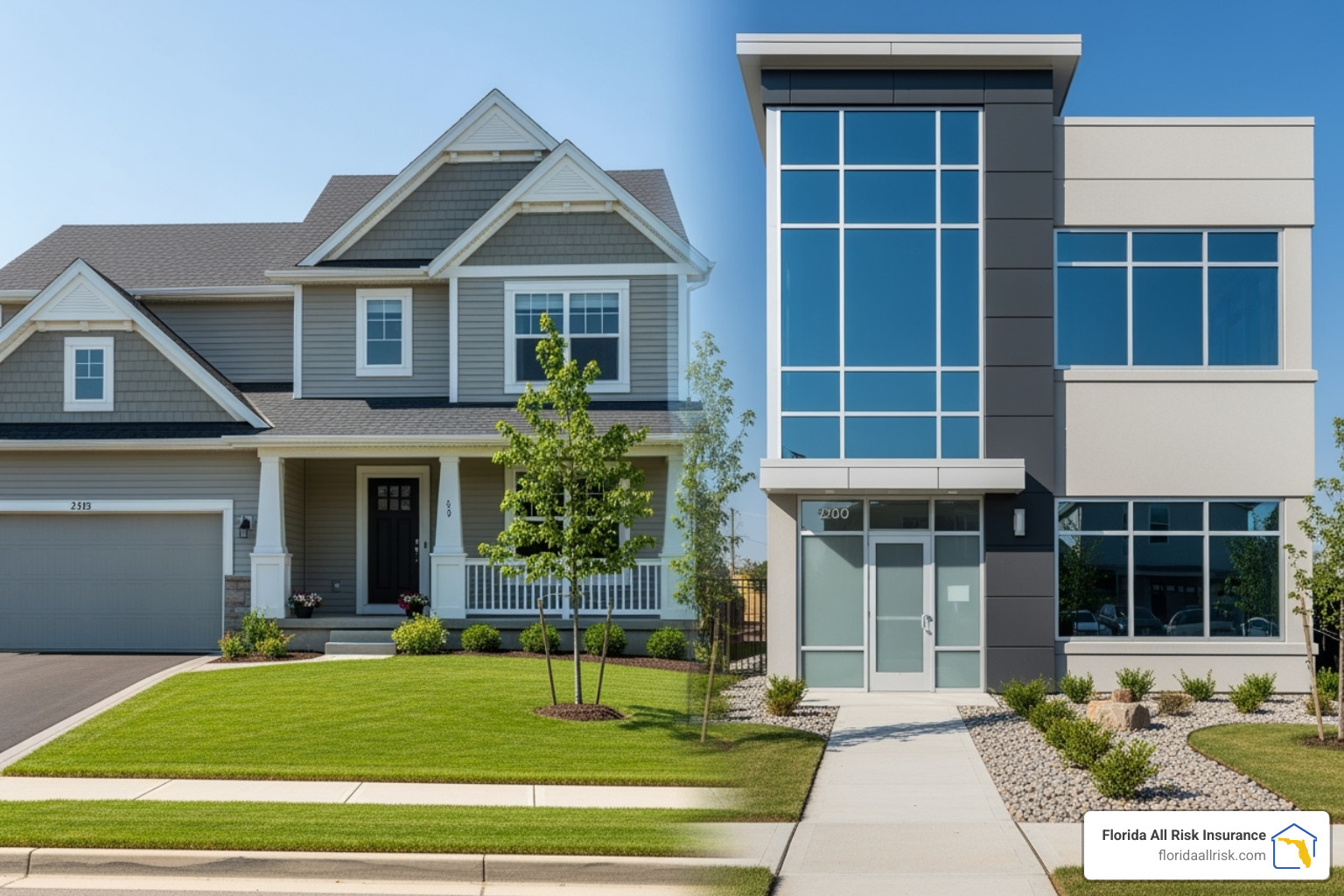
This distinction between private use and public/business occupancy creates different risk profiles, which is why commercial policies are highly customized while residential ones are more standardized. The Texas Department of Insurance provides helpful insights into these structural differences.
| Feature | Commercial Insurance | Residential Insurance |
|---|---|---|
| Property Covered | Offices, retail stores, warehouses, factories, restaurants, equipment, inventory, business personal property, signs, outdoor fixtures | Single-family homes, condos, apartments, personal belongings (furniture, electronics, clothing) |
| Liability Scope | Covers injuries to customers, employees, or visitors; property damage caused by business operations; product liability; personal and advertising injury; higher legal exposure | Covers injuries to guests on personal property; limited liability for personal activities |
| Typical Policyholder | Businesses (corporations, LLCs, sole proprietors), commercial landlords, property management firms | Homeowners, renters, condo owners |
| Primary Risks | Fire, theft, vandalism, natural disasters, business interruption, complex operational risks, public liability, employee dishonesty | Fire, theft, natural disasters (wind, hail), personal liability, water damage |
Property and Liability: A Closer Look
The types of properties covered highlight the contrast. Residential properties are relatively straightforward. For single-family homes, a standard homeowner’s policy (like an HO-3) covers the structure, other structures like a detached garage, and personal belongings. For condos, the owner’s policy (HO-6) is designed to cover the unit’s interior (walls, floors, fixtures) and personal property, while the condo association’s master policy covers the building exterior and common areas. Renters need their own policy (HO-4) for personal property and liability, as the landlord’s insurance only covers the building itself. Understanding the nuances of Florida Homeowners Insurance is crucial in our state’s unique coastal environment.
Commercial properties encompass a much broader and more complex range, from small retail storefronts and professional offices to massive industrial warehouses, manufacturing plants, and multi-unit apartment buildings. Each type has unique risks that require specialized underwriting. A restaurant’s kitchen fire hazard is entirely different from a warehouse’s theft risk or a medical clinic’s biohazard exposure. The policy must be custom to the specific use of the property.
This leads to the most significant difference: liability coverage. Residential liability is for personal risks, like a guest slipping on a wet floor or your dog biting a neighbor. Commercial liability, or General Liability, addresses a world of public access and operational hazards. It covers claims of bodily injury, property damage, and even personal and advertising injury (like libel, slander, or copyright infringement in your marketing). A customer slip-and-fall, product-related injuries, or an employee action that causes damage are all commercial concerns. This vastly increased exposure is why commercial policies have much higher liability limits, often starting at $1 million and going much higher, compared to the typical $300,000 to $500,000 for a homeowner’s policy. The legal and financial landscape for businesses is simply far more complex and demanding.
Key Coverages in a Commercial Property Policy
A comprehensive commercial property policy protects your entire livelihood, not just the building. It’s a financial safety net designed to cover business assets, operational needs, and income streams, ensuring a single disaster doesn’t end your business. Unlike standardized residential policies, commercial insurance is flexible and can be custom with endorsements to fit specific risks, from a bakery to a law firm.

Business Interruption and Extra Expense
If a fire forces your business to close for months, building insurance covers repairs, but what about the lost income? Business interruption insurance is the answer. It’s a critical component of commercial policies that replaces lost net revenue and covers ongoing expenses like rent, payroll, and loan payments while you’re unable to operate. This coverage can also include Extra Expense, which pays for reasonable costs to speed up recovery, such as renting a temporary location or paying overtime to get operations back online faster. A further improvement, Contingent Business Interruption, can protect you if a key supplier or customer suffers a loss that halts your own operations. It’s a key differentiator from residential insurance and vital for business survival. For more details, see our guide on commercial property and business interruption insurance.
Property Valuation: ACV vs. RCV
How your property is valued determines your payout after a loss.
- Actual Cash Value (ACV) pays the replacement cost minus depreciation. It’s a cheaper option but may leave you with a significant gap to cover when replacing old equipment with new.
- Replacement Cost Value (RCV) pays the full cost to replace damaged property with new items of similar quality, without deducting for depreciation. While the premium is higher, RCV provides far better financial protection and is recommended for most businesses.
Understanding Coinsurance
A common feature in commercial policies is a coinsurance clause, which requires you to insure your property for a certain percentage (usually 80%, 90%, or 100%) of its total value. If you fail to meet this requirement, you will face a financial penalty on partial claims. For example, if you have a $1 million building but only insure it for $700,000 with an 80% coinsurance clause, you are underinsured ($700k is less than the required $800k). If you then have a $100,000 claim, the insurer would only pay a portion of it ($700k/$800k * $100k = $87,500), leaving you to cover the rest. It’s crucial to ensure your coverage limits accurately reflect your property’s value to avoid this penalty.
Common Policy Exclusions
No policy covers everything. Standard commercial policies typically exclude damage from:
- Floods (requires separate coverage)
- Earthquakes and earth movement
- Normal wear and tear, rust, and corrosion
- Intentional damage by the owner
- Employee theft (requires a separate fidelity bond or crime policy)
- Government actions, war, or nuclear hazard
- Damage from utility failure originating off-premises
Understanding these exclusions is the first step to ensuring you have no gaps in your protection. Many can be covered with specific policy endorsements, such as Ordinance or Law coverage (for costs to comply with new building codes after a loss) or Equipment Breakdown coverage. Learn more about hazard insurance for commercial property.
The Advantage of a Business Owner’s Policy (BOP)
For many small to medium-sized businesses, a Business Owner’s Policy (BOP) is an ideal solution. It bundles three essential coverages—commercial property, general liability, and business income insurance—into one streamlined and affordable package. The primary benefits are cost savings from bundling, simplified management with a single policy, and comprehensive protection against the most common risks. A BOP is a great fit for businesses in lower-risk classes with predictable operations, like retail stores, professional offices, and small restaurants. Our guide to finding the best small business property insurance can help you decide if a BOP is right for you.
Navigating Special Scenarios in Commercial and Residential Building Insurance
Not all properties fit a standard insurance model. Construction sites, mixed-use buildings, and certain landlord situations require specialized solutions to address their unique and complex risks.
Builders Risk Insurance for Construction Projects
A building under construction is vulnerable to fire, theft of materials, vandalism, and weather events. Builders risk insurance is a temporary policy that protects a building’s structure and on-site materials during the construction or renovation phase. It can cover the building itself, temporary structures, foundations, and building materials waiting to be installed. Coverage can also be extended to include “soft costs” like architectural fees, legal fees, and interest on loans that accrue due to a delay caused by a covered loss. Whether for a new residential home or a large commercial development, this coverage is essential, especially in Florida where a single storm can cause major setbacks. It bridges the gap from groundbreaking to completion, at which point you transition to a permanent property policy. Explore more about managing these risks in our guide on Commercial Property Insurance Risk.
The Challenge of Mixed-Use Buildings
A building with apartments upstairs and a restaurant downstairs combines residential and commercial risks under one roof. This blended risk profile—from a tenant’s overflowing bathtub to a kitchen grease fire—creates significant underwriting complexity. Insurers must evaluate the liability of the residential portion alongside the higher hazards of the commercial operation. This often requires custom policies with higher liability limits and specific endorsements to cover all potential exposures. Property owners can manage this risk by enforcing strict lease requirements, such as mandating that commercial tenants maintain their own robust liability and property insurance, and requiring residential tenants to carry renters insurance. Installing modern safety systems, like firewalls between units and integrated sprinkler systems, is also critical. For properties with commercial condos, our Coverage for Commercial Condo units resource offers more guidance.
Lessor’s Risk Only (LRO) for Landlords
As a commercial landlord, you can be held liable for incidents on your property, even if they relate to your tenant’s business. Lessor’s Risk Only (LRO) insurance is a specialized liability policy that protects you, the landlord, from lawsuits arising from property ownership. If a customer of your tenant is injured in the parking lot you maintain, LRO provides legal defense and covers settlements. It is designed for property owners who lease their space to others rather than occupying it themselves. It’s an essential supplement to your building insurance, protecting you from risks you don’t directly control but for which you can be held legally responsible.
How Commercial and Residential Claims Differ
The claims process for commercial and residential building insurance varies significantly in complexity, duration, and documentation.
-
Residential Claims: These are typically more straightforward. The process involves an adjuster assessing damage to the home and personal property. Documentation usually consists of photos, repair estimates from contractors, and receipts for personal belongings. The goal is to restore the homeowner’s living situation.
-
Commercial Claims: These are far more complex and time-consuming. An adjuster must evaluate not only structural damage but also damage to specialized equipment, inventory, and tenant improvements. The documentation required is extensive and business-critical. The business income calculation is the most intricate part, often requiring forensic accountants to analyze historical financial data, profit and loss statements, payroll records, and market projections to verify the lost revenue. The settlement must account for the full scope of the business’s financial harm. Consequently, commercial claims involve larger settlement amounts, require more specialized expertise (engineers, accountants, public adjusters), and take much longer to resolve, highlighting the importance of having robust business interruption coverage and a detailed disaster recovery plan.
Managing Your Policy: Costs, Requirements, and Savings
Smart insurance management involves understanding costs, legal obligations, and savings opportunities. Proactively managing your policy ensures you have the right coverage at the best possible price.

Key Factors Influencing Insurance Costs
Insurers assess numerous factors to set your premium. Key drivers include:
- Location: Proximity to risks like hurricane zones, flood plains, or high-crime areas increases costs. Conversely, being located near a highly-rated fire station can lower them.
- Construction (COPE): This acronym is central to underwriting. It stands for:
- Construction: The materials used. Fire-resistive steel and masonry construction is cheaper to insure than wood-frame construction.
- Occupancy: How the building is used. A quiet law office presents a much lower risk than a restaurant with deep-fat fryers or a woodworking shop with flammable dust.
- Protection: The fire and theft protection systems in place. A building with a modern, monitored sprinkler and alarm system will have significantly lower premiums than one without.
- Exposure: The risks presented by neighboring properties. Being next to a fireworks factory is a greater exposure than being next to a park.
- Business Operations: Beyond occupancy, the specifics of your operations matter. A 24-hour business has different risks than one open 9-to-5.
- Claims History: A history of frequent or severe claims will lead to higher premiums, as it indicates a higher-risk profile.
- Coverage Choices: Higher coverage limits and value-added endorsements increase premiums, while higher deductibles lower them.
Florida-specific factors, particularly wind and flood risks, also play a significant role, as noted by the Florida Chief Financial Officer’s office.
Legal and Contractual Insurance Requirements
While not always mandated by state law, property insurance is often a requirement.
- Lenders: If you have a mortgage or commercial loan, your lender will require you to maintain insurance to protect their financial interest in the property. They will be listed as a mortgagee or loss payee on the policy.
- Lease Agreements: Commercial leases almost universally require tenants to carry their own property and liability insurance, and specify the limits required. Landlords also need coverage to protect their asset and satisfy their own loan covenants.
- Business Solvency: For business owners, insurance is a practical necessity to protect the company, its employees, and its stakeholders from a catastrophic loss that could otherwise lead to bankruptcy.
Strategies to Lower Your Premiums
You can actively reduce your insurance costs without sacrificing protection:
- Implement a Formal Risk Management Plan: Proactively identify and mitigate hazards through documented safety training, regular equipment inspections, and clear operational protocols.
- Install and Maintain Protection Systems: Modern fire suppression, security systems, and hurricane shutters can earn you significant discounts. Ensure they are regularly tested and certified.
- Choose a Higher Deductible: Agreeing to pay more out-of-pocket in a claim lowers your premium. Ensure the deductible is an amount your business can comfortably afford to pay.
- Bundle Coverage: A Business Owner’s Policy (BOP) or other package policy often provides better value than separate, monoline policies.
- Maintain Your Property: A well-maintained building with an updated roof, modern plumbing, and upgraded electrical systems presents a lower risk and can lead to better rates.
- Review Your Policy Annually: Work with your independent agent to ensure your coverage matches your current business needs, property values, and inventory levels so you aren’t over- or under-insured.
For more tips, see our guide on how to find cheap commercial property insurance.
Frequently Asked Questions about Commercial Building Insurance
Business owners often have questions when navigating the complexities of commercial and residential building insurance. Here are answers to some of the most common inquiries.
What other types of insurance should business owners consider?
Commercial property insurance is the foundation, but a complete protection plan includes other key coverages:
- General Liability: Covers third-party bodily injury or property damage claims. Essential for any business interacting with the public.
- Workers’ Compensation: Required by law in most states if you have employees, this covers medical bills and lost wages for on-the-job injuries.
- Commercial Auto: Necessary for any vehicles used for business purposes, as personal auto policies exclude this.
- Cyber Liability: Protects against losses from data breaches, ransomware, and other cybercrimes.
- Professional Liability (E&O): Crucial for businesses that provide professional services or advice, protecting against claims of negligence, errors, or omissions.
Do I need commercial property insurance if I only rent my business space?
Yes, absolutely. Your landlord’s insurance covers the building structure, not your business assets. You need your own commercial property policy to protect your Business Personal Property (BPP). This includes your computers, equipment, inventory, furniture, and any improvements you’ve made to the space (known as Tenants’ Improvements and Betterments). Without it, a fire or theft could force you to replace everything out-of-pocket. It also provides for business interruption, which your landlord’s policy will not cover.
What is the difference between an “all-risk” and a “named-peril” policy?
This distinction determines what types of events your policy covers.
- A named-peril policy only covers losses from dangers specifically listed in the policy (e.g., fire, theft, wind). If the peril isn’t listed, it’s not covered. This approach is less common and provides narrower protection.
- An all-risk (or open-peril) policy covers everything except for events specifically listed in the exclusions section (e.g., flood, earthquake, wear and tear). This is the standard for modern commercial policies.
All-risk policies offer much broader protection against unexpected events and are strongly recommended for most businesses. The key is to understand the exclusions and purchase separate coverage or endorsements where needed. Learn more in our guide to Understanding All-Risk Commercial Property Insurance.
Is my business property covered if I work from home?
Typically, no. A standard homeowner’s policy provides very limited coverage for business property—often just $2,500 for property on-premises and even less for property off-premises. It also provides no business liability coverage. If you run a business from home, especially if you have clients visiting or hold inventory, you need to speak with your agent. You may be able to add a business endorsement to your homeowner’s policy for a small operation, but for most, a separate commercial policy (like a BOP) is the proper way to ensure your equipment, inventory, and liability are adequately covered.
What is Ordinance or Law coverage and why is it important?
Ordinance or Law coverage is a critical endorsement that covers costs you incur to comply with building codes or laws after a covered loss. A standard policy pays to repair your building to its previous condition, but if your building is older, current codes may require significant, expensive upgrades during reconstruction (e.g., new sprinkler systems, updated wiring, ADA-compliant ramps). This coverage has three parts: (A) covers the value of the undamaged portion of the building that must be demolished, (B) covers the cost to demolish it, and (C) covers the increased cost to rebuild to current code. Without it, these substantial costs would come out of your pocket.
How does a commercial property claim affect my future premiums?
A claim will likely impact your premiums at renewal, but the extent depends on several factors: the frequency, severity, and type of claim. A single, large weather-related claim that affects an entire region may have less impact than a claim caused by negligence, like a preventable fire. Insurers look at your loss history over the past three to five years. A pattern of frequent claims, even small ones, signals a higher risk and will almost certainly lead to higher premiums or even non-renewal. This is why implementing strong risk management and only filing claims for significant losses is a wise long-term strategy.
Secure Your Business’s Future with the Right Coverage
Understanding the significant differences between commercial and residential building insurance is the first step toward protecting your assets. Commercial insurance is not just about covering a building; it’s a customized strategy to safeguard your operations, income, and long-term viability. Proactive risk management and a policy custom to your specific needs are non-negotiable for building a resilient business.
As an independent agency in St. Petersburg, Florida, we specialize in navigating our local market’s unique challenges. We partner with you to craft a comprehensive insurance solution that fits your business perfectly.
Get a comprehensive quote for your commercial property today
Contact Us
For questions about commercial and residential building insurance in Florida or to review your current policy, contact Florida All Risk Insurance using the details below.
At Florida All Risk Insurance, our St. Petersburg location gives us practical insight into Florida’s coastal risks and the needs of local property owners. As an independent agency, we work with multiple carriers to help you find custom coverage and competitive rates.
Address: 455 Central Avenue, Suite 200, Saint Petersburg, FL 33701
Phone: (727) 897-5432
Email: [email protected]

