

Box Truck Insurance Cost: Secure 5 Best Rates
Understanding Box Truck Insurance Costs in Florida
For any box truck business in Florida, from local furniture movers to regional last-mile delivery services, the box truck insurance cost is a foundational operational expense. Viewing insurance not just as a cost but as a strategic asset is key to long-term success. It protects your business from catastrophic financial loss, ensures you meet client and federal requirements, and ultimately enables your growth.
Quick Answer: Box Truck Insurance Cost Ranges
- Liability-only coverage: $3,000 – $6,000 per year
- Full coverage (Liability + Physical Damage): $7,000 – $12,000 per year
- Comprehensive policies (including Cargo): $12,000 – $17,900+ per year
This wide range reflects the unique risk profile of every trucking operation. Factors like your driving history, truck specifications, the cargo you haul, and your operating radius all play a significant role. For example, a new operator with a single truck might face premiums exceeding $15,000 annually, while an established business with a clean multi-year safety record could pay as little as $3,000 for basic liability.
Box truck insurance is a legal necessity, ensuring compliance with Federal Motor Carrier Safety Administration (FMCSA) requirements and Florida state laws. More importantly, it shields your business from liability claims that could otherwise be financially devastating. This guide will break down what influences your premiums, the essential coverages you need to consider, and actionable strategies to secure the most competitive rates for your Florida-based operation.
I’m Jason Miller, and with over 20 years of experience in the Florida insurance industry, I’ve helped countless owner-operators and fleet managers navigate the complexities of commercial trucking insurance. My background provides a unique insight into how underwriters calculate risk and how to structure policies that deliver real, sustainable savings for your business.
What is the Average Box Truck Insurance Cost?
Asking for the average box truck insurance cost is like asking for the average price of a house—the real answer is highly dependent on your specific situation. However, we can analyze general figures and scenarios to establish a realistic baseline for your financial planning.
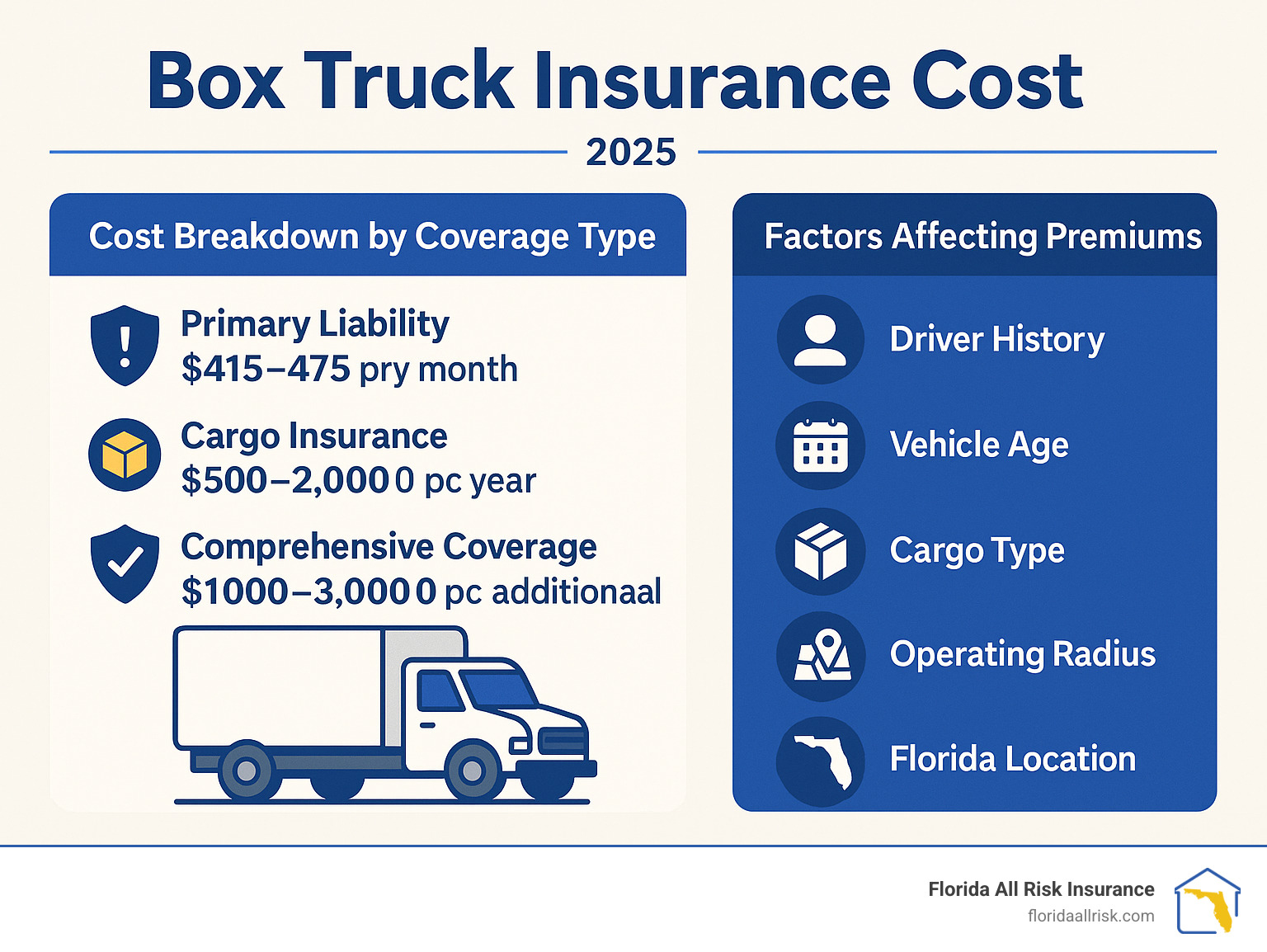
Nationally, most box truck operators can expect to pay between $12,400 and $17,900 annually for a comprehensive policy. This breaks down to a monthly average of around $909, but the spectrum is vast. Policies can range from as low as $2,000 per year for a very low-risk, liability-only operation to over $40,000 for high-risk ventures, such as those with a poor claims history or hauling hazardous materials. For the federally required primary liability coverage alone, expect monthly premiums between $415 and $475. But remember, that’s just one piece of the puzzle.

Average Costs by Coverage Level
Your box truck insurance cost is directly tied to your chosen level of protection. Here’s a more detailed look:
- Liability-only coverage is the legal minimum, covering damages you cause to other people’s property or injuries to them. It typically runs $3,000 to $6,000 per year. While it satisfies basic legal requirements for some operations, it offers no protection for your own truck or the cargo you’re hauling, making it a risky choice for most businesses.
- Full coverage premiums add physical damage protection (comprehensive and collision) for your truck. This level costs between $7,000 and $12,000 annually. It’s the standard for any business that has a loan on their vehicle or cannot afford to replace the truck out-of-pocket after an accident, theft, or weather event.
- Comprehensive policy costs represent the most robust protection. These policies bundle primary liability, general liability, cargo insurance, and physical damage coverage. Expect to pay over $1,000 per month ($12,000+ annually), but this provides the security needed to meet shipper requirements and fully protect your business assets.
Sample Box Truck Insurance Cost Scenarios
Real-world examples can help you estimate your potential costs:
- Established Local Mover (Low Risk): A business with 5+ years of experience, a clean claims history, and experienced drivers (over 30 years old, clean MVRs). They operate one 24-foot box truck within a 100-mile radius of Tampa. They might pay $4,500 – $6,000 annually for a $1 million liability policy with $50,000 in cargo coverage.
- New Venture Amazon Relay Driver (Medium Risk): A new owner-operator with a good personal driving record but no commercial history. They operate a 26-foot box truck for Amazon Relay, requiring $1 million in auto liability and $100,000 in cargo coverage. Their initial premium could be $15,000 – $22,000 annually. This higher cost reflects the insurer’s uncertainty about a new business.
- Non-CDL Expedited Freight (Higher Risk): An operator using a non-CDL box truck (under 26,001 lbs GVWR) for regional expedited freight. Insurers may view non-CDL drivers as having less training, which can increase rates. If the driver is under 25 or has a minor violation, the cost could be $18,000 – $25,000 annually for a full coverage package.
How Costs Compare to Other Commercial Vehicles
Box truck insurance costs fit within a broader landscape of commercial vehicle insurance. The comparison of box trucks vs. semi-trucks shows a clear difference; semi-trucks are larger, carry heavier loads, travel longer distances, and pose greater risks, leading to significantly higher premiums, often double that of a box truck. You can learn more about 18 Wheeler Truck Insurance.
Conversely, the comparison of box trucks vs. cargo vans shows that smaller, lighter cargo vans are typically cheaper to insure. The higher Gross Vehicle Weight Rating (GVWR) and greater cargo capacity of box trucks mean larger vehicles and higher risk, which directly translates to higher insurance premiums.
Key Factors That Influence Your Premiums
Your box truck insurance cost is the result of a complex risk assessment by insurance companies. They are essentially calculating the likelihood and potential cost of paying a claim on your behalf. The higher the perceived risk, the higher your premium. Let’s break down the main factors in detail.
Driver Profile and History
The person behind the wheel is the single most important factor in determining your rate. A clean driving record is pure gold. Insurers will pull a Motor Vehicle Record (M.V.R.) for every driver on your policy. A single major violation like a DUI or reckless driving charge can make you uninsurable with some carriers and cause massive premium increases with others. Even minor violations like speeding tickets or at-fault accidents will raise your rates for 3-5 years. Regarding driver age and experience, the sweet spot is often between 30 and 60 years old with several years of commercial driving experience. Surprisingly, operating a non-CDL box truck can cost more to insure, as insurers often associate non-CDL drivers with less specialized training and a higher frequency of smaller claims.
Vehicle Specifications
Every detail of your truck matters to underwriters.
- Age and Value: Newer trucks may have lower liability insurance costs due to better safety features (like automatic emergency braking) and reliability. However, their higher market value means physical damage coverage will cost more. An older truck may be cheaper to cover for physical damage, but insurers may see it as a higher risk for mechanical failure, potentially leading to cargo claims.
- Size and Weight: Your truck’s Gross Vehicle Weight Rating (GVWR) is key. A larger, heavier truck can cause more damage in an accident. Therefore, a 26-foot box truck with a 26,000 lb GVWR will cost more to insure than a 16-foot model with a 19,500 lb GVWR. For more details on larger trucks, see our page on 26 Foot Box Truck Insurance Cost.
- Safety Features: Proactively investing in safety pays off. Telematics systems that monitor speed and hard braking, dash cams (especially multi-camera systems), blind-spot monitoring, and anti-theft devices all demonstrate a commitment to safety and can earn you significant discounts.
Business Operations and Scope
How, where, and what you haul directly impacts your risk profile.
- Operating Radius: A local delivery service operating within a 50-mile radius will have lower rates than a regional or long-haul operation covering multiple states. More miles on the road simply means more exposure to risk.
- Cargo Type: The goods you transport directly influence your premium. Hauling general freight like pallets of paper is low-risk. Transporting high-value electronics, temperature-sensitive pharmaceuticals, or hazardous materials is much riskier and requires specialized, more expensive cargo coverage.
- Business & Claims History: A new venture will always pay more than an established business with a three-year track record of safe operations. Insurers reward longevity and a clean claims history with preferential rates. Frequent claims, even if not your fault, can signal higher risk and lead to non-renewal.
- Fleet Size: Owner-operators often pay higher per-truck rates than large fleets. Fleets benefit from spreading risk across many vehicles and often have dedicated safety managers, which insurers view favorably. Learn more about Fleet Insurance Risk Management.
How Location Impacts Your Box Truck Insurance Cost
Where you operate is a major rating factor.
- State and Local Risks: State regulations vary, and Florida’s unique insurance landscape includes higher claim frequencies due to population density and specific risks like hurricanes and flooding. Our Commercial Truck Insurance Florida page explores this in depth.
- Routes and Garaging: Urban versus rural operations have different risk profiles. Driving primarily in congested areas like Miami or the I-4 corridor between Tampa and Orlando often leads to more accidents and theft claims. Even where you park your truck overnight (your garaging location) affects your premium. A truck parked in a secured, fenced yard will have a lower rate than one parked on a residential street, which is more exposed to theft, vandalism, and weather hazards. Studies on accident frequency show how location affects risk.
Decoding Your Policy: Essential Coverages
Think of your box truck insurance policy as a toolkit where each coverage serves a specific purpose. Understanding these components is crucial for balancing your box truck insurance cost with the proper protection for your business assets, employees, and contractual obligations.
Mandatory and Primary Coverages
Primary Liability Insurance is the non-negotiable foundation of your policy. It covers bodily injury and property damage your truck causes to others in an at-fault accident. The Federal Motor Carrier Safety Administration (FMCSA) sets the minimums, typically requiring at least $750,000 in liability for trucks over 10,001 pounds operating interstate. This is often expressed as a Combined Single Limit (CSL), meaning the full amount is available per incident, regardless of how it’s split between bodily injury and property damage. While $750,000 is the minimum, most brokers and shippers now contractually require a $1,000,000 CSL, which has become the industry standard. Learn more on our Commercial Truck Liability Insurance page.
Protecting Your Cargo
Motor Truck Cargo Insurance covers the goods you are paid to transport against loss, theft, or damage from perils like collisions, fires, or theft. This is almost always required by shippers and is federally mandatory if you haul household goods. While federal minimums can be as low as $5,000, this is inadequate for most loads. The industry standard is $100,000 in cargo coverage, and some high-value loads may require more. This coverage typically costs between $500 and $2,000 annually. It’s vital to understand your policy’s terms, such as whether it’s a ‘Named Peril’ or ‘All-Risk’ policy and what exclusions apply (e.g., spoilage due to driver error). Explore this further on our Cargo Insurance for Trucks page.
Protecting Your Vehicle
Physical Damage Coverage protects your truck itself and is essential if you have a loan or can’t afford to replace the vehicle. It consists of two parts:
- Comprehensive coverage handles non-collision events like theft, vandalism, fire, hail, and other natural disasters.
- Collision coverage pays for damage to your truck from accidents, whether you hit another vehicle, a stationary object, or experience a rollover.
This coverage is typically written on an ‘Actual Cash Value’ (ACV) basis, but can sometimes be written for a ‘Stated Amount’. Adding physical damage coverage typically increases your annual premium by $1,000 to $3,000. For more details, see our Comprehensive Business Vehicle Insurance page.
Other Important Coverages to Consider
- General Liability Insurance: Protects against non-driving claims, like a customer slipping and falling at your loading dock or a lawsuit for slander. Costs average around $52 per month.
- Non-Trucking Liability: For owner-operators leased to a motor carrier, this covers personal use of the truck when not under dispatch. It’s affordable at $30 to $90 monthly.
- Uninsured/Underinsured Motorist: Covers your injuries and damages if an at-fault driver lacks sufficient insurance. This is critical in a state like Florida with a high rate of uninsured drivers.
- Workers’ Compensation: Mandatory in Florida if you have four or more employees (including corporate officers). It covers medical bills and lost wages for on-the-job injuries. This is crucial for a business involving physical labor.
- Reefer Breakdown & Spoilage: If you operate a refrigerated box truck, this coverage protects you if your refrigeration unit fails and the cargo spoils. Standard cargo insurance often excludes this.
- Downtime/Rental Reimbursement: If your truck is out of commission due to a covered claim, this coverage provides funds to help cover lost income or the cost of a rental truck, keeping your business running.
How to Lower Your Box Truck Insurance Costs
You have more control over your box truck insurance cost than you might think. Proactive strategies can help you secure better rates and build long-term savings. The key is to demonstrate to insurers that you are a low-risk, professional operation.
Improve Your Risk Profile
The most effective way to lower your premiums is to become a safer, more diligent operation.
- Hire Safe Drivers: This is the most impactful step. Establish strict hiring criteria, including a minimum age (e.g., 25), a minimum number of years of commercial experience, and a clean Motor Vehicle Record for the last 3-5 years. A driver with a clean MVR is an insurer’s ideal client.
- Implement a Safety Program: A documented safety program is a powerful tool. This should include formal policies, regular driver training on topics like defensive driving and cargo securement, and documented pre-trip and post-trip inspection routines. Documenting these procedures shows insurers you are serious about risk management.
- Maintain Clean Driving Records: Encourage safe driving with incentives or bonuses for accident-free periods. A clean record for your entire team is crucial for securing the best rates at renewal.
- Use Telematics: GPS tracking and dash cams are no longer just for large fleets. They allow you to monitor driving habits, correct risky behavior like speeding or hard braking, and provide indisputable evidence in case of a claim, which can protect you from fraudulent lawsuits. Many insurers offer substantial discounts for this technology.
Smart Policy Management
Making smart choices about your policy structure can lead to immediate savings.
- Choose a Higher Deductible: Agreeing to pay more out-of-pocket in the event of a claim (e.g., increasing your physical damage deductible from $1,000 to $2,500) will lower your premium. Ensure you have the cash flow to cover this higher amount if needed.
- Pay Premiums Annually: Most providers offer a significant discount, often between 10-20%, for paying your entire annual premium upfront rather than in monthly installments.
- Bundle Policies: If you need general liability or workers’ compensation insurance, placing all your policies with one carrier can often lead to multi-policy discounts.
- Review Coverage Annually: Your business is not static. An annual review with your agent is essential to identify opportunities to adjust coverage limits, remove drivers or vehicles, and ensure your policy still aligns with your operational needs, eliminating unnecessary costs. Find more tips on our Affordable Commercial Vehicle Insurance page.
Available Discounts for Box Truck Insurance
Always ask your agent to proactively search for all available discounts, as they aren’t always applied automatically. Common discounts include:
- Safe Driver Discount
- Paid-in-Full Discount
- EFT (Electronic Funds Transfer) Payment Discount
- Policy Bundling / Multi-Policy Discount
- Safety Features Discount (for GPS, dash cams, etc.)
- Experienced Business Discount (3+ years in business)
- Commercial Driver’s License (CDL) Discount
- Loyalty/Renewal Discount
Frequently Asked Questions about Box Truck Insurance Cost
Here are answers to the most common questions box truck owners ask about their insurance expenses.
What are the minimum insurance requirements for a box truck?
Minimums depend on your operations, but generally fall into four categories:
- Federal Requirements: The FMCSA typically requires at least $750,000 in liability coverage for trucks over 10,001 lbs operating interstate. However, the industry standard required by most contracts is $1,000,000.
- State-Specific Rules: Florida has its own commercial auto insurance minimums you must meet, especially for intrastate operations (operating only within Florida).
- Cargo Insurance: This is mandatory if you haul household goods or hazardous materials, with a federal minimum of $5,000. Again, contracts will dictate much higher limits, typically $100,000.
- Contractual Requirements: This is often the most important factor. Clients like Amazon Relay, major retailers, and logistics brokers often require higher limits, such as $1 million in auto liability, $1 million in general liability, and $100,000 in cargo coverage.
Does operating a non-CDL box truck affect insurance costs?
Yes, it often increases your box truck insurance cost. Insurers’ data shows that non-CDL drivers, as a group, have a higher frequency of claims. This is often attributed to less rigorous training and testing compared to CDL holders. This perception of higher risk leads to higher base premiums. Maintaining a perfect driving record and demonstrating professionalism through safety technology are the best ways for a non-CDL operator to offset this and earn lower rates over time.
How much more is insurance for an owner-operator versus a large fleet?
Owner-operators typically face higher per-truck rates, often paying $5,000 to $10,000 annually for a single truck. This is because their entire business risk is concentrated on that one vehicle and driver. Large fleets benefit from lower per-truck costs due to several structural advantages:
- Risk Distribution: Spreading risk across many vehicles makes the overall account more predictable and stable for insurers.
- Bulk Pricing: Insurers offer volume discounts for larger accounts, similar to any other bulk purchase.
- Formal Safety Programs: Fleets often have dedicated safety managers and robust risk management systems that demonstrably reduce claims and thus perceived risk.
The pricing models for fleet policies versus individually rated commercial auto policies reflect these structural differences, with insurers offering different rating structures for each.
How does my credit score affect my box truck insurance cost?
In many states, including Florida, insurers are permitted to use a credit-based insurance score when calculating premiums for commercial auto policies. Statistically, there is a correlation between credit history and claim frequency. A business owner with a strong credit history may be offered lower premiums, as they are considered a lower risk. Conversely, a poor credit history can lead to higher rates or even difficulty securing coverage with preferred carriers. It’s one of many factors, but it can have a noticeable impact.
What is an MCS-90 endorsement?
The MCS-90 is an endorsement that must be attached to the policy of any for-hire motor carrier operating interstate. It’s not insurance; it’s a guarantee to the public that the trucker has the minimum required liability coverage to pay for damages in an accident, even if the insurance policy itself wouldn’t have covered the specific incident (e.g., due to an exclusion). If the insurer is forced to pay a claim under the MCS-90 that wasn’t covered by the policy, they will seek reimbursement from the motor carrier. It ensures the public is protected.
Conclusion: Securing the Right Coverage at the Best Price
Navigating the world of box truck insurance cost is a dynamic and critical process for any trucking entrepreneur. As we’ve detailed, your premium is not a fixed number but a variable expense influenced by a multitude of factors. It’s a complex equation that includes the specific characteristics of your truck, the age and driving records of your drivers, your operational radius, the type of cargo you haul, and even your garaging location in Florida. Understanding these individual factors is the first and most crucial step toward effectively managing them.
By implementing proactive safety measures—such as establishing a rigorous driver hiring process, creating a documented safety program, and utilizing telematics—you can fundamentally improve your risk profile. By making smart policy choices, like opting for higher deductibles, paying premiums annually, and conducting yearly policy reviews with your agent, you can directly control your costs. These strategies, combined with leveraging every available discount, can lead to substantial long-term savings that flow directly to your bottom line.
Securing the right coverage isn’t just about finding the lowest box truck insurance cost; it’s about building a resilient business. It’s about protecting your valuable assets, ensuring legal and contractual compliance, and safeguarding your company’s future against unforeseen events. As an independent insurance agency, Florida All Risk Insurance is uniquely positioned to help. We work with a wide range of top-rated carriers, allowing us to compare options and build a customized policy that perfectly fits your specific needs and budget. We provide personalized service and expert advice, ensuring you get competitive rates and the right protection for your Florida-based operation.
Ready to find out your exact box truck insurance cost and secure the best protection for your business? We invite you to connect with our expert team today.
Get a Quote from our experts today!
For personalized advice on protecting your business, explore our comprehensive Commercial Truck Insurance solutions.
Contact Us
Have questions about your box truck insurance cost or need a personalized quote? We’re here to help! At Florida All Risk Insurance, we believe that great insurance starts with great relationships, and that means being accessible when you need us most.
Our experienced team understands the unique challenges facing box truck operators in Florida. Whether you’re dealing with hurricane season preparations, navigating FMCSA requirements, or simply trying to balance comprehensive coverage with budget constraints, we’ve got the expertise to guide you through every step of the process.
Ready to get started? You can reach us in whatever way works best for you:
Address: 7751 66th St N, Pinellas Park, FL 33781
Phone: (727) 522-6000
Email: [email protected]
We’re proud to serve box truck operators throughout the Tampa Bay area and across Florida. Our Pinellas Park location puts us right in the heart of one of Florida’s busiest commercial corridors, so we understand the traffic patterns, weather challenges, and business opportunities that affect your insurance needs.
When you contact us, you’re not just getting a quote – you’re getting a partner who’s committed to helping your business succeed. We’ll take the time to understand your specific operation, explain your options in plain English, and work with you to build a policy that provides the protection you need at a price that makes sense for your business.
Don’t let uncertainty about insurance costs hold back your box truck business. Give us a call today, and let’s start the conversation about protecting your investment and your future.

