

Box Truck Business Insurance Cost 2025: Smart Savings
The Lifeline of Your Business: Why Box Truck Insurance Matters
For delivery companies, moving services, and logistics businesses across Florida, the box truck business insurance cost is a critical operational expense. Whether you’re hauling furniture across Tampa or delivering packages statewide, your box truck is both your primary asset and your biggest financial risk. One accident, cargo theft, or liability claim can shut down your business overnight. Without proper coverage, you risk everything you’ve worked to build.
Quick Answer: Box Truck Insurance Cost Breakdown
- 16-foot box truck: $216 – $820 per month
- 26-foot box truck: $231 – $946 per month
- Average annual cost: $3,000 – $5,000 for liability only
- Full coverage: Around $900 per month for any size truck
- Key cost factors: Truck size, cargo type, driving record, location
Box truck operators face unique challenges that personal auto insurance simply won’t cover. From protecting valuable cargo to meeting shipper insurance requirements, commercial coverage is essential for business continuity. Businesses operating without adequate insurance face financial ruin, legal penalties, and the inability to secure profitable contracts.
At Florida All Risk Insurance, we’ve helped Florida businesses steer commercial insurance challenges for over 20 years. Our experience in the volatile Florida insurance marketplace has shown us how proper planning around the box truck business insurance cost can make or break a transportation business.
Running a box truck business comes with inherent risks like collisions, cargo damage, theft, and costly liability claims. Without the right insurance, these unpredictable events can become devastating financial burdens. Understanding and securing the right coverage is paramount for your financial protection and peace of mind.
Understanding the Average Box Truck Business Insurance Cost
When starting or running a box truck business, insurance costs can feel like a mystery. There’s no single price tag; your box truck business insurance cost depends on many factors, from your truck’s size to your driving record and cargo. Understanding these averages provides a crucial baseline for your financial planning.
Industry data shows that most box truck operators pay around $909 per month for their commercial vehicle insurance, which is roughly $10,910 per year. This typically covers commercial auto liability and physical damage protection. While significant, this cost protects an asset that likely cost $30,000 to $80,000 or more. Other coverages like general liability and workers’ compensation will add to this total. For established businesses with clean records, liability-only coverage can range from $3,000 to $5,000 annually. New businesses, however, often start at the higher end of the spectrum. Insurers view new ventures as a higher risk until they can build a positive track record of safety and reliability, which is why first-year premiums are often the most expensive.
Cost Breakdown by Truck Size
Your truck’s size and weight directly impact your premium. The difference can be substantial because it correlates with potential damage in an accident.
- 16-foot box trucks, common for local deliveries and smaller loads, typically cost between $216 and $820 per month to insure. Their lighter weight means they generally cause less damage in accidents and are cheaper to repair.
- 26-foot box trucks have higher premiums, ranging from $231 to $946 per month. For more details on these larger vehicles, see our guide on 26 Foot Box Truck Insurance Cost.
The key factor for insurers is the Gross Vehicle Weight Rating (GVWR), which is the maximum operating weight of the vehicle as specified by the manufacturer. A higher GVWR indicates a greater potential for severe damage in a collision, more complex and costly repairs, and a larger overall risk profile. This is why a heavier truck, even if it’s the same length as another, might have a higher premium.
Cost Breakdown by Coverage Type
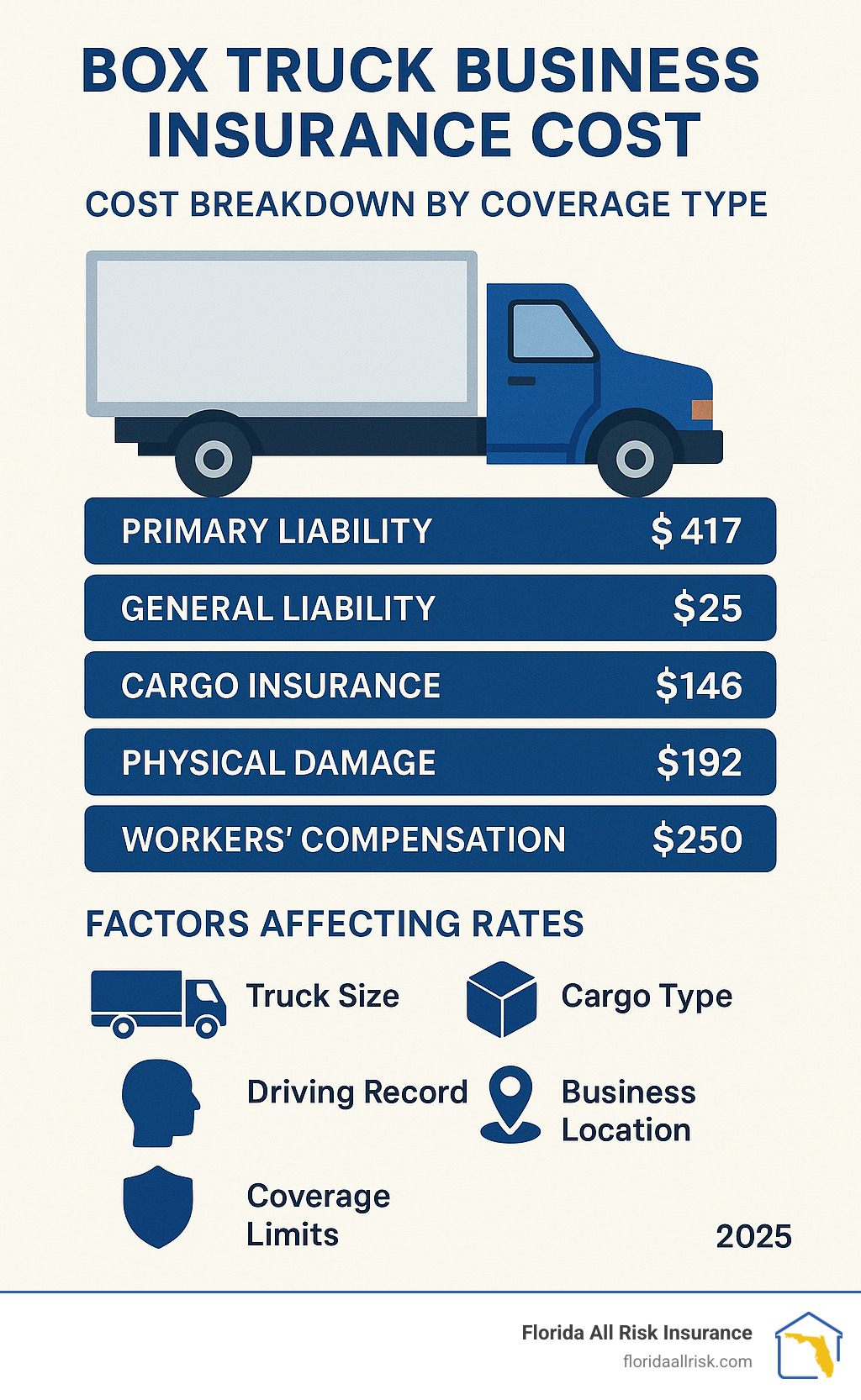
Understanding where your insurance dollars go helps you make smarter decisions. Here’s how average monthly costs can break down:
| Coverage Type | Average Monthly Cost |
|---|---|
| Primary Liability | $416.66 |
| Physical Damage | $191.66 |
| Cargo Insurance | $145.83 |
| General Liability | $25.00 |
| Workers’ Compensation | $250.00 |
| Non-Trucking Liability | $41.66 |
Primary liability is the largest expense because it protects you from potentially massive, business-ending lawsuits resulting from at-fault accidents. Physical damage protects your most valuable asset—the truck itself. Cargo insurance is vital for protecting the goods you’re paid to haul. General liability is an affordable but crucial addition that covers non-vehicle incidents, like a customer slip-and-fall during a delivery, which are not covered by your auto policy.
What are the Mandatory Insurance Requirements in Florida?
Florida has strict commercial vehicle insurance requirements. If you use a box truck for business, you must carry commercial coverage; a personal auto policy is not sufficient and will lead to a denied claim. The state mandates bodily injury liability and property damage liability coverage. The required amounts depend on your truck’s weight and its use. If your business crosses state lines (interstate commerce), you must also meet federal requirements. The Federal Motor Carrier Safety Administration (FMCSA) sets its own rules, which can require liability coverage from $750,000 to $5 million, depending on your truck’s weight and the type of cargo you transport. Transporting hazardous materials will increase these requirements even further. Operating without proper insurance is illegal and can lead to fines, penalties, and business shutdowns.
Key Factors That Determine Your Insurance Premium
Quotes for box truck insurance can vary dramatically because insurers assess each business’s unique risk profile. They use sophisticated analysis to calculate your box truck business insurance cost. Understanding these factors gives you the power to influence your rates over time.

How Truck and Cargo Specifics Impact Your Premium
Every detail about your truck and what it carries influences your premium.
- Vehicle Value and Age: Newer, more valuable trucks cost more to insure because they are more expensive to replace or repair. However, older trucks may have higher maintenance needs and lack modern safety features, which can also be perceived as a risk.
- Gross Vehicle Weight Rating (GVWR): This is a major factor. Heavier trucks can cause more damage in an accident, leading to higher liability claims and thus higher premiums. Insurers use your Vehicle Identification Number (VIN) to determine these specifications.
- Type of Cargo: The goods you transport can dramatically change your box truck business insurance cost. Hauling general merchandise like boxed furniture or pallets of paper is less risky than transporting high-value electronics, fragile artwork, perishable foods, or hazardous materials. High-risk cargo requires specialized coverage and higher limits, making comprehensive Cargo Insurance for Trucks essential.
How Business Operations Affect Your Box Truck Business Insurance Cost
Where and how you operate creates a unique risk fingerprint that insurers examine closely.
- Business Location: Operating in dense urban areas like Miami or Orlando often means higher rates due to increased traffic congestion, higher accident frequency, and higher crime rates. Conversely, rural areas may have lower rates but present different risks like higher speeds, longer emergency response times, and wildlife collisions. Insurers also consider regional weather risks, such as the high frequency of hurricanes in Florida.
- Operating Radius: Local delivery routes (e.g., within a 50-mile radius) generally have lower premiums than long-haul or interstate operations. Longer routes expose drivers to more road time, unfamiliar conditions, and varying state regulations, increasing the overall risk.
- Years in Business: Established businesses with a proven track record of safety are seen as less risky and often receive better rates. New ventures are considered a higher risk until they can provide a loss run report showing a clean claims history.
- Claims History: A clean claims history is your best tool for securing lower premiums. A loss run report, which details past claims, is proof of a well-run, safe operation. Effective Fleet Insurance Risk Management is key to long-term cost control.
How Your Driver Profile Influences Rates
The people behind the wheel are a critical part of the risk equation.
- Driver’s Age and Experience: More experienced drivers (typically over 25) with several years of commercial driving experience often qualify for lower insurance premiums due to their statistically lower accident rates.
- Motor Vehicle Record (MVR): A driver’s MVR is a detailed history of their driving habits. A clean record with no at-fault accidents, speeding tickets, or other violations is crucial for obtaining favorable rates. Insurers will pull MVRs for all drivers on a policy. You can learn more about these records from official sources like the [Arizona Department of Transportation](https://azdot.gov/motor-vehicles/driver-services/driver-license-information/motor-vehicle-records#:~:text=A%20motor%20vehicle%20record%20(MVR,%2C%20Chapter%202%2C%20Article%205.).
- Hiring Practices: Demonstrating strict hiring standards, including mandatory MVR checks, background screenings, and a formal driver training program, shows insurers you are committed to safety. This proactive risk management can lead to significant discounts.
Building Your Policy: Essential Box Truck Insurance Coverages
Think of your insurance policy as a custom-built safety net. You can’t rely on basic coverage to protect a complex operation. Building the right policy means understanding which coverages work together for comprehensive protection against the diverse risks you face on and off the road. At Florida All Risk Insurance, we specialize in creating Comprehensive Business Vehicle Insurance custom to your unique assets and operations.
Core Coverages Every Box Truck Business Needs
Every solid policy starts with a few fundamental protections that are often legally required.
- Commercial Auto Liability: This is your mandatory legal shield. It covers bodily injury liability (medical bills, lost wages, and pain and suffering for injured parties) and property damage liability (repairs to other vehicles, buildings, or property) if you’re at fault in an accident. Given the potential for high-cost claims, especially in the litigious environment of busy Florida cities, having adequate limits well above the state minimum is crucial for protecting your business assets. Learn more about Commercial Truck Liability Insurance.
- Physical Damage Coverage: This protects your truck, which is often your most valuable business asset. It is typically a combination of collision coverage, which pays for repairs to your truck from accidents and rollovers, and comprehensive coverage, which handles non-collision events like theft, vandalism, fire, hail, and storms.
- Uninsured/Underinsured Motorist Coverage: This is especially critical in Florida, which consistently ranks among the states with the highest percentage of uninsured drivers. If an uninsured or underinsured driver hits you, this coverage steps in to pay for your driver’s injuries and your truck’s repairs, preventing you from bearing the cost of someone else’s irresponsibility.
Specialized and Optional Coverages to Consider
Beyond the basics, specialized coverages can prevent a business-ending catastrophe by filling common gaps in standard policies.
- Motor Truck Cargo Insurance: Essential for hauling valuable goods, this protects the cargo itself from perils like collision, fire, theft, or damage during transit. Many shippers and brokers will not hire you without proof of cargo insurance, making it a commercial necessity.
- General Liability Insurance: This covers risks that happen off the road but are related to your business operations. Examples include a customer slipping and falling at your warehouse, or your driver causing property damage while loading or unloading at a client’s site. Explore our General Liability Insurance for Small Business options.
- Non-Trucking Liability (Bobtail): This fills a specific gap for owner-operators leased to a motor carrier. It provides liability coverage when the truck is used for personal, non-business purposes, such as driving home after a haul.
- Hired and Non-Owned Auto (HNOA) Insurance: If you ever rent or borrow vehicles for your business, or if you have employees who use their personal cars for work-related errands, this coverage is essential. It provides liability protection for accidents involving vehicles your business uses but doesn’t own.
- Workers’ Compensation: This is legally required in Florida if you have employees (with few exceptions). It covers medical expenses and a portion of lost wages for employees who suffer work-related injuries, protecting both your team and your business from lawsuits.
- Business Interruption Insurance: If a major covered event like a fire or severe storm damage halts your operations, this coverage helps replace lost income and cover ongoing expenses like rent and payroll while you recover.
Commercial vs. Personal Auto Insurance: What’s the Difference?
Understanding this distinction is critical. Personal auto policies contain business use exclusions, meaning they will not cover any claim that occurs while you’re using your vehicle for commercial purposes. Trying to save money with a personal policy is a gamble that can lead to financial ruin.
Commercial policies differ in several key ways:
- Higher Liability Limits: They offer limits of $750,000 or more to cover the greater risk posed by a large commercial truck.
- Specialized Coverages: They allow for the addition of crucial coverages like cargo, non-trucking liability, and HNOA that personal policies do not offer.
- Policy Ownership: Commercial policies are issued to a business entity (like an LLC or corporation), protecting the business’s assets separately from your personal assets.
Smart Strategies to Lower Your Box Truck Insurance Premiums
While the box truck business insurance cost can be substantial, you are not powerless over your rates. You can take proactive steps to manage and reduce your premiums without sacrificing essential coverage. At Florida All Risk Insurance, we are committed to helping you find Affordable Commercial Vehicle Insurance by leveraging every available strategy.
How to Get the Best Rates
A strategic approach to shopping for and structuring your policy can help you secure the most competitive rates from the start.
- Shop Around and Compare Quotes: Don’t settle for the first quote you receive. As an independent agency, we do the shopping for you, leveraging our relationships with a wide range of A-rated carriers to find the best combination of coverage and price for your specific needs.
- Ask for Discounts: Insurers offer a variety of discounts. Be sure to ask about them, including discounts for having safety features (like anti-lock brakes), paying your premium in full for the year, or having prior continuous insurance coverage.
- Increase Your Deductible: A higher deductible (the amount you pay out-of-pocket on a claim) will lower your premium. However, you must ensure you have the cash reserves to comfortably cover this amount if a claim occurs. It’s a balance between monthly savings and potential out-of-pocket costs.
- Bundle Policies: Purchasing multiple policies, such as your commercial auto and general liability, from a single provider often leads to a multi-policy discount and simplifies your insurance management.
Maintaining a Strong Safety Record
A demonstrated commitment to safety is the single most effective way to control your insurance costs long-term. Insurers reward businesses that have low claim rates with lower premiums at renewal.
- Implement a Formal Safety Program: This goes beyond just telling drivers to be safe. A formal program should include written safety policies, regular safety meetings, pre- and post-trip vehicle inspection checklists, and clear procedures for proper cargo securement.
- Driver Training and Screening: Invest in ongoing driver training, including defensive driving courses. Be meticulous in your hiring process, prioritizing drivers with clean MVRs and extensive commercial driving experience.
- Regular Vehicle Maintenance: A strict preventative maintenance schedule does more than just keep your trucks running; it keeps them safe. Documented maintenance records show insurers that you are proactive about reducing the risk of accidents caused by mechanical failure.
- Install Safety Technology: Telematics and GPS trackers do more than monitor location. They can track driving behaviors like speeding, hard braking, and rapid acceleration, allowing you to coach drivers and improve safety. Dash cams provide crucial, indisputable evidence in an accident, helping to prove you were not at fault and protecting you from fraudulent claims.
- Maintain Driving Logs: Ensuring drivers maintain accurate and compliant logs, such as printable driver’s daily log books, helps prevent fatigue-related accidents, which are a major concern for insurers.
- Review Your Policy Annually: Your business is not static, and neither is your insurance policy. Conduct an annual review with your agent to discuss any changes in your operations, fleet size, or operating radius. This ensures your coverage remains adequate and identifies new opportunities for discounts.
Frequently Asked Questions about Box Truck Insurance
Navigating commercial insurance can be complex. Here are answers to common questions about box truck business insurance cost and coverage.
What are the consequences of not having adequate box truck insurance?
Operating without proper insurance can lead to severe consequences, including:
- Financial Ruin: You would be personally liable for all damages and legal fees from an accident, which could lead to bankruptcy.
- Legal Penalties: You could face heavy fines, license suspension, vehicle impoundment, and even jail time.
- Business Shutdown: Authorities can halt your operations until you provide proof of insurance.
- Lost Contracts: Most clients require proof of insurance, so you would lose out on profitable work.
- Personal Asset Risk: A major claim could put your personal assets, like your home and savings, at risk. Comprehensive Business Liability Insurance is essential protection.
What is commercial fleet insurance and who needs it?
Commercial fleet insurance is a single policy that covers multiple business vehicles. It’s ideal for any business with two or more vehicles. The benefits include simplified management with one policy and renewal date, potential cost savings through multi-vehicle discounts, and consistent coverage across your entire fleet. It’s a smart way for growing businesses to streamline operations and manage costs. Learn more about our Fleet Insurance Risk Management services.
Does my box truck insurance cover loading and unloading?
This is a critical detail, as standard commercial auto liability often excludes accidents that happen during loading and unloading. Incidents like cargo falling and injuring someone may fall under your General Liability policy instead. To ensure there are no gaps, you can add a specific “loading/unloading” endorsement to your commercial auto policy. It’s crucial to discuss this with your agent to ensure you are fully protected. Our Commercial General Liability Insurance can be customized to include these endorsements.
Get the Right Coverage at the Best Rate
Securing an affordable box truck business insurance cost is crucial for protecting your business and maximizing profitability. By understanding the factors that influence your rates, choosing the right coverages, and implementing smart safety strategies, you can control your costs without sacrificing protection. Navigating the complexities of commercial insurance can be challenging, but you don’t have to do it alone. The expert agents at Florida All Risk Insurance specialize in helping businesses like yours find custom, cost-effective solutions.
Ready to find the best rates for your box truck business? Get a Quote online today for a fast, no-obligation estimate.
For a comprehensive overview of our trucking insurance options, we invite you to explore our Commercial Truck Insurance page.
Contact Us:
Florida All Risk Insurance
Address: 700 94th Ave N STE 300, Saint Petersburg, FL 33702
Phone: (727) 577-4700
Email: [email protected]

