

Why Understanding Bodily Injury Liability is Essential for Florida Drivers
Bodily injury liability is a cornerstone of responsible driving. It’s the part of your auto insurance that helps pay for costs when you cause an accident that injures someone else—covering their medical treatment, lost income, pain and suffering, and even your legal defense if you’re sued. While this protection doesn’t pay for your own injuries, it shields your finances when other people are harmed by a crash you’re found to have caused.
Florida drivers face a unique landscape. Unlike most states, Florida doesn’t require bodily injury liability coverage for many drivers. Instead, the state relies on a no-fault system in which your own Personal Injury Protection (PIP) pays a portion of your initial medical bills, regardless of fault. But there’s a catch: injured people can still sue for damages beyond their PIP benefits, including pain and suffering in certain circumstances. That means your assets can be exposed if you injure someone and don’t carry adequate bodily injury liability coverage.
The stakes are high. Today’s medical care costs can escalate quickly—from ambulance and ER charges to surgery, rehabilitation, and long-term care. A serious accident can easily result in six-figure claims. With the average cost of motor-vehicle injuries estimated at $180,000, insufficient coverage can threaten your savings, home equity, and future earnings. Even a single hospital stay can average tens of thousands of dollars, and legal fees alone can be substantial.
At Florida All Risk Insurance, we’ve spent decades helping Florida families and businesses match their protection to their risk. In our experience, the difference between a manageable claim and a financially devastating lawsuit often comes down to selecting the right limits of bodily injury liability—and understanding how this coverage fits within Florida’s no-fault framework.
This guide explains what bodily injury liability covers, how policy limits work, how Florida’s rules differ from those in other states, and practical steps for choosing appropriate protection. Our goal is to help you make a confident, informed decision that aligns with your budget and safeguards the assets you’ve worked hard to build.
Understanding the Basics of Auto Liability
Auto insurance is fundamentally about managing risk. When you drive, you’re operating a heavy, fast-moving vehicle in unpredictable conditions. Even careful drivers can face accidents caused by momentary distraction, poor weather, mechanical issues, or another driver’s mistakes. Liability coverage is your promise—backed by an insurance policy—to pay for the harm you cause others.
Bodily injury liability focuses on the human cost of a crash: medical care, lost wages, and other damages experienced by people you injure. If you’re found legally at fault, your insurer pays those costs up to your policy limits. Without enough coverage, you may be personally responsible for the remainder. That can open the door to judgments, wage garnishment, and liens on assets, potentially for years to come.
Property damage liability, by contrast, covers damage you cause to other people’s property—primarily their vehicle, but also items like fences, signs, or buildings. You’ll see these listed as separate limits on your policy, and one can’t be used to pay the other. It is crucial to ensure both types of liability coverage are adequate, as a single accident can easily involve both significant injuries and extensive property damage.
It’s easy to underestimate exposure. Consider how quickly medical expenses accumulate: emergency transport, diagnostic imaging, surgery, hospital stays, and rehabilitation. Add time off work for recovery, and potential compensation for pain and suffering if permitted by law, and the total can exceed basic policy limits. That’s why minimum required limits—where they apply—often fall short of real-world costs. Many drivers only realize they’re underinsured after a serious crash, when it’s too late to adjust.
A practical approach is to treat liability coverage as a financial firewall. By setting limits that reflect your assets and earning potential, you reduce the chance that a single accident will derail your long-term plans. This firewall is designed to protect everything you’ve built—your home, your retirement accounts, your children’s college funds, and your future income stream. A significant judgment against you could jeopardize all of these. If you own a home, have savings or investments, or anticipate higher income, choosing more robust protection is almost always the most cost-effective move you can make.
To learn how liability coverage interacts with other protections in a policy, you can explore our overview of policy structure at https://floridaallrisk.com/liability-insurance-policy/.
What Is Bodily Injury Liability and What Does It Cover?
Bodily injury liability (BI) is the part of your auto insurance that pays when you are legally responsible for injuries to other people. It covers the costs of their care and recovery, as well as your defense if you’re sued. Importantly, BI does not pay for your own injuries. In an at-fault crash, BI helps protect your assets from the consequences of someone else’s medical and legal claims against you.
For a primer on how BI fits into broader liability coverage, visit https://floridaallrisk.com/general-civil-liability/.
What Expenses Are Typically Covered?
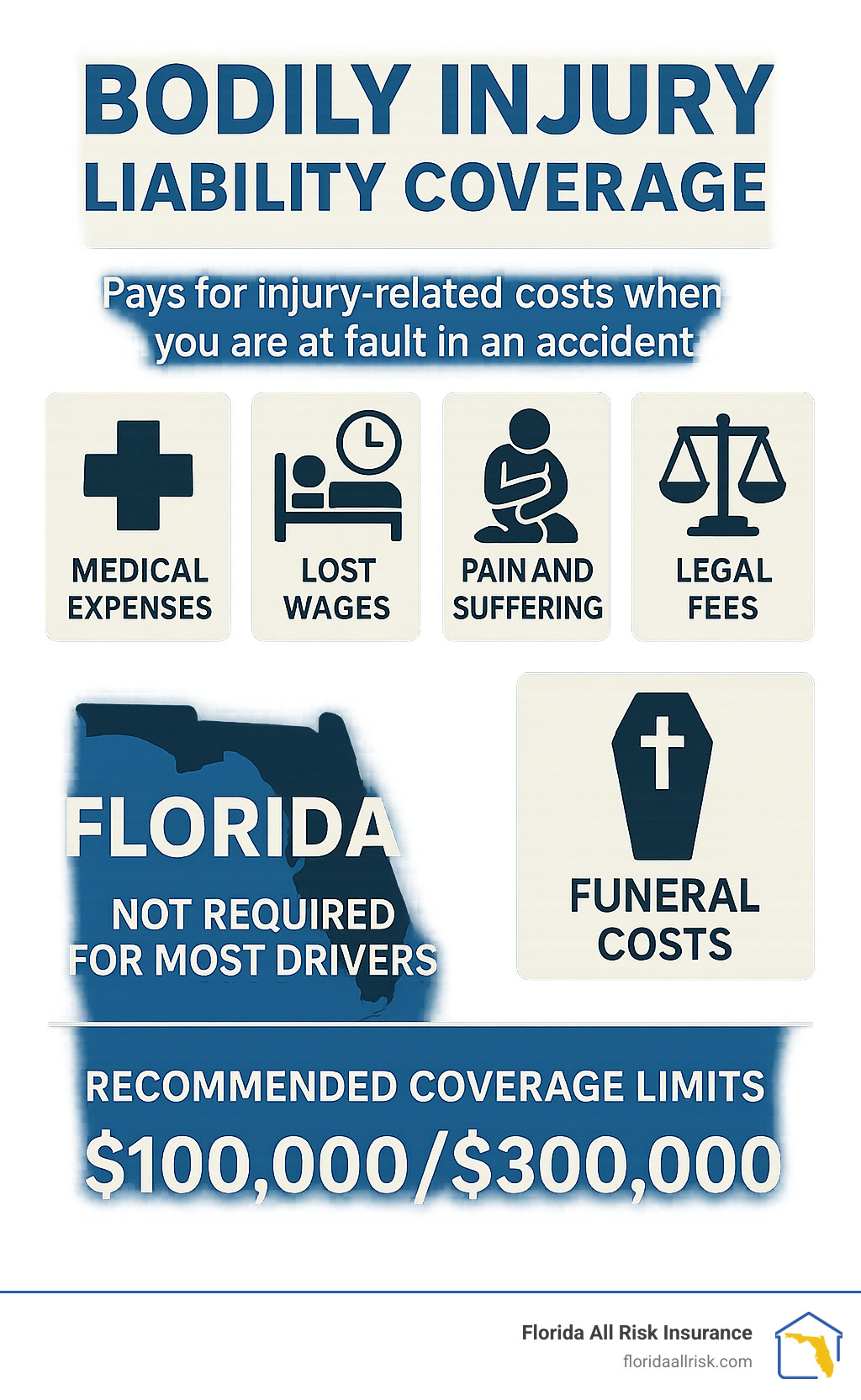
When your BI coverage applies, it can pay for a wide range of damages suffered by the injured party, up to your policy limits:
- Medical treatment: Ambulance transport, emergency room care, hospital stays, surgery, diagnostic imaging, specialist visits, prescription medications, and follow-up care.
- Rehabilitation and therapy: Physical therapy, occupational therapy, chiropractic care, and other therapies necessary for recovery or long-term functionality.
- Lost wages: Compensation for time away from work during recovery, which can be substantial for more serious injuries. This can also extend to loss of future earning capacity if the injury prevents the person from returning to their previous job or line of work, representing a potentially massive long-term financial loss for which you could be held responsible.
- Pain and suffering: Compensation for non-economic damages such as physical discomfort, emotional distress, and reduced quality of life, when permitted by law. This category is often the most subjective and can be the largest component of a serious injury claim. It can include compensation for permanent disfigurement or scarring, chronic pain, mental anguish, loss of enjoyment of life, and loss of consortium (the impact on the injured person’s spousal relationship). Because these damages are not tied to specific bills, they can escalate claim values dramatically.
- Funeral and end-of-life costs: In tragic cases, BI can help cover expenses associated with a fatality.
Because these costs can escalate quickly, your chosen limits matter. A single fracture with surgery, for example, can lead to hospital bills and lost wages that easily exceed $100,000. Multiple injured parties in the same crash multiply the exposure.
Bodily Injury vs. Property Damage Liability
BI addresses injuries to people. Property damage liability (PD) handles damage to vehicles or other property you strike. These coverages are separate and have distinct limits. A robust BI limit doesn’t increase your PD protection, just as a strong PD limit cannot be used to pay someone’s medical bills. To understand how liability coverages work together, see https://floridaallrisk.com/general-liability-insurance/.
Does BI Cover Legal Defense?
Yes. Most auto policies include a duty to defend. If you’re sued after an at-fault accident, the insurer provides an attorney, manages the defense, and pays legal costs in addition to or within policy terms—commonly outside the liability limits but subject to policy language—then pays settlements or judgments up to your BI limits. Legal defense can be extremely expensive, so this feature is a major value-add.
What Isn’t Covered by BI?
BI won’t pay for:
- Your own injuries (that’s where PIP, medical payments, or your health insurance may apply).
- Damage to your own vehicle (collision coverage addresses your car).
- Intentional harm or criminal acts.
- Non-covered drivers, vehicles, or uses excluded by your policy.
Understanding these boundaries helps you build a cohesive plan: BI for others’ injuries, PD for property you damage, PIP for your initial medical needs in Florida, and optional coverages like collision, comprehensive, medical payments, or uninsured motorist to fill remaining gaps.
Deciphering Your Policy: Limits and Recommended Amounts

Policy limits determine how much the insurer will pay for a covered accident. Getting these numbers right is critical because they define your maximum protection against claims. You’ll typically see either split limits or a combined single limit (CSL) on your declarations page.
How to Read Split Limits (e.g., 100/300/100)
- The first number (per person): The maximum the insurer will pay for one person’s injuries (e.g., $100,000).
- The second number (per accident): The total maximum for all injuries in one accident (e.g., $300,000), regardless of how many people are hurt.
- The third number (property damage): The maximum for all property damage per accident (e.g., $100,000).
With 100/300 limits, if two occupants are injured, Person A could receive up to $100,000 and Person B up to $100,000, but the combined total for all injured people can’t exceed $300,000. If total medical claims and damages exceed your limit, you’re personally responsible for the difference.
Combined Single Limit (CSL)
Some policies use a single combined limit (e.g., $500,000 CSL) that applies to both BI and PD together. CSL can offer more flexibility because funds are not compartmentalized between BI per-person, per-accident, and PD limits. For example, if one injured person has very high medical costs but property damage is minimal, a CSL may provide more effective coverage for that scenario.
How Much Coverage Do You Need?
Minimum limits—where required—are set by law, not by medical economics. In real claims, they can be exhausted quickly. A commonly recommended guideline is the net-worth rule: select liability limits at least equal to your net worth. For many households, 100/300 or 250/500 (or a $500,000 CSL) is a prudent starting point. Given that the average cost of motor-vehicle injuries has been estimated at $180,000, limits below $100,000 per person often provide inadequate protection.
For deeper context on structuring coverage, visit our overview at https://floridaallrisk.com/liability-insurance-policy/ and our planning guide at https://floridaallrisk.com/how-much-general-liability-insurance-do-i-need/.
Umbrella Policies
If you have significant assets or income, consider a personal umbrella policy. Umbrellas typically add $1 million or more of liability coverage that sits above your auto and homeowners policies, kicking in when those primary limits are exhausted. Umbrellas are usually affordable relative to the amount of extra protection they provide, and they can help preserve your long-term financial goals if a catastrophic accident leads to unusually high damages.
State Requirements and Florida’s Unique Position
Auto insurance rules differ by state. Many states require drivers to carry bodily injury liability coverage at minimum levels that range widely. For example, some states mandate $15,000 per person while others require higher limits. These legal minimums can be far below what a serious crash actually costs, which is why many drivers choose higher limits regardless of the minimums where they live.
For a helpful state-by-state overview of financial responsibility and minimum limits, see this resource from the Insurance Information Institute: https://www.iii.org/automobile-financial-responsibility-laws-by-state.
Florida’s No-Fault Framework
Florida uses a no-fault system centered on Personal Injury Protection (PIP). Key points:
- PIP typically covers 80% of reasonable medical expenses and 60% of lost wages up to $10,000, subject to the state’s rules and whether the injury qualifies as an emergency medical condition.
- Property Damage Liability (PDL) is mandatory to pay for damage you cause to other people’s property.
- Bodily Injury Liability (BI) is generally optional for many drivers—an exception compared to most states. However, optional does not mean unnecessary.
In Florida, injured parties may still pursue claims against you for damages that exceed their own PIP benefits. They can also seek compensation for pain and suffering if the legal threshold for serious or permanent injury is met. This threshold is a critical concept in Florida law. It generally includes significant and permanent loss of an important bodily function, permanent injury within a reasonable degree of medical probability, significant and permanent scarring or disfigurement, or death. An injury that requires surgery or results in a long-term disability will almost certainly meet this threshold, opening the door to a lawsuit for non-economic damages. If you don’t carry BI, your personal assets may be on the line for amounts above what PIP or other coverages pay.
Financial Responsibility After Crashes and DUIs
Florida’s financial responsibility laws require drivers to be able to pay for the damages they cause. In certain situations—such as accidents involving injuries, at-fault crashes with significant property damage, or serious violations—drivers may be required to carry specific liability limits or provide proof of financial responsibility for a period of time.
After a DUI conviction in Florida, drivers are typically required to carry elevated limits (often 100/300/50) and to file proof of insurance with the state for a designated term. You can learn more about Florida’s insurance rules at the official Florida Department of Highway Safety and Motor Vehicles site: https://www.flhsmv.gov/insurance/.
What This Means for Florida Drivers
- Your PIP helps with your own immediate medical needs, regardless of fault—but it does not protect your assets if you injure someone else.
- Because BI is not always required, many Florida drivers carry insufficient protection. This creates a dangerous environment on the road, as you cannot assume other drivers have coverage to pay for your injuries if they are at fault. It also means that if you cause serious injuries, the gap between what’s covered and what’s owed can be large, potentially leading to bankruptcy.
- Carrying BI at meaningful limits (e.g., 100/300 or higher) can reduce the risk that a single accident leads to long-term financial strain.
For business owners who use vehicles for work—whether personally titled or in a company’s name—liability considerations can be more complex. If you’re operating as an LLC or have mixed personal and business use, coordinating coverage is especially important. Learn more at https://floridaallrisk.com/business-insurance-for-llc/.
Bodily Injury vs. Other Coverages and Legal Terms
Insurance policies are full of terms that sound similar but serve different purposes. Understanding how BI interacts with other coverages helps you avoid gaps.
BI vs. Personal Injury Protection (PIP)
- Who’s covered?
- BI: Other people you injure—drivers, passengers, pedestrians.
- PIP: You and certain passengers, regardless of fault, up to policy limits.
- When does it apply?
- BI: When you are legally at fault for injuries to others.
- PIP: For your initial medical expenses and lost wages under Florida’s no-fault rules.
In practice, an injured person’s PIP pays first. If their costs exceed PIP benefits, they may bring a claim against your BI coverage for the balance and, if applicable, for pain and suffering based on the legal threshold.
For a broader look at liability coverage fundamentals, see https://floridaallrisk.com/what-does-general-liability-insurance-cover/.
BI vs. Personal Injury (Legal Term)
- Bodily Injury: Physical harm to a person’s body.
- Personal Injury: A legal term for broader harm that can include bodily injury but may also cover non-physical damages (like certain defamation claims) in specific contexts.
Most auto claims for injuries arising from crashes are bodily injury claims. However, the larger personal injury category is what plaintiffs’ attorneys use to describe the total harm suffered, which can encompass medical bills, lost wages, and pain and suffering.
Other Coverages to Consider
- Property Damage Liability: Pays for damage to other people’s property. Separate from BI and essential to pair with it.
- Medical Payments (MedPay): Optional coverage that can help with you and your passengers’ medical costs regardless of fault, often filling gaps in PIP.
- Uninsured/Underinsured Motorist (UM/UIM): Helps if you’re hit by a driver with no insurance or too little BI coverage. In a state where BI isn’t always required, UM/UIM is particularly valuable to protect your household.
- Collision and Comprehensive: Physical damage coverage for your vehicle due to crashes (collision) and non-crash incidents like theft, vandalism, storms, or hail (comprehensive).
Frequently Asked Questions About Bodily Injury Liability
We commonly hear these questions from Florida drivers evaluating their coverage.
How much does BI coverage cost?
BI is part of your overall auto premium. Cost varies by factors like your location, driving history, vehicle type, claims record, and the limits you choose. Surprisingly, raising your limits from bare minimums to more realistic levels (e.g., 100/300) can sometimes add less to your monthly premium than you expect—often a modest increase for a major jump in protection. For more details on pricing drivers and businesses can expect with liability policies, see https://floridaallrisk.com/liability-insurance-cost/.
How do BI claims work?
Typically, the injured party files a third-party claim with your insurer. You report the accident, cooperate with the investigation, and your insurer assigns an adjuster. The adjuster evaluates fault, reviews medical records and bills, and negotiates a settlement. If a lawsuit is filed, your insurer provides and manages your legal defense, then pays settlements or judgments up to your limits.
Does BI cover my passengers?
BI generally covers non-household passengers as third parties if you’re at fault. Household members may be excluded under a household exclusion clause, subject to policy language. In Florida, your PIP is typically the first line for you and certain passengers’ initial medical costs, regardless of fault.
What happens if my limits aren’t high enough?
If claims exceed your limits, you’re personally responsible for the difference. That can lead to wage garnishment or liens on eligible assets. Choosing prudent limits—often 100/300 or higher—and considering a personal umbrella policy can mitigate this risk.
Should I choose split limits or a combined single limit (CSL)?
Both can provide good protection. CSL offers flexibility by using one pool for BI and PD. Split limits compartmentalize per-person, per-accident, and PD coverage. Your choice depends on budget, risk tolerance, and how you want your protection structured. An agent can help you compare quotes and scenarios.
Is BI coverage required in Florida?
For many drivers, no. Florida requires PIP and Property Damage Liability. However, if you cause injuries or have certain violations, you may be required to prove financial responsibility and carry specific limits for a time. After a DUI, you must carry higher limits (often 100/300/50) and file proof with the state. See official guidance at https://www.flhsmv.gov/insurance/.
Do I still need BI if I have significant savings or an umbrella policy?
Yes. Insurers typically require you to carry certain underlying auto limits for an umbrella to apply. Your primary BI coverage also defends and pays claims up to its limits before the umbrella kicks in. Drivers with assets to protect are prime candidates for higher BI limits aligned with umbrella coverage.
Conclusion: Make a Confident, Informed Choice
Bodily injury liability is more than a line on your auto policy—it’s a vital safeguard for your financial future. It pays for injuries you cause to others, covers legal defense when you’re sued, and helps ensure one accident doesn’t unravel years of hard work. In Florida’s no-fault system, PIP may cover your initial medical needs, but it doesn’t protect your assets from third-party injury claims. Carrying meaningful BI limits bridges that gap.
The best coverage reflects both your risk and your resources. Consider your household’s assets, income, and tolerance for risk when selecting limits. Many Florida drivers find that 100/300 or higher—and, for some, a personal umbrella—offers a sensible balance of protection and cost. Thoughtful choices today can provide peace of mind every time you drive.
Ready to take the next step?
- Get a personalized quote tailored to your driving profile and coverage goals: https://floridaallrisk.com/non-owner-car-insurance-florida/
- Have questions or want an expert review of your current limits? Contact us to discuss your options: https://floridaallrisk.com/non-owner-car-insurance-florida/
Contact Us
Florida All Risk Insurance
123 Main Street, Saint Petersburg, FL 33701
Phone: (727) 555-1234
Email: [email protected]

