

What Does Boat Insurance Cover: 2025 Ultimate Guide
Protecting Your Investment on the Water: A Florida Boater’s Guide
What does boat insurance cover? For any Florida boat owner, this question is as fundamental as checking the tides before leaving the dock. Here in the Sunshine State, a boat is far more than a simple recreational toy; it’s a significant financial investment, a source of priceless memories, and a passport to the stunning 1,350 miles of coastline, countless inland lakes, and vibrant waterways that define our lifestyle. The thrill of cruising the Gulf, fishing the Keys, or exploring the St. Johns River comes with inherent risks, and understanding your protection is paramount.
Boat insurance is designed to cover a wide array of potential mishaps, including:
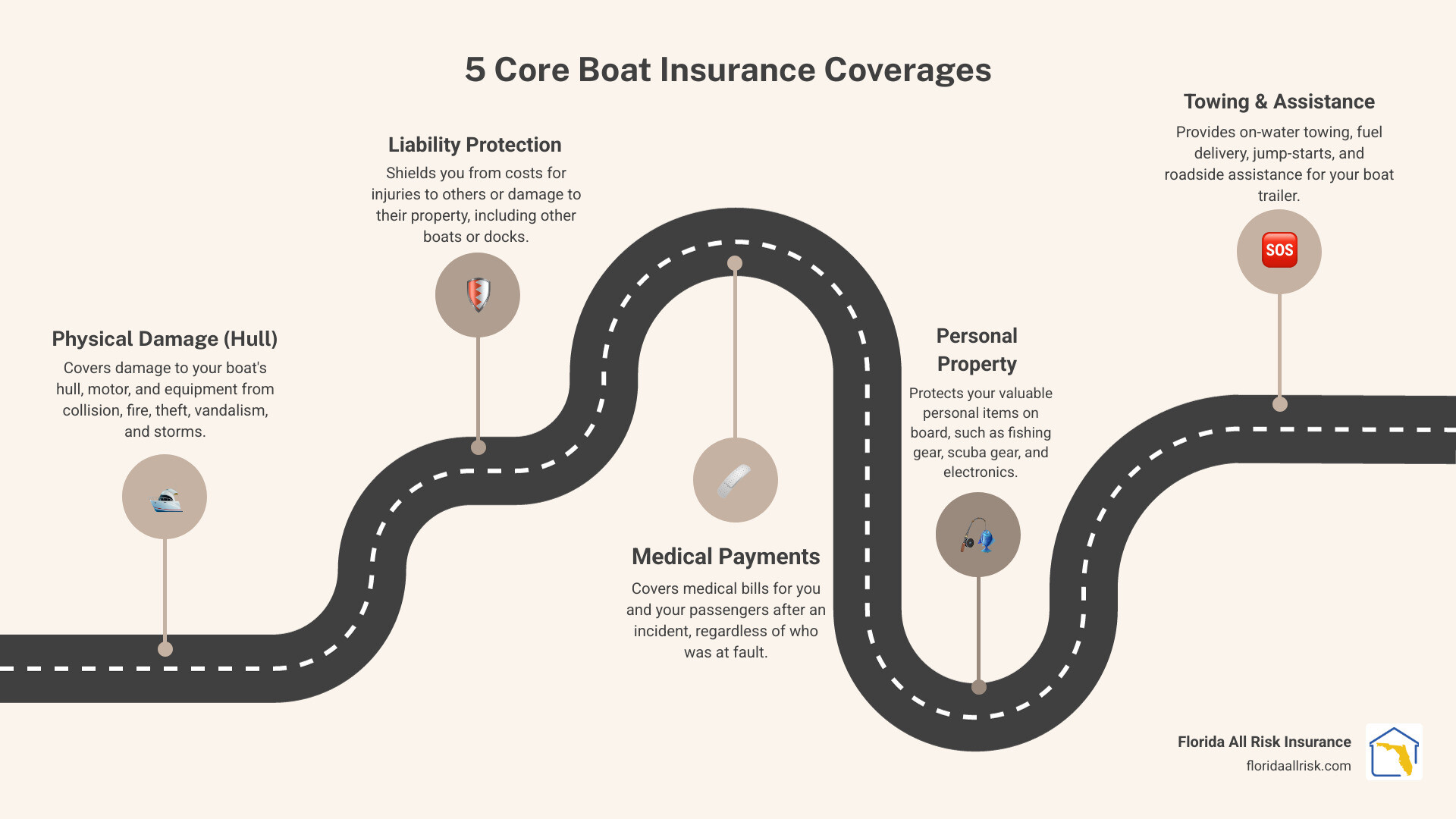
- Physical damage to your boat’s hull, engine, and equipment from collision, fire, theft, vandalism, and severe weather.
- Liability protection for injuries to other people or damage to their property caused by your watercraft.
- Medical payments for injuries sustained by you or your passengers, regardless of who is at fault.
- Coverage for personal property, such as valuable fishing gear, electronics, and other items you bring aboard.
- Towing and assistance services, both on the water and for your trailer on the road.
- Protection from uninsured or underinsured boaters who cause an accident without adequate coverage.
Navigating the responsibilities of boat ownership in Florida means preparing for everything from the sudden intensity of hurricane season to the crowded conditions of a holiday weekend on the water. Even a simple mechanical failure can lead to a costly and dangerous situation. The right insurance policy is your financial safeguard, providing the peace of mind needed to truly enjoy your time on the water.
Interestingly, the concept of insuring marine vessels is not a modern invention. In fact, boat insurance is one of the earliest known forms of insurance{:target=”_blank”}, with ancient merchants pooling resources to cover losses at sea. This historical precedent underscores a timeless truth that modern boaters understand well: protecting your vessel against the unpredictable nature of water-based risks is simply smart, responsible planning.
However, figuring out the nuances of a policy can feel like navigating a tricky channel without a chart. This comprehensive guide is designed to be your map. We will break down exactly what boat insurance covers, explore the crucial optional coverages that tailor a policy to your needs, and demystify the fine print that can make all the difference in a claim.
I’m Jason Miller, and with over two decades of dedicated experience in the Florida insurance market, I’ve had the privilege of helping thousands of boat owners answer the question, “what does boat insurance cover?” My expertise is born from a genuine passion for Florida’s unique boating lifestyle and a professional commitment to providing comprehensive risk management solutions. Let’s dive in and ensure your investment is properly protected.
What Does Boat Insurance Cover? A Breakdown of Core Protections
Think of your boat as more than just a recreational vehicle—it’s your ticket to Florida’s endless waterways and a significant financial investment that deserves proper protection. What does boat insurance cover goes far beyond simple collision damage. Modern boat insurance policies are specifically designed for the unique challenges of marine environments, offering comprehensive protection that auto or homeowners insurance simply can’t match.
The foundation of any solid boat insurance policy rests on three essential pillars: protecting your vessel itself, shielding you from liability, and covering medical expenses for everyone on board. Let’s explore each of these core protections and find how they work together to keep you confidently navigating Florida’s beautiful waters.
Physical Damage Coverage (Hull Insurance)
Often referred to as hull insurance, physical damage coverage is the bedrock of your policy. It protects the actual boat and its components from loss or damage. This coverage is typically divided into two main categories: collision and comprehensive. This protection extends beyond just the hull to include the vessel’s essential operating components.
What’s typically covered under Physical Damage:
- Hull and Gelcoat: The main body of your boat.
- Propulsion Systems: Engines (inboard or outboard), jets, and propellers.
- Sails and Rigging: For sailboats, this includes masts, booms, sails, and lines.
- Permanently Attached Equipment: Items bolted or installed on the boat, such as GPS units, fish finders, radar, stereos, and fixed seating.
- Fuel Tanks, Batteries, and Electrical Systems: The core operational components.
- Boat Trailers: If specified and included in the policy.
Collision Coverage
This protection is straightforward: it covers the cost to repair or replace your boat if it’s damaged in a collision with another boat or a stationary object. In Florida’s often-crowded waterways, the risk of a collision is ever-present. Scenarios include:
- Striking another vessel while navigating a busy channel or marina.
- Hitting a submerged object like a log, rock, or crab pot.
- Running aground on an unmarked sandbar.
- Colliding with a dock, pier, or buoy.
- Damage sustained if your boat capsizes in rough seas.

Comprehensive Coverage
While collision covers impact-related events, comprehensive coverage is your shield against a vast range of other perils. For Florida boaters, this protection is non-negotiable. It covers losses from events other than a collision, such as:
- Theft: Protection if your boat is stolen from a marina, your driveway, or a storage facility.
- Vandalism: Covers damage from malicious acts, such as slashed seats or a smashed windshield.
- Fire, Storms, and Hurricanes: Absolutely essential in Florida, this covers damage from high winds, lightning strikes, flooding, and hail.
- Sinking: If your boat sinks at the dock or while underway due to a covered peril.
- Falling Objects: Damage from a tree limb falling on your boat during a storm, for example.
An important feature often included under comprehensive coverage is wreckage removal. If your boat sinks and is deemed a hazard to navigation by authorities like the U.S. Coast Guard, you are legally responsible for its removal. This process can be incredibly expensive, often costing thousands or even tens of thousands of dollars. Wreckage removal coverage handles these costs, protecting you from a massive and unexpected financial burden.
Crucially, this physical damage coverage isn’t limited to when your boat is in the water. It protects your vessel during transport on its trailer, while in storage (on a lift, in a dry-stack, or on your property), and during the off-season.
Liability Coverage: Your Financial Shield
While hull insurance protects your boat, liability coverage protects your financial future. If you are found legally responsible for an accident that causes injury to others or damages their property, liability coverage steps in to pay for the associated costs. A boating accident can lead to devastating financial consequences, and this coverage is your most important defense.
Bodily Injury Liability
This covers the costs when someone is injured in an accident involving your boat. It pays for their medical bills, lost wages, pain and suffering, and other related expenses. This protection is vital and applies to:
- Occupants of another boat.
- Swimmers, divers, or water-skiers.
- People on a dock or pier that you hit.
- Guests on your own boat who are injured due to your negligence (e.g., a slip and fall on a wet deck).
Property Damage Liability
This portion of your policy covers the costs to repair or replace someone else’s property that you damage with your boat. Common examples include:
- Damaging another boat in a marina.
- Hitting a private dock or seawall.
- Damaging navigational aids or other public property.
Legal Defense Costs
In the event of a lawsuit, your liability coverage also pays for your legal defense. This includes attorney fees, court costs, and expert witness fees, regardless of whether you are ultimately found at fault. These costs can be substantial, and this coverage ensures you can mount a proper defense without draining your savings.
Pollution and Fuel Spill Liability
Modern boat policies include specific coverage for the accidental discharge of oil or fuel. Environmental regulations are strict, and cleanup costs can be enormous. This coverage protects you from the potentially ruinous expenses associated with containing and cleaning up a fuel spill, as mandated by laws like the Clean Water Act.
Medical Payments Coverage
Accidents happen, even to the most cautious boaters. Medical Payments coverage, or “MedPay,” is a no-fault coverage that pays for the immediate medical needs of you and your passengers if an injury occurs on your boat. The key feature is that it pays out regardless of who was at fault for the accident.
This coverage is designed to handle immediate expenses like:
- Health insurance deductibles and co-pays.
- Ambulance or emergency transport fees.
- Hospital visits and X-rays.
- Dental care if an injury involves teeth.
For Florida boaters who often have friends and family on board, MedPay is invaluable. It ensures that if a guest is injured—perhaps by a slip, a sudden wave, or a minor mishap with equipment—their medical bills can be paid promptly without the need to establish fault or file a lawsuit. This “goodwill” coverage can prevent a fun day on the water from turning into a strained relationship or a legal battle. It provides a crucial safety net, allowing everyone to focus on recovery rather than finances.
Customizing Your Policy: Optional and Specialized Coverages
Think of your boat insurance policy like a custom tackle box—the basic compartments hold your essentials, but the real magic happens when you add specialized sections for your unique gear. Beyond the core protections of physical damage, liability, and medical payments, a robust policy can be custom with additional endorsements to perfectly match your boating lifestyle and protect your valuable equipment.
The beauty of modern boat insurance lies in its flexibility. Whether you’re a dedicated angler chasing tournaments, a family that loves watersports, or a long-distance cruiser, there are specific coverages designed for how you use your boat. Let’s explore some of the most important optional coverages.
What does boat insurance cover for equipment and personal items?
Your boat isn’t just fiberglass and an engine—it’s a floating base for your hobbies, filled with everything that makes your time on the water special. A standard policy provides only limited coverage for personal belongings, which is why Personal Effects Coverage is such a critical add-on for most boaters.
This specialized endorsement protects your valuable gear from theft, loss, or damage, both on and off the boat. It covers a wide range of items that you bring aboard but aren’t permanently attached to the vessel. For an avid Florida boater, the value of these items can add up quickly.
Here’s a more detailed look at what’s commonly covered:
- Fishing Equipment: This goes beyond a simple rod and reel. It includes your entire collection of rods, reels, tackle boxes filled with lures, downriggers, cast nets, and gaffs.
- Watersports Gear: For families who love to play, this covers water skis, wakeboards, kneeboards, towable tubes, and the ropes and vests that go with them.
- Diving and Snorkeling Gear: Protects your investment in scuba tanks, regulators, buoyancy control devices (BCDs), dive computers, masks, and fins.
- Portable Electronics: While permanently installed electronics are covered under hull insurance, this protects your portable GPS units, handheld VHF radios, Bluetooth speakers, and tablets.
- Cameras and Valuables: Covers cameras, video recorders, binoculars, and other personal items you use to capture memories on the water.
- General Personal Belongings: This includes clothing, sunglasses, coolers, portable grills, and other items that contribute to your comfort and enjoyment.
Without this coverage, you would have to pay out-of-pocket to replace these items if they were stolen from your boat or lost overboard. When selecting this coverage, it’s wise to create an inventory of your gear to ensure you choose a limit that accurately reflects its value.
Uninsured/Underinsured Watercraft (UM/UIM) Coverage
Here’s an uncomfortable but crucial truth about boating in Florida: not everyone on the water is as responsible as you are. A significant number of boaters operate with minimal insurance, or worse, no insurance at all. Uninsured/Underinsured Watercraft (UM/UIM) coverage is your essential defense against the financial fallout from an accident caused by one of these boaters.
This coverage steps in when an at-fault boater lacks the insurance to pay for the damage they’ve caused to you and your property. It functions in two ways:
- Protection from Uninsured Boaters: If you’re hit by a boater with no liability insurance, your UM coverage pays for your medical expenses and, depending on the policy, repairs to your boat.
- Fills the Gap from Underinsured Boaters: If an at-fault boater has insurance, but their liability limits are too low to cover your costs, your UIM coverage pays the difference, up to your policy limit.
Consider this scenario: You’re involved in an accident that isn’t your fault. You and your passengers sustain $100,000 in medical bills, and your boat has $50,000 in damage. The at-fault boater only carries the state minimum liability of $10,000. Without UIM coverage, you would be personally responsible for the remaining $140,000 in costs. With UIM, your own policy would step in to cover those expenses.
This coverage also protects you in hit-and-run incidents on the water. If another boater causes damage and flees the scene, your UM coverage can help pay for the repairs, ensuring you’re not left with the bill for someone else’s irresponsibility.
On-Water & Roadside Assistance
Even the most carefully maintained boat can suffer a breakdown. Whether it’s a dead battery, a fouled propeller, or an engine that just won’t start, being stranded on the water is stressful and potentially dangerous. On-Water Towing and Assistance coverage transforms this major crisis into a manageable inconvenience.
This endorsement typically covers a range of emergency services, including:
- Towing: Professional towing to the nearest port or repair facility if your boat is disabled.
- Fuel Delivery: If you run out of gas or diesel far from the dock.
- Jump-Starts: For a dead battery that leaves you powerless.
- Soft Ungrounding: Assistance if you run aground on a sandbar or mud flat.
Many boaters also underestimate the value of Roadside Assistance for your boat trailer. A flat tire, a broken axle, or faulty lights on your trailer can ruin a trip before it even begins or after a long day on the water. This coverage extends assistance to your tow vehicle and trailer, providing towing to the nearest repair shop, flat-tire changes, and other essential services. It’s a small addition that provides immense peace of mind for the entire boating experience, from your driveway to the water and back again.
For details on coverage options custom to Florida boaters, see our Watercraft & Boat Insurance page.
Understanding Your Policy’s Fine Print: Valuation, Exclusions, and Limits
The devil is in the details, and this is especially true for insurance policies. To truly understand what boat insurance covers, you must look beyond the headline features and into the fine print. Two of the most critical areas to comprehend are how your insurer will value your boat in a total loss and what events or types of damage are specifically excluded from coverage. Grasping these concepts is essential for setting realistic expectations and avoiding unwelcome surprises when you need to file a claim.
What does boat insurance cover based on valuation: Agreed Value vs. Actual Cash Value?
One of the most significant decisions you’ll make when purchasing boat insurance is choosing the valuation method. This determines the payout you will receive if your boat is declared a total loss. The two primary methods are Agreed Value and Actual Cash Value, and the difference between them is substantial.
| Feature | Agreed Value (AV) | Actual Cash Value (ACV) |
|---|---|---|
| Payout Method | A fixed, predetermined amount that you and the insurer agree upon when the policy begins. | The boat’s market value at the time of the loss, after accounting for depreciation. |
| Depreciation | No depreciation is applied at the time of a total loss claim. The payout is locked in. | Depreciation for age, wear and tear, and market conditions is a major factor that reduces the payout. |
| Predictability | Highly predictable. You know exactly how much you will receive if your boat is a total loss. | Unpredictable. The payout amount decreases each year as the boat ages and depreciates. |
| Best For | Newer boats, classic or restored vessels, boats with significant custom upgrades, and owners who want financial certainty. | Older, lower-value boats where the owner is willing to accept a lower, depreciated payout in exchange for a cheaper premium. |
| Premium Cost | Typically higher premium due to the guaranteed payout and higher risk for the insurer. | Usually a lower premium because the insurer’s potential payout decreases over time. |
Agreed Value (AV) coverage offers the highest level of protection and peace of mind. When you start the policy, you and the insurance company agree on a specific value for your boat, hull, and equipment. If the boat is stolen or damaged beyond repair, you receive that full, agreed-upon amount, without any deduction for depreciation. For most owners of new or well-maintained boats, AV is the superior choice because it provides the funds needed to replace the vessel with one of similar quality.
Actual Cash Value (ACV) coverage, on the other hand, pays out the boat’s current market value at the time of the loss. This means the insurer will calculate the replacement cost of your boat and then subtract depreciation due to age, condition, and general wear and tear. While ACV policies have lower premiums, the payout can be significantly less than what you originally paid for the boat, potentially leaving you unable to afford a comparable replacement.
For the vast majority of Florida boaters, an Agreed Value policy is the recommended standard, ensuring your investment is fully protected.
Common Boat Insurance Exclusions
No insurance policy covers everything. Understanding the common exclusions helps you take preventive measures and know where your responsibilities lie. These are perils or conditions that are typically not covered by a standard recreational boat policy:
- Normal Wear and Tear: Insurance is for sudden and accidental events, not the slow, gradual effects of time. Fading gelcoat, worn upholstery, sun-damaged canvas, and saltwater corrosion that occurs over time are considered maintenance issues, not insurable losses.
- Mold, Rot, and Deterioration: Especially in Florida’s humid climate, mold and rot are constant threats. However, since they are typically the result of poor ventilation or trapped moisture, they are considered maintenance-related and are excluded.
- Mechanical Breakdown: If your engine fails due to an internal defect or age, the policy won’t cover the engine repair itself. However, if that mechanical failure leads to a covered peril (e.g., the engine catches fire), the resulting fire damage would be covered. This is known as a “resulting damage” clause.
- Damage from Marine Life, Vermin, or Insects: Damage caused by barnacles, muskrats chewing on wires, or insects nesting in components is generally excluded as it’s considered a natural part of the marine environment.
- Racing and High-Risk Activities: Standard policies exclude damage that occurs while the boat is being used in any official race or speed trial. Specialized racing insurance is required for these activities.
- Commercial Use: If you use your boat for any business purpose, such as charters, fishing guides, or rentals, your recreational policy will be voided in the event of a claim. You must have a commercial marine policy for this type of use.
- Damage by Unnamed or Unqualified Operators: Your policy may have restrictions on who can operate your boat. If you let someone who is not listed, is under a certain age, or lacks required experience operate the vessel, any resulting damage may not be covered.
Navigational (Territorial) Limits
Another critical piece of the fine print is your policy’s navigational limit. This defines the geographical area where your boat is covered. A typical Florida policy might cover coastal waters up to a certain distance offshore (e.g., 75 miles) and all inland waterways within the continental U.S. and Canada. If you plan to travel to the Bahamas or further into the Caribbean, you will need to purchase a separate endorsement to extend your navigational limits. Operating your boat outside of these defined territories will void your coverage.
Your Voyage to Comprehensive Coverage
Navigating boat insurance can seem complex, but it’s one of the most important steps you can take to protect your investment and ensure your peace of mind on the water. As we’ve explored, a comprehensive policy is much more than just basic accident protection. It’s a flexible and powerful financial tool that can be customized to your exact needs.
From the foundational pillars of Physical Damage and Liability coverage to the crucial, personalized protection offered by endorsements for Personal Effects and Uninsured Boaters, every element of your policy works together to create a safety net. Understanding the difference between Agreed Value and Actual Cash Value, and being aware of common Exclusions and Navigational Limits, empowers you to be an informed boat owner.
In a state like Florida, where boating is a year-round passion, having the right insurance isn’t a luxury—it’s a necessity. It allows you to focus on the joy of being on the water, confident that you are prepared for the unexpected. Don’t leave your protection to chance; a well-crafted policy is the best first mate you can have.
Ready to find the perfect policy for your Florida boating lifestyle? Get started with a fast, no-obligation quote online: https://floridaallrisk.com/get-a-quote/
Prefer personal guidance from a local expert? Connect with our Florida-based team here: https://floridaallrisk.com/contact-us/
We’re here to help you make the best decision for your on-the-water adventures.
Contact Florida All Risk Insurance Today
Our team of experienced insurance professionals is ready to assist you with all your watercraft insurance needs. Whether you’re looking for a new policy or want to review your existing coverage, we’re here to provide personalized advice and comprehensive solutions custom to your Florida boating lifestyle.
Florida All Risk Insurance
Address:
7220 Central Avenue
Saint Petersburg, FL 33710
Phone:
(727) 344-0040
Email:
[email protected]
Visit us today to find how we can protect your investment on the water with the right boat insurance coverage. Our local experts understand the unique challenges and opportunities of Florida boating, and we’re committed to finding the perfect policy for your needs and budget.

