Understanding Today’s Truck Insurance Landscape
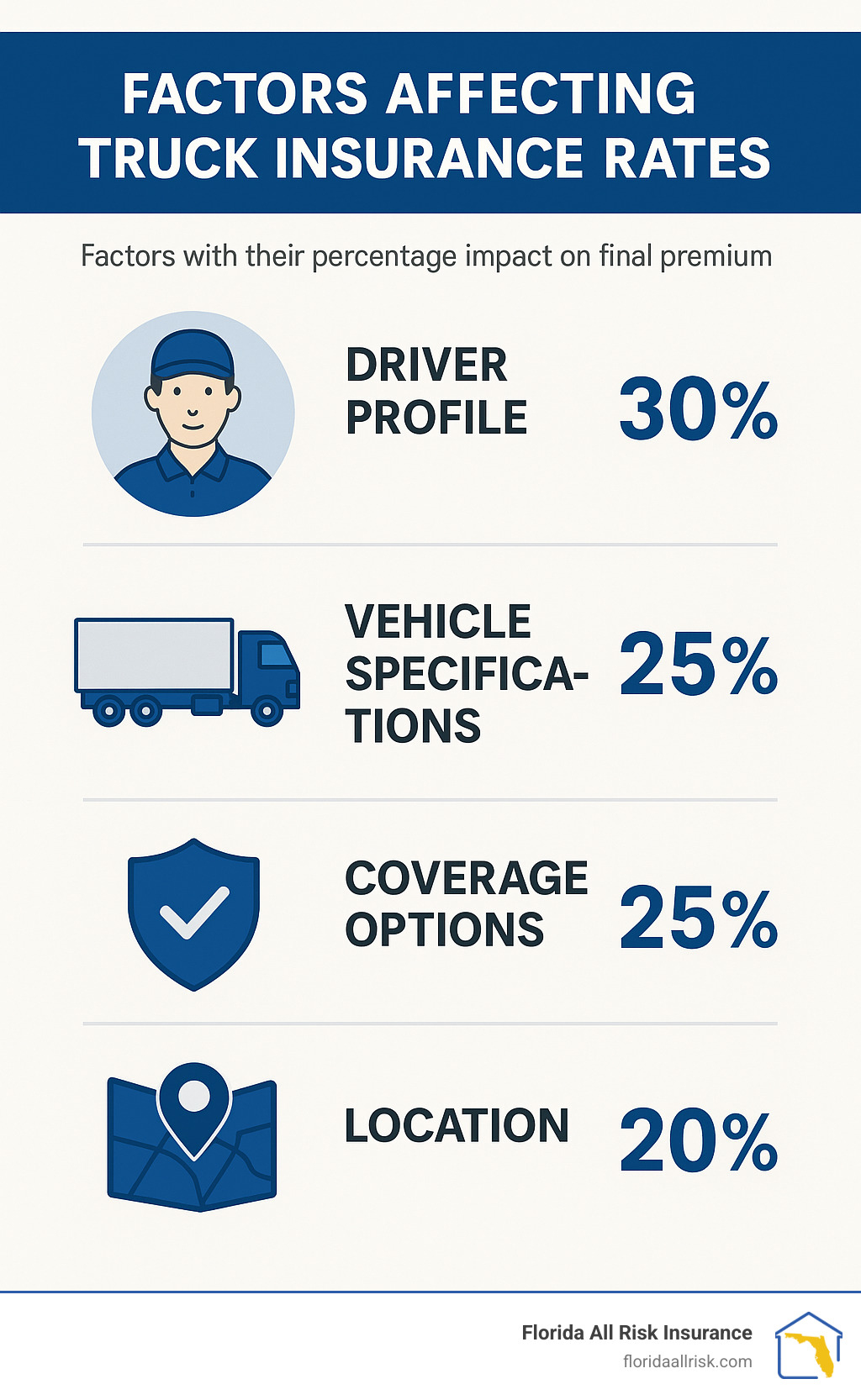
Best truck insurance rates are currently averaging $179 per month ($2,152 per year) for pickup trucks, though commercial truck insurance can range from $2,500 to $20,000 annually depending on several factors:
| Key Factors Affecting Truck Insurance Rates | Impact |
|---|---|
| Truck make and model | Ford Maverick is cheapest ($1,746/year), Ford F-450 most expensive ($3,010/year) |
| Driver history | Clean records save up to 30% |
| Location | Mississippi, Wyoming, and Nebraska offer lowest rates |
| Coverage type | Liability-only vs. full coverage significantly impacts cost |
| Commercial vs. personal | Commercial rates 3-5x higher than personal pickup coverage |
In today’s challenging insurance market, finding affordable truck insurance requires strategic shopping. Insurance costs have risen 20.6% year-over-year as of January 2024, marking the 17th consecutive month of double-digit growth. Whether you’re an owner-operator paying $3,000-$5,000 annually with a motor carrier lease or $9,000-$12,000 with your own authority, understanding what drives these costs is the first step toward securing better rates.
Trucks are generally more affordable to insure than cars, with the average truck premium ($2,152) running about 23% less than the average car premium ($2,790). However, rates vary dramatically based on truck type, usage patterns, and coverage needs.
I’m Jason Miller, and with over 20 years of experience helping Florida businesses find the best truck insurance rates, I’ve guided thousands of truck owners through this complex landscape to secure competitive coverage that protects their livelihoods without breaking the bank.
Related content about Best truck insurance rates:
– Cargo insurance for trucks
– 24 hour commercial truck insurance
– 26 foot box truck insurance cost
Truck Insurance Costs in 2024: Numbers You Need to Know
Let’s talk real numbers about truck insurance in 2024—because knowing what you’re up against is half the battle in finding those best truck insurance rates.
The sticker shock is real this year. The national average for truck insurance now sits at $2,152 annually—that’s a whopping 20.6% jump from last year. If you’re feeling the pinch, you’re not alone. We’ve now seen 17 straight months of double-digit premium increases, a trend that’s making many truck owners lose sleep.
Breaking this down to monthly payments, the average truck owner is shelling out about $179 per month. But as any trucker knows, averages only tell part of the story. If you’re hauling across state lines, you’re likely paying more than someone who stays within Florida, simply because interstate operations face tougher regulations and cover more territory.
Here’s how the numbers stack up between last year and now:
| Comparison | 2023 Average Annual Premium | 2024 Average Annual Premium | Percentage Increase |
|---|---|---|---|
| Pickup Trucks | $1,795 | $2,152 | 19.9% |
| Commercial Trucks (Leased) | $4,100 | $5,000 | 22.0% |
| Owner-Operators (Own Authority) | $9,800 | $12,000 | 22.4% |
| Semi-Trucks | $14,500 | $17,500 | 20.7% |
Why rates are surging 20% yet the Best truck insurance rates are still within reach
“I nearly fell off my chair when I saw my renewal,” says Mark Thompson, an owner-operator from Tampa who watched his premium jump from $8,900 to $11,000 in just one year. His experience is becoming all too common.
So what’s behind these steep climbs? It’s a perfect storm of economic pressures. Inflation has hit the auto repair industry particularly hard, with parts shortages creating maintenance backlogs nationwide. According to recent CPI data, fixing your truck now costs 18.7% more than it did in 2022—outpacing general inflation.
Then there’s the litigation factor. A recent Fitch study showed bodily injury settlements have shot up 35% in just three years. With multi-million dollar verdicts becoming more common, insurers are raising rates to protect themselves from these massive potential payouts.
Yet despite these challenges, finding best truck insurance rates isn’t impossible. Insurance companies are increasingly rewarding safety-conscious truckers. Those clean MVRs, telematics systems, and documented safety protocols aren’t just good business—they’re becoming essential for affordable coverage.
Comparing owner-operators to fleets
Your operational structure makes a huge difference in what you’ll pay. If you’re an owner-operator leased to a motor carrier, you might pay between $3,000 and $5,000 annually. That’s because your motor carrier typically shoulders most of the primary liability responsibility.
Strike out on your own with your own authority, though, and prepare for premiums between $9,000 and $12,000 per truck. This dramatic difference reflects the additional liability you take on when the buck stops with you.
Fleet operators have their own advantages. “When I started with just one truck, I was paying nearly $11,000 for full coverage,” shares Carlos Rodriguez, who runs five trucks in Miami. “Now my per-truck cost is about $8,200. The fleet savings literally funded my expansion.” This economy of scale typically delivers 15-20% savings per vehicle once you hit 10+ trucks.
Deductible strategies also vary widely. Single-truck owners often gamble on higher deductibles ($1,000-$2,500) to keep monthly costs manageable. Meanwhile, established fleets with better cash reserves might opt for lower deductibles, knowing they can handle the occasional claim without disrupting cash flow.
The landscape is challenging, but with the right approach to safety, coverage selection, and risk management, those best truck insurance rates are still within reach—even in 2024’s difficult market.
More info about Commercial Truck Insurance Florida
Scientific research on FMCSA minimums
State-by-State Breakdown: Where Rates Rev Up or Slow Down

Your zip code matters more than you might think when it comes to finding those best truck insurance rates. I’ve seen how moving just across state lines can cut a trucker’s premium in half – or sadly, double it in some cases.
After analyzing thousands of policies, we’ve found that Mississippi, Wyoming, and Nebraska consistently offer the most wallet-friendly rates for commercial truckers. These states have a secret sauce: fewer people on the roads, less traffic congestion, and regulatory environments that don’t pile on excessive requirements.
Meanwhile, if you’re operating in Florida, California, or Texas, you’re probably all too familiar with premium sticker shock. Each of these states faces unique challenges that make insurers nervous – and when insurers get nervous, rates go up.
“When I moved my business from California to Wyoming last year, my insurance costs dropped by 38%,” shares Marcus Johnson, an owner-operator who hauls construction equipment. “Same truck, same driving record, same coverage limits – just a different home base.”
For Florida truckers (that’s most of you reading this!), we understand your pain. While our sunshine state ranks among the pricier locations, our team at Florida All Risk Insurance has developed specialized approaches to find competitive options that national agencies often miss.
Cheapest states for the Best truck insurance rates
What makes certain states so much more affordable for truck insurance? It’s a combination of factors that create the perfect environment for lower premiums.
Mississippi tops our affordability list with rates running 15-20% below national averages. The state’s predominantly rural road network means fewer accidents and lower claim frequencies. When truckers spend more time on open highways and less time in bumper-to-bumper traffic, insurers breathe easier.
Wyoming’s vast open spaces translate directly to your bottom line, with premiums averaging 12-18% below the national norm. With the lowest population density in the lower 48 states, Wyoming truckers enjoy fewer interactions with other vehicles – meaning fewer opportunities for accidents.
Nebraska offers rates about 10-15% below average while providing excellent access to major shipping corridors. The state’s balanced approach to regulation gives truckers enough structure for safety without excessive compliance costs.
These budget-friendly states offer more than just lower premiums. Your cost-per-mile drops significantly when factoring in both insurance and operational expenses. Many truckers also benefit from synergies with lower fuel taxes and fewer urban congestion points that waste both time and fuel.
Most expensive states & how to cope
If you’re hauling in Florida, you’re facing some of the steepest insurance rates nationwide – often 30-40% above the national average. This isn’t random bad luck; it’s driven by specific factors:
Florida’s hurricane exposure makes insurers nervous about physical damage claims. Our dense urban corridors, especially along I-95 and I-4, create more opportunities for accidents. Add in a legal climate that tends to favor higher settlements, and you have the perfect storm for premium hikes.
At Florida All Risk Insurance, we’ve developed specialized approaches for our home state’s unique challenges. We dig deeper to find carriers with Florida expertise and risk appetites that align with your specific operation. Learn more about our Florida-focused solutions on our Commercial Truck Insurance Florida page.
California truckers face their own challenges with strict environmental regulations and a notoriously litigious environment. Texas operators contend with extreme weather risks across a massive geographic footprint.
Regardless of your home state, there are proven strategies to bring those rates down:
Invest in comprehensive safety programs with documented driver training. Install quality dashcams and telematics – they not only help prove your innocence in false claims but many insurers offer direct discounts for using them. Consider raising your deductibles to lower premium costs, especially if you have the cash reserves to handle a larger out-of-pocket expense if needed.
For scientific research on FMCSA minimum requirements that affect interstate operations across all states, review the official federal regulations on financial responsibility for motor carriers.
Location matters – but it’s just one piece of the puzzle in finding those best truck insurance rates. Working with an agency that understands your specific region gives you a significant advantage in navigating these state-by-state differences.
Cheapest vs. Priciest Rigs to Insure

When it comes to truck insurance, what you drive matters—a lot. I’ve seen countless clients surprised by how dramatically premiums can vary between different models. Let’s take a look at which trucks will be kindest to your wallet and which might have you digging deeper.
Budget-friendly models for the Best truck insurance rates
If keeping insurance costs down is a priority, the Ford Maverick deserves your attention. With average premiums of just $1,746 annually, this compact pickup is the clear winner in affordability. Many of my clients are amazed that they can insure this practical truck for less than many family sedans.
The Ford Ranger follows closely behind at $1,864 per year, with the Nissan Frontier right on its bumper at $1,885 annually. These mid-size trucks strike a sweet spot in the insurance world because they’re less expensive to repair and replace than their larger cousins.
“I switched from a full-size Ram to a Frontier last year,” shares Mike, a contractor from Clearwater. “My insurance dropped by almost $600 a year, and I can still handle most of my daily work needs just fine.”
The Hyundai Santa Cruz ($1,941/year) and trusty Toyota Tacoma ($1,952/year) complete the top five most affordable trucks. The Tacoma’s legendary reliability means fewer claims for mechanical issues, something insurance companies definitely notice—and reward.
What makes these trucks cheaper to insure? It’s a combination of factors: excellent safety ratings, lower theft rates, more affordable replacement parts, and generally less costly repairs when accidents happen. For many Florida drivers looking for best truck insurance rates, these mid-size options offer the perfect balance of utility and economy.
High-ticket heavyweights and why they cost more
On the opposite end of the spectrum sits the mighty Ford F-450, commanding a hefty $3,010 in annual premiums. When I explain these rates to clients, I often say, “More truck means more insurance.” It’s simple math—these heavy-duty beasts cost more to buy, more to fix, and can cause more damage in accidents.
The muscle-bound Ram 1500 TRX will set you back about $2,565 yearly for insurance, while the robust Nissan Titan XD follows at $2,464. These premium trucks pack powerful engines, specialized components, and luxury features that translate directly to higher repair costs.
Heavy-duty trucks designed for serious commercial use or extreme towing aren’t just built differently—they’re insured differently. When these vehicles are involved in accidents, the damage tends to be more extensive and repairs significantly more expensive. Those sophisticated engine components and high-tech systems don’t come cheap when they need replacing.
Looking at brands overall, Ram trucks are typically the most expensive to insure, averaging around $2,233 annually. Hyundai, meanwhile, offers the most insurance-friendly trucks at approximately $1,941 per year.
For Florida truck owners weighing their options, it’s worth considering how your choice of vehicle will impact your long-term insurance costs. Sometimes, the more affordable truck to buy isn’t necessarily the most economical to own when insurance is factored into the equation. At Florida All Risk Insurance, we help clients understand these tradeoffs before they make their purchase, potentially saving them thousands over the life of their vehicle.
Coverage & Compliance Guide for Commercial Operators
Navigating commercial truck insurance can feel like driving through a maze without a map. Trust me, I’ve guided countless truckers through this complex landscape, and I understand the confusion you might be feeling right now.
Commercial truck coverage isn’t one-size-fits-all – it’s a carefully assembled package designed to protect your specific operation. At its core, every solid commercial truck insurance program includes several key components.
Primary liability insurance forms the foundation of your protection, covering bodily injury and property damage you might cause to others. Think of this as your first line of defense. Alongside this, physical damage coverage protects your actual truck through collision and comprehensive coverage – because your rig is your livelihood.
If you’re hauling freight, motor truck cargo coverage is essential, protecting the goods you transport. Meanwhile, general liability extends beyond the road, covering non-auto related incidents that might occur during your business operations.
Many owner-operators also need bobtail insurance (also called non-trucking liability), which covers you when driving without a trailer or for personal use. If you frequently handle trailers owned by others, trailer interchange coverage provides that extra layer of protection.
Other important coverages include medical payments for injury expenses regardless of fault, excess liability/umbrella policies that provide coverage beyond your primary limits, and workers’ compensation for companies with employees.
Florida truckers can learn more about these essential coverages on our Commercial Truck Liability Insurance page.
Minimum legal requirements (federal & state)
The rulebook for commercial trucking comes from both federal and state authorities, and knowing the difference is crucial for staying compliant and protected.
For interstate operations, the Federal Motor Carrier Safety Administration (FMCSA) sets the baseline requirements:
- General Freight: $750,000 minimum liability
- Oil Transport: $1,000,000 minimum liability
- Hazardous Materials: $5,000,000 minimum liability
Interstate carriers must also file Form MCS-90 as proof of insurance, which guarantees you can cover minimum claim amounts regardless of any policy exclusions. For the full regulatory details, you can check the official FMCSA minimums.
State requirements for intrastate operations vary significantly. Here in Florida, if you’re operating solely within state lines, your minimum liability requirements are:
- $300,000 for general freight vehicles under 26,000 lbs
- $750,000 for general freight vehicles over 26,000 lbs
- $1,000,000 for oil transport
- Up to $5,000,000 for hazardous materials
One of our clients, James Wilson, a Florida-based owner-operator, recently shared his experience: “When I started hauling solely within Florida, I was surprised to learn that the state requirements were different from what I needed for interstate operations. Working with Florida All Risk Insurance helped me steer these differences and ensure I was properly covered without overpaying.”
Matching coverage to your role: owner-operator, motor carrier, private carrier
Your specific role in the trucking industry directly impacts what insurance coverage you need – and what you don’t.
If you’re an owner-operator leased to a motor carrier, you’ll typically need non-trucking liability (bobtail) insurance, physical damage coverage for your truck, and occupational accident coverage as an alternative to workers’ comp. You might also need supplemental liability to cover gaps in the motor carrier’s policy.
For owner-operators with their own authority, the requirements expand significantly. You’ll need primary liability at FMCSA-mandated levels, physical damage coverage, motor truck cargo insurance (often required by shippers), general liability for non-driving business activities, and workers’ compensation if you have employees.
Private carriers – businesses that transport their own goods – need primary liability coverage, physical damage protection, general liability for their overall business operations, and workers’ compensation for drivers and other employees.
If you operate a fleet, consider an umbrella policy that provides an additional layer of protection beyond your primary coverage limits. These policies typically offer more cost-effective ways to increase your overall protection compared to raising limits on individual policies.
Typical exclusions & the claims process
Understanding what your best truck insurance rates don’t cover is just as important as knowing what they do. Most policies won’t cover intentional damage, normal wear and tear, or mechanical breakdowns (unless specifically included). You might also face driver exclusions for those with poor records, geographic limitations (especially for specialized cargo), and restrictions on certain types of cargo like hazardous materials.
When the unfortunate happens and you need to file a claim, following proper procedures makes all the difference:
- Document everything thoroughly with photos and written accounts
- Report the claim immediately to your insurance provider
- Work collaboratively with your assigned claims adjuster
- Use preferred repair shops when available (they often expedite the process)
- Keep detailed records of all communications and expenses
At Florida All Risk Insurance, we don’t just sell policies – we stand beside you through the claims process. Our clients benefit from our claims advocacy services, where we help steer the process and ensure fair treatment from insurance carriers.
The right coverage isn’t about checking boxes – it’s about protecting the business you’ve worked so hard to build. We’re here to help you find that perfect balance of protection and value.
How to Open up the Best Truck Insurance Rates

Finding the best truck insurance rates isn’t just about luck – it’s about strategy. As someone who’s helped countless Florida truckers slash their premiums without sacrificing protection, I’ve seen what works and what doesn’t.
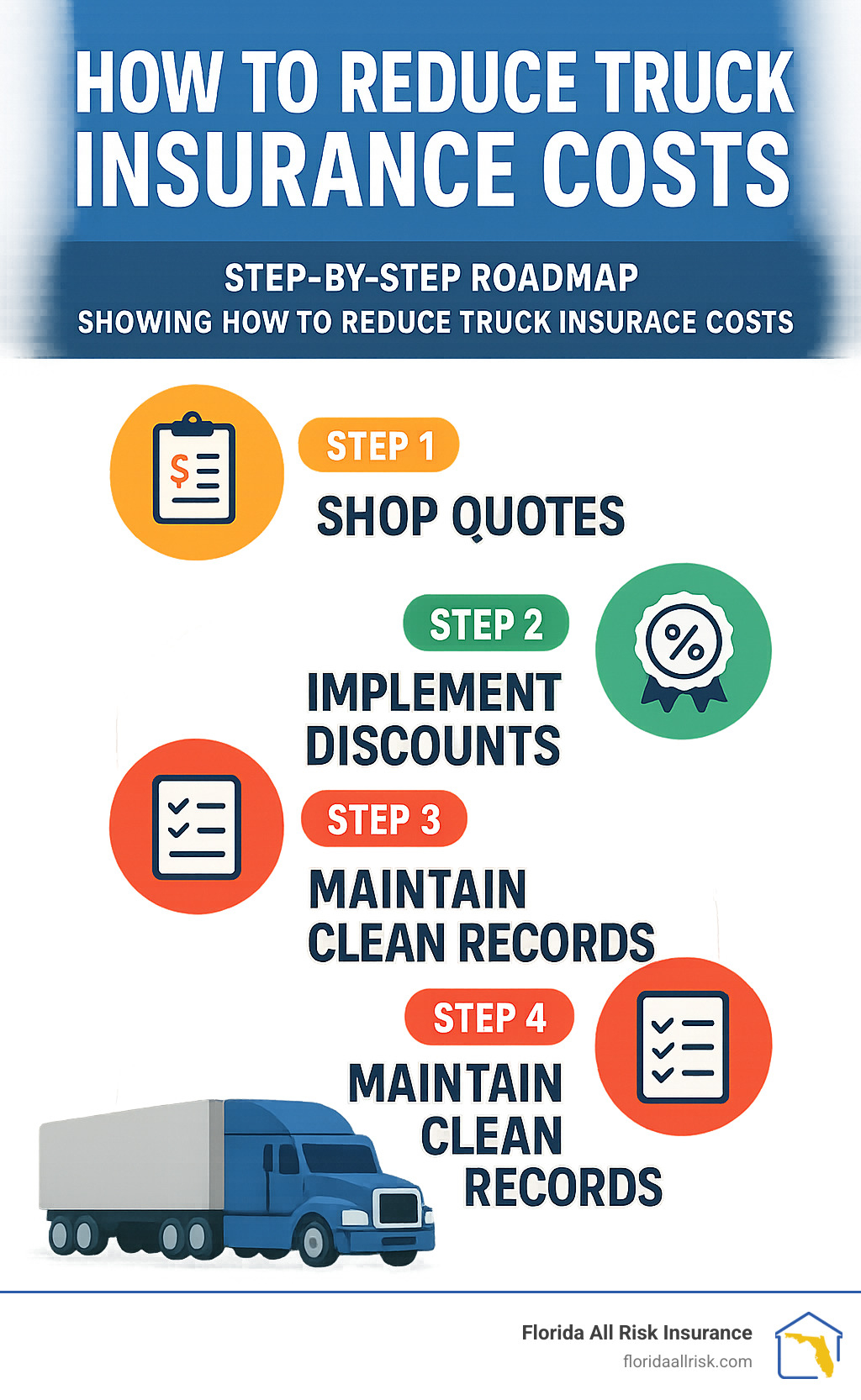
Start by gathering multiple quotes – I always tell my clients to aim for at least 3-5 different options. The differences can be shocking! Working with an independent agency like ours gives you access to numerous carriers through a single point of contact, saving you hours of repetitive phone calls and form-filling.
Technology has become your friend in the battle for lower premiums. Telematics programs like Progressive’s Smart Haul® are game-changers, with the average trucker saving over $1,000 annually just for sharing their ELD data. One of my clients, a Tampa-based hauler, cut his premium by nearly 18% this way alone.
Your experience matters tremendously. Carriers typically offer their sweetest deals to drivers with 3+ years of clean CDL experience. Similarly, how you pay can make a substantial difference – paying your premium in full rather than monthly can save around 15% with many carriers.
Don’t underestimate the impact of your credit score. While it might seem unrelated to your driving abilities, many insurers use credit-based insurance scores as a major rating factor. A client of mine raised his score by 70 points and saw his renewal premium drop by over $800.
Discount checklist you might be missing
Many truckers I meet are leaving money on the table by overlooking valuable discounts. Multi-policy discounts can trim 5-15% when you bundle commercial auto with other coverages. Prior coverage discounts reward your loyalty to being insured, even if you’re switching carriers.
Formal safety programs might seem like paperwork headaches, but they can reduce premiums by up to 20%. One owner-operator I work with implemented a documented safety protocol, and his savings more than paid for the time investment within the first month.
ELD data sharing has evolved beyond compliance into a money-saving opportunity. Professional association memberships often come with insurance perks – I’ve seen discounts of 5-10% for members of certain trucking associations.
If you’re looking for temporary coverage, you might benefit from specialized short-term options. You can learn more about these at our 24 Hour Commercial Truck Insurance page.
Balancing coverage and cost for the Best truck insurance rates
Finding that sweet spot between protection and affordability is more art than science. Adjusting your deductibles can dramatically impact your premium – moving from a $500 to $1,000 deductible typically saves 10-15%, while jumping to $2,500 might save you 20-30%. Just be sure you have the cash reserves to handle that higher out-of-pocket cost if you need to file a claim.
For older trucks, being strategic about coverage makes sense. I remember helping Frank, a Florida produce hauler, evaluate his 9-year-old Peterbilt. “I was paying over $13,000 a year until we sat down together,” he told me later. “By restructuring my coverage with higher deductibles I could actually afford, I saved nearly $3,200 annually without compromising protection.”
If your operation has predictable slow periods, ask about seasonal adjustments. Some insurers will reduce coverage costs during times when vehicles are stored, which works beautifully for specialized seasonal haulers.
Take time for a thorough gap analysis with your agent. We often find clients are paying for redundant coverages while leaving dangerous gaps elsewhere. This review alone saved one small fleet operator over $4,700 last year.
Top 5 commercial truck insurers in 2024—strengths & cautions
At Florida All Risk Insurance, we work with numerous carriers, each with their own sweet spots. Here’s my honest take on some leading options:
Progressive Commercial shines with competitive rates and tech integration. Their Smart Haul® program delivers substantial savings, and their payment flexibility is excellent. However, their claims process can get complicated for complex situations – something to consider if you’re hauling specialized cargo.
Nationwide offers rock-solid coverage with excellent financial stability (A+ AM Best rating). Their fleet programs are particularly impressive, though they tend to be less enthusiastic about higher-risk drivers.
State Farm’s local agent model translates to personalized service and strong claims satisfaction. They’re ideal for small fleets and mixed-use vehicles but might not be your best bet for specialized long-haul operations.
The Hartford excels with business insurance packages that include commercial auto coverage. Their risk management resources are outstanding, particularly for established businesses, though newer ventures might face higher premiums.
Sentry focuses specifically on trucking with specialized coverages and transportation-specific claims handling. Their deep industry understanding is valuable, but their underwriting guidelines tend to be stricter than some competitors.
The beauty of working with an independent agency like ours is that we evaluate all these options (and many more) to find the perfect match for your specific situation, operational profile, and budget. We’ve been helping Florida truckers find the best truck insurance rates for decades, and we’d love to do the same for you.
Frequently Asked Questions About the Best Truck Insurance Rates
What factors influence truck insurance premiums most?
When it comes to truck insurance, not all factors carry equal weight. Your driving history is probably the most significant influencer – those speeding tickets and fender benders can increase your premium by a whopping 20-50% (or even more in some cases). It’s like paying for those mistakes twice!
Your operational radius also plays a crucial role. If you’re sticking close to home (within 50 miles), you’ll generally pay less than regional haulers covering 51-200 miles. And those long-haulers going beyond 200 miles? They typically face the highest rates due to increased exposure to varying road conditions and regulations.
What you’re hauling matters too. Transporting hazardous materials or high-value cargo will significantly bump up your premiums compared to general freight. Similarly, that shiny new Peterbilt with all the bells and whistles will cost more to insure than an older, more modest rig – simply because replacement value factors heavily into insurance calculations.
Michael Chang, a box truck operator from Tampa, shared an interesting insight: “When I moved my business from Orlando to Tampa, my insurance actually dropped by about 8%, even though everything else stayed the same. Location really does matter.”
Other key factors include your coverage limits and deductibles (higher limits cost more, higher deductibles cost less), business experience (newcomers pay 15-30% more), and in many states, your credit-based insurance score can swing your rates by 10-40%.
Are trucks really cheaper to insure than cars or SUVs?
Yes, trucks are generally cheaper to insure than cars – but there’s an important asterisk here. Personal pickup trucks cost about 23% less to insure than passenger cars ($2,152 vs. $2,790 annually). This isn’t just random good fortune for truck owners.
Pickup trucks often feature simpler construction with parts that don’t cost an arm and a leg to replace. They’re built tougher too, meaning they sustain less damage in minor fender-benders. Many truck owners (especially in rural areas) drive fewer miles in congested areas, reducing their accident risk. Plus, that higher seating position and better visibility might actually help prevent accidents in the first place.
But here’s where that asterisk comes in: this advantage primarily applies to personal pickup trucks. When we step into commercial trucks, especially semis and specialized equipment, we’re playing a whole different ballgame. Commercial trucks are substantially more expensive to insure than personal vehicles because:
- They can cause significantly more damage in accidents (think physics: mass × velocity)
- Their parts and repairs often require specialized service centers and technicians
- Federal and state regulations demand higher policy limits
- They rack up far more annual miles, increasing exposure to risk
How can new or high-risk drivers still find affordable coverage?
If you’re new to trucking or have a less-than-stellar driving record, don’t despair – there are still ways to find coverage that won’t break the bank.
For fresh CDL holders, patience is key. Consider starting with a company that provides insurance coverage while you build 1-2 years of professional experience. Some new drivers find success with team driving alongside a veteran, which can help mitigate the risk in the insurer’s eyes. Going above and beyond with safety certifications can also demonstrate your commitment to responsible driving.
If your record has some blemishes, focus on carriers that specialize in non-standard risks. Yes, you’ll likely pay higher premiums initially, but consider it an investment in your future insurance rates. Accepting higher deductibles can help offset those premium increases too. Many drivers find success with telematics or dashcams that provide concrete evidence of improved driving behavior.
Sarah Johnson’s experience resonates with many new owner-operators: “I was quoted over $18,000 for my first year of coverage as an owner-operator with two speeding tickets on my record. By working with Florida All Risk Insurance, I found a carrier willing to take a chance on me at $14,200. After two clean years, my premium dropped to $9,800.”
Working with an independent agency like Florida All Risk Insurance gives you access to multiple markets, including those more willing to work with higher-risk drivers. Some regional carriers have more flexible underwriting guidelines than the major national insurers, and specialized programs exist that will reassess your rates as your driving history improves.
The path to the best truck insurance rates might be longer for new or high-risk drivers, but with the right approach and some patience, more affordable coverage is definitely within reach.
Conclusion & Get a Custom Quote Today
Finding the best truck insurance rates isn’t just about saving money—it’s about protecting your livelihood while keeping your business competitive. Here in Florida, truck owners face unique challenges that require specialized knowledge and targeted solutions.
At Florida All Risk Insurance, we understand these challenges firsthand. Our St. Petersburg team has helped countless truck owners across Florida steer the complexities of commercial truck insurance. Being independent gives us a powerful advantage: instead of pushing policies from just one company, we can shop multiple carriers to find coverage that truly fits your operation.
Think of us as your personal truck insurance navigators. We know the Florida landscape—from the hurricane exposure that worries insurers to the state-specific regulations that affect your compliance. This local expertise often helps us uncover competitive options that big national agencies simply miss.
Remember those strategies we discussed throughout this guide? Implementing them could save you thousands of dollars annually. Whether it’s adjusting deductibles, leveraging available discounts, or tailoring coverage to your specific operational profile, these approaches work—we’ve seen the results with our clients.
One of our owner-operators in Tampa recently told us, “I was ready to sell my truck because insurance costs were eating all my profits. Working with Florida All Risk turned that around completely. Now I’m actually expanding my business.”
The truth is, the cheapest policy isn’t always the best value. The real test of insurance quality comes when you need to file a claim. That’s when having the right coverage—and the right agency in your corner—truly matters. Our focus isn’t just finding affordable coverage; it’s finding protection that delivers when you need it most.
Ready to explore your options? Visit our comprehensive trucking coverage page or give us a call. We’ll take the time to understand your operation, identify your specific risks, and develop a protection plan that makes sense for your business and budget.
Don’t let rising insurance costs derail your trucking operation. With the right approach and the right partner, you can steer today’s challenging insurance market successfully. Contact Florida All Risk Insurance today, and let’s work together to find the best truck insurance rates for your specific situation.
Your truck is more than just a vehicle—it’s the foundation of your business. Let us help you protect it properly, without breaking the bank.