

Good Homeowners Insurance: Unlock Peace 2025
What Makes Homeowners Insurance “Good”?
Good homeowners insurance provides comprehensive protection for your most valuable asset—your home—while offering the financial security and peace of mind you deserve as a Florida homeowner.
Quick Answer: What Makes Homeowners Insurance “Good”?
- Comprehensive Coverage: Protects your dwelling, personal property, and liability exposure.
- Adequate Limits: Covers 100% replacement cost, not just market value.
- Florida-Specific Protection: Includes wind, hail, and optional flood coverage.
- Reasonable Deductibles: Balances premium costs with out-of-pocket expenses.
- Strong Financial Ratings: Insurance company rated A- or better by A.M. Best.
- Responsive Claims Service: Quick claim processing and fair settlements.
Your home is more than an investment; it’s your family’s sanctuary. Yet many Florida homeowners have basic coverage with dangerous gaps. With construction costs rising significantly and Florida’s unique risks from hurricanes and flooding, having the right coverage is critical.
Good homeowners insurance goes beyond meeting mortgage lender requirements. It should cover your dwelling at full replacement cost, protect your belongings, and shield you from liability claims. Not all policies are the same. Some cover personal property at its depreciated actual cash value, while better policies offer full replacement cost. Understanding these differences is key to avoiding surprises after a loss.
At Florida All Risk Insurance, our experienced team has guided thousands of homeowners through Florida’s complex insurance market. We help families secure good homeowners insurance that truly protects their lifestyles and assets at competitive rates.
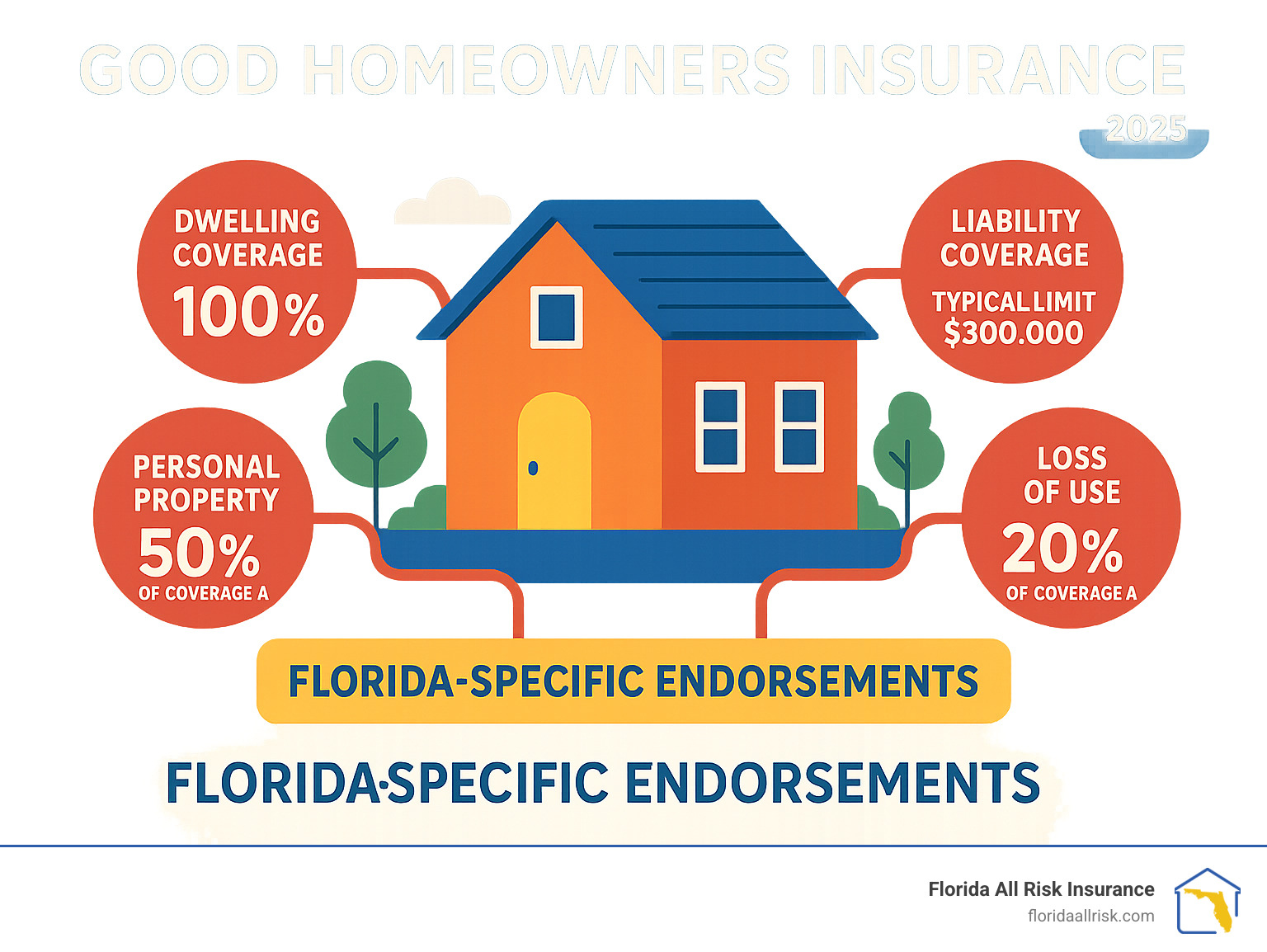
Understanding the Core Components of Homeowners Insurance
Think of good homeowners insurance as a multi-line policy combining property and liability protection. It’s a package of six core coverages that work together to shield you from unexpected events.
Dwelling Coverage (Coverage A)
This is the core of your policy, covering the cost to rebuild your home’s structure from the foundation to the roof, including attached structures like garages. Replacement cost is not the same as market value. Market value includes land, which isn’t damaged in a fire. Replacement cost covers only the materials and labor to rebuild. With construction costs soaring, insuring for 100% of your home’s replacement value is the safest strategy. Most insurers require you to cover at least 80% to avoid penalties on claims, but aiming for 100% ensures you can fully rebuild. For Florida homeowners, understanding Florida Homeowners Insurance is vital, as policies have specific wind and hurricane deductibles.
Other Structures (Coverage B)
This protects structures on your property not attached to your house, such as detached garages, sheds, fences, and swimming pools. Coverage is typically set at 10% of your dwelling coverage limit. If you have a large workshop or an elaborate pool setup, you may need to purchase additional coverage.
Personal Property (Coverage C)
This covers your belongings—furniture, electronics, clothing, and more—from perils like fire and theft. The limit is usually 25% to 50% of your dwelling coverage. Pay close attention to the type of coverage:
- Actual Cash Value (ACV): Pays for your item’s value today, including depreciation. A three-year-old laptop gets you the value of a used three-year-old laptop.
- Replacement Cost (RC): Pays to replace your item with a new one of similar quality. This is highly recommended.
Standard policies have low limits for valuables like jewelry, art, and firearms ($500-$2,500). Consider scheduling these items separately for better protection. A home inventory is essential for a smooth claims process.
Loss of Use (Coverage D)
Also known as Additional Living Expenses (ALE), this covers extra costs if a covered loss makes your home uninhabitable. It reimburses you for hotel bills, temporary rent, and restaurant meals above your normal spending. This coverage provides critical financial breathing room while your home is being repaired.
Personal Liability (Coverage E)
This protects your finances if you’re legally responsible for injuring someone or damaging their property. Common scenarios include a delivery person slipping on your steps or your dog biting a visitor. This coverage pays for medical bills, lost wages, and legal defense costs. Given that the average dog bite claim can exceed $35,000, adequate limits are essential to protect your assets. Our guide on Paws Policies: Navigating Homeowners Insurance with Dogs can help pet owners understand their options.
Medical Payments to Others (Coverage F)
This is “goodwill” coverage that pays for small medical bills if a guest is injured on your property, regardless of fault. It typically covers $1,000 to $5,000 and helps resolve minor incidents quickly, preventing them from becoming larger liability claims.
Comparing Policies to Find Good Homeowners Insurance
Not all insurance policies are created equal. Finding good homeowners insurance requires looking beyond the price tag to understand the differences in policy forms, exclusions, and essential add-ons, especially in Florida.
Standard Policy Types: HO-3 vs. HO-5
The two most common policy forms are the HO-3 and HO-5. The HO-3 (Special Form) is popular, providing “open perils” coverage for your dwelling (protection from all risks unless excluded) but more limited “named perils” coverage for your personal property. The HO-5 (Comprehensive Form) offers broader protection, covering both your dwelling and personal property on an “open perils” basis. It’s ideal for those with high-value belongings.
| Feature | HO-3 (Special Form) | HO-5 (Comprehensive Form) |
|---|---|---|
| Dwelling Coverage | Open Perils (all risks unless excluded) | Open Perils (all risks unless excluded) |
| Personal Property | Named Perils (only listed risks covered) | Open Perils (all risks unless excluded) |
| Cost | More affordable | Higher premium |
| Best For | Budget-conscious homeowners wanting solid protection | Those seeking maximum coverage for personal belongings |
Key Exclusions: What Isn’t Covered?
Even the best policies have exclusions. It’s vital to know what isn’t covered so you can address potential gaps.

- Flood Damage: Standard policies do not cover flooding from external sources. This requires a separate policy.
- Earthquake Damage: This is another common exclusion.
- Normal Wear and Tear: Policies are not maintenance plans; they don’t cover aging roofs or failing appliances.
- Pest Infestations: Damage from termites or rodents is typically excluded.
- Home-Based Businesses: Standard policies offer little to no coverage for business activities. You’ll need to Safeguard Your Home-Based Business with a separate endorsement or policy.
Does homeowners insurance cover mold or water damage?
Coverage for water damage depends on its source. Policies generally cover “sudden and accidental” damage, like a burst pipe. However, gradual damage from a slow, unrepaired leak is typically excluded. Mold coverage is also limited and may only be covered if it’s the direct result of a covered water loss that was addressed promptly.
Hazard Insurance vs. Homeowners Insurance
Your mortgage lender may use the term “hazard insurance,” but this isn’t a separate policy. It’s the part of your homeowners policy that covers the physical structure (dwelling coverage). A comprehensive homeowners insurance policy provides much more, including personal property and liability coverage.
Essential Add-Ons (Endorsements) for Florida Homes
To get good homeowners insurance in Florida, you often need to customize your policy with endorsements:
- Flood Insurance: Essential in Florida, even for homes outside high-risk zones. Florida Flood Insurance is a wise investment.
- Sinkhole Coverage: Addresses a unique Florida risk not fully covered by standard policies.
- Ordinance or Law Coverage: Covers the extra cost to rebuild to current, stricter building codes after a loss.
- Water Backup Coverage: Protects against damage from backed-up sewers or drains.
- Identity Theft Protection: Covers costs associated with recovering from identity theft.
What Determines the Cost of Your Policy?
Understanding what drives your homeowners insurance premium is your roadmap to finding affordable, high-quality coverage. Insurers assess risk based on several factors, many of which you can influence.
Key Factors That Influence Your Premium
- Location: Proximity to the coast, elevation, and local fire protection all impact your rates. You can check your property’s flood risk using FEMA’s online mapping tool, but flooding can happen anywhere in Florida.
- Home’s Age and Construction: Newer homes built to modern codes often cost less to insure. Concrete block construction is generally preferred over wood frames for its wind resistance.
- Roof Condition: A newer roof, especially one with wind-resistant features, can significantly lower your premium. An old roof signals higher risk and can make insurance harder to obtain.
- Claims History: A history of frequent claims can lead to higher premiums. It’s sometimes wise to handle minor repairs out-of-pocket if the cost is close to your deductible.
- Credit-Based Insurance Score: In Florida, insurers may use a credit-based insurance score to help determine rates, as statistics show a correlation between credit management and claim frequency.
- Protective Devices: Discounts are often available for centrally monitored burglar and fire alarms, deadbolts, and other security features.
Common Discounts to Lower Your Costs
Always ask your agent about available discounts. The most common ways to save include:
- Bundling: Combining your home and auto policies with the same insurer can offer significant savings.
- Home Safety: Installing storm shutters, impact-resistant windows, or a monitored security system can earn you discounts.
- Claims-Free History: Many insurers reward homeowners who remain claim-free for several years.
- Higher Deductible: Raising your deductible lowers your premium, but ensure you can comfortably pay the higher amount out-of-pocket if you need to file a claim.
- New Home: Newer homes often qualify for discounts due to modern construction and safety features.
The Role of a Home Inspection
In Florida, insurers often require inspections to assess risk. A four-point inspection examines the four major systems: roof, electrical, plumbing, and HVAC. A wind mitigation inspection documents features that help your home withstand hurricane-force winds, such as roof-to-wall connections and storm shutters. A favorable wind mitigation report can lead to substantial premium discounts. These inspections identify potential issues for you to fix and give the insurer a clear picture of the property, leading to more accurate pricing and a smoother insurance relationship.
Your Step-by-Step Guide to Securing the Best Coverage
Finding good homeowners insurance is manageable with a methodical approach. By preparing properly, you can avoid the common pitfall of finding coverage gaps only after a disaster strikes.
Step 1: Assess Your Coverage Needs
Before getting quotes, understand what you need to protect.
- Calculate Replacement Cost: Determine what it would cost to rebuild your home from scratch with today’s labor and material prices. This is not the same as market value. An online calculator can provide a good estimate, but a contractor’s appraisal is most accurate.
- Inventory Your Belongings: Create a detailed list or video of your personal property. This helps you select the right amount of coverage and is invaluable during a claim.
- Evaluate Liability Risks: Consider your personal liability exposure. Do you have a pool, a dog, or teenage drivers? Your liability limits should be high enough to protect your total assets. An umbrella policy is an affordable way to add extra protection.
- Consider Florida’s Risks: Standard policies don’t cover floods, a major risk in Florida. You will likely need a separate flood insurance policy.
Step 2: How to find good homeowners insurance providers
Finding the right insurance partner is a critical step.
- Work with an Independent Agent: Unlike captive agents who represent one company, independent agents like Florida All Risk Insurance work with multiple carriers. We shop the market for you to find the best combination of coverage and price.
- Get Multiple Quotes: Always compare at least three quotes. Rates can vary significantly between companies for the same coverage.
- Compare Coverage, Not Just Price: The cheapest policy may have high deductibles or critical exclusions. Do an apples-to-apples comparison of limits, deductibles, and coverage types.
- Check Financial Strength: Use a service like A.M. Best to check an insurer’s financial rating. A rating of “A” or better indicates they have the resources to pay claims, even after a widespread disaster.
- Research Customer Service: Look for companies with a strong reputation for fair and responsive claims handling.
Step 3: How to File a Homeowners Insurance Claim
If you need to file a claim, a calm and organized approach will lead to a smoother process.
- Contact Your Insurer Immediately: Report the damage as soon as possible via their 24/7 hotline or app.
- Document Everything: Take extensive photos and videos of the damage before any cleanup. Do not discard damaged items until the adjuster has seen them.
- Make Temporary Repairs: Take reasonable steps to prevent further damage, like putting a tarp on the roof. Keep all receipts for reimbursement.
- Keep Detailed Records: Log all communication with your insurer, including dates, names, and conversation summaries.
- Work with the Adjuster: Be cooperative and provide all necessary information. A good working relationship helps ensure a fair and timely settlement.
Frequently Asked Questions
Here are answers to some of the most common questions Florida homeowners ask when searching for the right protection.
How much homeowners insurance do I really need?
This is about creating a complete financial safety net, not just meeting lender requirements.
- Dwelling Coverage: Insure your home for 100% of its replacement cost, not its market value. This ensures you have enough funds to rebuild completely with current construction costs.
- Personal Property Coverage: Your limit should be high enough to replace all your belongings with new items. A home inventory will help you calculate this value. Always opt for replacement cost (RC) coverage over actual cash value (ACV).
- Liability Coverage: Your limits should be high enough to protect your total net worth. If your assets exceed standard policy limits (typically $300,000-$500,000), an umbrella policy is a crucial and affordable addition.
Will a claim increase my premium?
It’s possible, but it depends on the circumstances. Insurers are more concerned with claim frequency than a single, isolated event. Filing multiple small claims can flag you as a higher risk, potentially leading to premium increases or non-renewal. However, a single large claim, especially one related to a widespread weather event like a hurricane, is less likely to impact your individual rate. Some policies even offer claim forgiveness. For minor damage that is barely over your deductible, it may be wiser to pay out-of-pocket to protect your claims-free history.
What is the 80% rule in homeowners insurance?
The 80% rule is a clause that can lead to a significant penalty if you are underinsured. To receive full payment for a partial loss, most insurance companies require you to insure your home for at least 80% of its full replacement value. If your coverage falls below this threshold, the insurer will only pay a percentage of the loss, leaving you to cover the rest. For example, if your home’s replacement cost is $400,000 but you only insure it for $250,000 (62.5%), the insurer would only pay 62.5% of a covered claim (minus your deductible). To avoid this, always insure your home for 100% of its replacement cost and review your coverage annually.
Conclusion: Get the Protection You and Your Home Deserve
Finding good homeowners insurance is about more than just finding the lowest price; it’s about building a reliable safety net for your family and your largest investment. Your home is where life happens, and it deserves comprehensive protection that goes beyond basic requirements.
In Florida’s challenging insurance market, with rising construction costs and unique risks like hurricanes, understanding your policy is more critical than ever. Knowing the difference between replacement cost and actual cash value, recognizing the need for flood insurance, and understanding how your policy is structured can save you from devastating financial gaps after a loss.
Working with an independent agency like Florida All Risk Insurance means you have a dedicated advocate. We don’t work for one insurance company; we work for you. Our team analyzes your needs, compares options from multiple top-rated carriers, and helps you build a policy that provides true peace of mind.
Don’t wait for a disaster to find your coverage is inadequate. Protect your home, your family, and your future with a policy designed for your life.
Ready to find the right coverage for your home? Get a free homeowners insurance quote today and see how comprehensive protection can give you true peace of mind.
Contact our expert agents to review your current policy and ensure you have the protection you and your family deserve.
Contact Us
Florida All Risk Insurance
Address: 333 3rd Ave N Suite 400, Saint Petersburg, FL 33701
Phone: (727) 346-6019
Email: [email protected]

