Protecting Your Investment: Commercial Real Estate Insurance Essentials
For property investors and business owners seeking the best commercial real estate insurance, here’s a quick comparison of top providers in 2025:
| Insurance Company | Best For | Key Strengths | Average Annual Premium |
|---|---|---|---|
| Nationwide | Overall Coverage | Financial strength, comprehensive policies | $1,671 |
| Next Insurance | Small Businesses | Affordability, digital experience | Starting at $17/month |
| The Hartford | Business Owners | Excellent claims handling, bundling options | $1,605 |
| Liberty Mutual | Risk Management | Loss prevention services, customization | Varies by property |
| Chubb | Large Properties | Global coverage, specialized solutions | Premium for high-value assets |
Best commercial real estate insurance protects your physical assets—buildings, equipment, inventory, and fixtures—against risks like fire, theft, storms, and vandalism. Without it, a single disaster could wipe out years of investment and income. Commercial property insurance differs significantly from residential coverage, with specialized options for different property types and business needs.
Commercial property policies typically include building coverage, business personal property protection, and sometimes business interruption insurance. Most standard policies exclude flood and earthquake damage, requiring separate coverage for these perils. The right policy depends on your property’s location, value, construction type, and usage.
According to industry data, 40% of small businesses will experience an insurance claim in the next decade, with average annual premiums around $1,605 for basic coverage. However, costs vary dramatically based on location, with some states like Delaware averaging $3,257 while Florida averages $1,159.
I’m Jason Miller, a second-generation insurance professional with over 20 years of experience helping Florida businesses find the best commercial real estate insurance solutions in our volatile insurance marketplace.

Best commercial real estate insurance terms explained:
– commercial lease liability insurance
– commercial condo insurance
– independent insurance agency Florida
What Is Commercial Real Estate Insurance & How It Works
When you invest in commercial property, you’re not just buying buildings—you’re creating income streams and building a future. Best commercial real estate insurance protects that investment from disasters that could otherwise wipe out years of hard work overnight.
Commercial real estate insurance is fundamentally different from your home policy. It’s specifically designed for properties that generate income, whether that’s an apartment building, office complex, or retail center.
At its heart, this insurance provides first-party coverage—it protects your own assets rather than covering liability to others. When a fire tears through your building or a windstorm damages the roof, your policy kicks in to cover repairs or replacement, subject to your limits and deductible.
As one of our risk management specialists at Florida All Risk Insurance likes to say, “If you were to turn the building upside down and shake it, almost everything that falls out could be covered by commercial property insurance. The building itself stays put, while the contents—furniture, equipment, inventory—fall out. Both categories need protection.”
Most property owners choose between two main options:
You can purchase standalone commercial property insurance that covers just your physical assets, or you might prefer a Business Owner’s Policy (BOP) that bundles property coverage with general liability protection, often at a better price point.
When we help clients value their property for insurance, we typically discuss three approaches:
Replacement Cost Value (RCV) pays the full cost to replace damaged property with new items of similar quality—no deduction for depreciation. It costs more but provides the most complete protection.
Actual Cash Value (ACV) calculates replacement cost minus depreciation, resulting in lower premiums but smaller claim payments when you need them most.
Functional Replacement Cost allows for replacement with less expensive but functionally equivalent materials—a practical middle ground for many owners.
One concept that trips up many commercial property owners is coinsurance, typically set at 80%. This means you must insure your property for at least 80% of its replacement value to receive full coverage for partial losses.
Our claims specialist often warns clients: “Many commercial property owners don’t realize they’re underinsured until they file a claim. For example, if you insure a $1 million building for only $600,000 with an 80% coinsurance clause, you’d only receive 75% of your claim amount.”
The insurance needs differ significantly between property owners and tenants:
As a landlord, you need coverage for the building structure, common areas, and potentially loss of rental income if disaster strikes. As a tenant, you typically need coverage for leasehold improvements you’ve made, your business personal property, and business interruption protection.
Be aware that standard commercial property policies typically exclude flood damage, earthquake damage, normal wear and tear, intentional damage, nuclear hazards, and war and terrorism (though terrorism coverage can be added as an endorsement).
More info about Commercial Property Insurance
Best Commercial Real Estate Insurance: How We Rank the Leaders
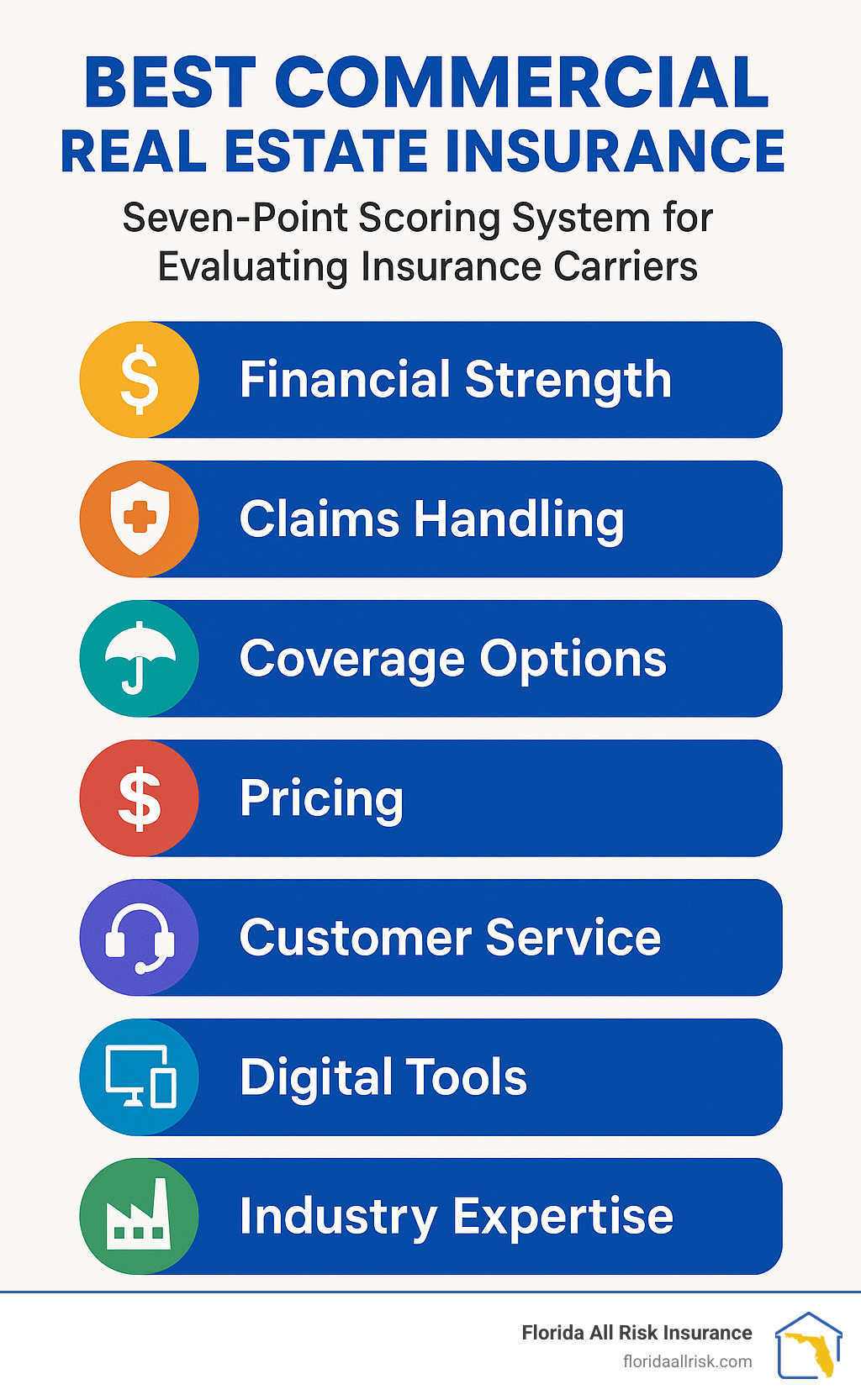
When you’re looking for the best commercial real estate insurance, comparing policies isn’t as simple as looking at price tags. At Florida All Risk Insurance, we’ve developed a thoughtful approach to evaluate insurance carriers that goes deeper than just premium costs.
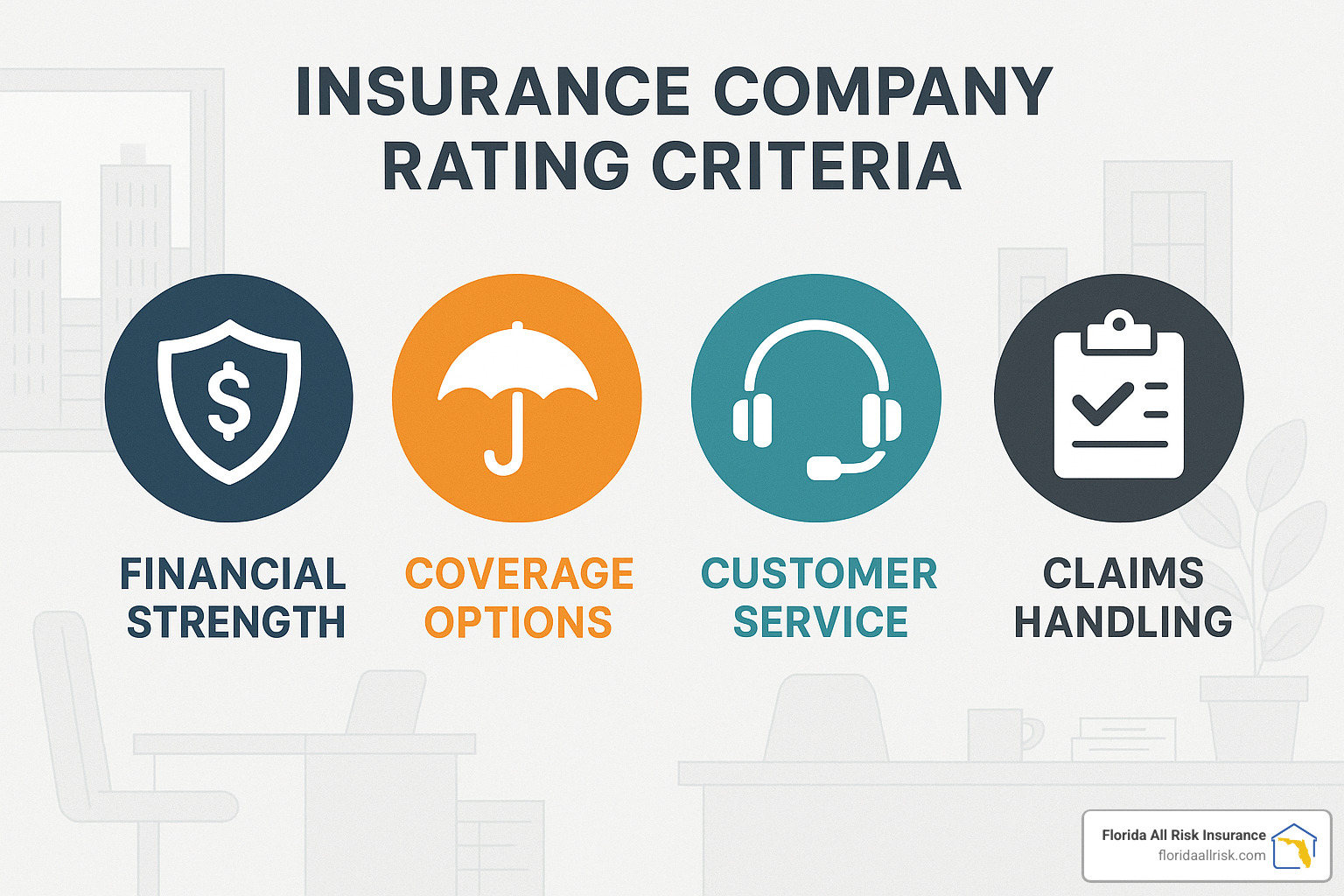
Think of our evaluation process as giving each carrier a complete physical exam, not just checking their pulse. We examine:
Financial Strength – Can they weather the storm? We dig into ratings from independent agencies like A.M. Best and Standard & Poor’s to make sure your carrier can pay claims even after a major catastrophe hits multiple clients at once.
Coverage Breadth – We look beyond the basics to see how comprehensive their protection really is. Does the policy have gaps? Can it be customized to your specific property needs?
Claims Satisfaction – The true test of insurance comes when you need to file a claim. Using J.D. Power surveys and NAIC complaint data, we can see which companies deliver when it matters most. For example, Nationwide scores an impressive 884 out of 1,000 on J.D. Power’s property claims satisfaction survey, landing them in 3rd place overall.
Risk Engineering Services – The best insurers don’t just pay claims—they help prevent them. We evaluate the quality of their loss prevention services that can actually reduce your chances of suffering a loss in the first place.
Cost Transparency – Nobody likes surprises on their bill. We examine how clearly carriers explain their pricing and whether their policy language is straightforward or filled with confusing jargon.
Technology Integration – The ability to manage your policy and report claims online can make a huge difference in your experience. We check for user-friendly digital tools that make your life easier.
Industry Specialization – Some carriers just “get” certain property types better than others. We consider their expertise in your specific market segment.
This thorough approach helps us match you with the perfect carrier for your needs. And with insured catastrophe losses approaching $80 billion annually according to the Insurance Information Institute, choosing the right insurance partner isn’t just about saving a few dollars—it’s about protecting your financial future.
Commercial Property Insurance Risk
Our 7-Point Scoring Model
Our scoring system isn’t just pulled from thin air—we’ve carefully weighted each factor based on what really matters for long-term protection:
Financial Stability (25%) – This gets the biggest share of our attention because it’s the foundation everything else sits on. We prioritize carriers with A.M. Best ratings of A or higher. When hurricane season hits Florida and thousands of claims pour in simultaneously, you need a company with deep enough pockets to handle it all.
Claims Process Excellence (20%) – Even the broadest coverage isn’t worth much if getting paid is a nightmare. We analyze how quickly claims get processed, how fair settlements are, and whether adjusters actually know what they’re doing. We combine data from J.D. Power surveys, NAIC complaint ratios, and most importantly, the real experiences of our own clients.
Coverage Comprehensiveness (15%) – We’re looking for policies that don’t leave you hanging when you need them most. Does the standard policy cover the perils most likely to affect your property? Are important add-ons like equipment breakdown, ordinance coverage, and business interruption protection available?
Pricing Competitiveness (15%) – While we never recommend choosing solely on price, we do evaluate whether you’re getting good value for your premium dollars. We also look at available discounts and—crucially—whether the carrier has a history of stable rates or wild premium swings.
Underwriting Flexibility (10%) – Some properties just don’t fit neatly in a box. We check how well carriers handle unique situations, special property types, and challenging locations like Florida’s coastal areas.
Risk Management Resources (10%) – The best commercial real estate insurance companies don’t just pay for damage—they help prevent it. We evaluate the quality of their loss prevention services, risk assessment tools, and educational resources.
Customer Experience (5%) – The little things matter too. Can you easily reach someone when you have questions? Are their digital tools actually helpful? Is dealing with them a pleasure or a pain?
This weighted approach ensures we’re focusing on what really matters—financial stability and claims handling—while still considering the full picture of what makes an insurance carrier truly excellent for your commercial property needs.
1. The Full-Service National Carrier
Looking for rock-solid protection for your commercial real estate investments? Our top-ranked full-service national carrier delivers peace of mind with exceptional coverage and best financial stability. With an impressive A++ rating from A.M. Best, this carrier has weathered multiple catastrophes while continuing to support their policyholders when they needed it most.
What makes this provider special is their genuine nationwide presence. Unlike some insurers that claim to be “nationwide” but have spotty coverage areas, this carrier truly operates in all 50 states. This means consistent coverage terms and claims handling no matter where your properties are located – a huge advantage for investors with multi-state portfolios.
“After Hurricane Ian hit our Tampa property, their catastrophe team was on-site within 48 hours,” shares one of our clients. “The same adjuster who helped us after a minor claim last year remembered our building layout and expedited the entire process.”
Their loss control services are truly exceptional. Rather than just selling you a policy and disappearing until claim time, their risk engineers – many with 20+ years of experience in commercial property protection – conduct thorough on-site inspections to identify issues before they become expensive problems. These consultations have helped countless clients implement simple, cost-effective safety improvements that significantly reduce risk exposure.
For commercial real estate where property values can be substantial, financial strength matters tremendously. With over $50 billion in policyholder surplus, this carrier has the deep pockets necessary to handle even the most significant property losses without breaking a sweat.
Comparing Actual Cash Value vs. Replacement Cost Value Payouts
| Damage Scenario | ACV Payout | RCV Payout | Difference |
|---|---|---|---|
| 10-year-old roof damage | $15,000 | $25,000 | $10,000 |
| Office equipment (5 years old) | $30,000 | $50,000 | $20,000 |
| HVAC system (8 years old) | $40,000 | $75,000 | $35,000 |
| Building interior (15 years old) | $200,000 | $350,000 | $150,000 |
As you can see from the table above, this carrier’s superior replacement cost coverage results in significantly better claim settlements. Their claims service is refreshingly efficient – most property claims receive initial contact within 24 hours, and settlement offers average just 14 days for standard claims. That’s the kind of responsive service that gets your property back in operation quickly.
Why It Qualifies as the best commercial real estate insurance option
This carrier has earned its spot as offering the best commercial real estate insurance for several compelling reasons:
First, their claims satisfaction ratings consistently rank in the top three across industry surveys, with an impressive 92% policyholder satisfaction rate. This isn’t by accident – they’ve built specialized commercial property claims teams with adjusters who understand different property types. The adjuster handling your office building claim actually understands office buildings, not just general property insurance.
Second, their multi-policy discount program offers real savings – not just marketing fluff. Our clients typically save 12-15% when bundling commercial property with general liability, umbrella, and auto policies. For a mid-sized property portfolio, this can translate to thousands in annual premium savings.
Third, their policy forms are widely accepted by commercial lenders and mortgage holders, which makes life much easier if you have financed properties. Their certificates of insurance generate instantly through a user-friendly online portal, eliminating those frustrating delays when trying to close transactions or satisfy lender requirements.
Finally, in today’s market where construction costs can increase dramatically, their inflation guard endorsement automatically adjusts your coverage limits to keep pace with rising replacement costs – a feature that’s become increasingly valuable in recent years.
Ideal For
This carrier shines brightest for:
- Multi-state property owners seeking consistent coverage across different geographic locations
- Midsize commercial portfolios valued between $5 million and $100 million
- Industrial park owners who benefit from the carrier’s deep knowledge of manufacturing, warehouse, and distribution risks
- Mixed-use development investors needing comprehensive coverage for both commercial and residential components
As one Florida property investor told us after experiencing a major fire: “I always thought insurance was just a necessary expense until we had our claim. The difference between having this carrier versus my previous insurer became crystal clear. They were responsive, fair with the settlement, and got us back in operation months ahead of schedule. The premium difference was negligible compared to the claim experience.”
2. The Digital-First Small Business Specialist
In today’s commercial real estate world, our second-ranked carrier stands out by making insurance remarkably simple and accessible. This innovative provider has completely reimagined how property owners can protect their investments—no more paperwork headaches or endless waiting.
Picture this: instead of scheduling appointments and filling out lengthy forms, you answer a few straightforward questions about your property online. Within minutes—not days—custom coverage options appear on your screen with clear, transparent pricing. While you can certainly speak with an expert if you’d like, the entire process works smoothly without requiring a single phone call.
Their mobile app truly makes life easier for busy property owners. With just a few taps, you can access policy documents, submit claims with photos, generate insurance certificates, manage payments, and even receive weather alerts for your properties. One of our clients recently told us, “I handled an entire claim from my phone while waiting for coffee—it was almost too easy!”
Behind this user-friendly experience lies some serious technology. The carrier uses sophisticated AI to analyze hundreds of property characteristics, resulting in more accurate pricing—especially beneficial for lower-risk properties that might otherwise be overcharged with traditional underwriting.
What really impresses small investors is the affordability factor. Premiums start at just $17 monthly for some properties, making quality coverage accessible even for those just starting their real estate journey. Their Business Owner’s Policy (BOP) smartly bundles property and liability coverage at a discounted rate, with options to add equipment breakdown protection—particularly valuable if your property has elevators, complex HVAC systems, or commercial kitchen equipment.
Cheap Commercial Property Insurance
Why It Qualifies as the best commercial real estate insurance solution
This carrier has earned its spot among providers of the best commercial real estate insurance by addressing what property owners truly value—speed, simplicity, and transparency.
Their claims process is refreshingly straightforward, with decisions typically delivered within 48 hours—dramatically faster than industry averages. Each claim gets assigned to a dedicated specialist who stays with you throughout the process. As one Florida client put it, “Not having to repeat my situation to five different people during a stressful time was worth every penny of my premium.”
The paperless certificate system is a game-changer for property owners who frequently need to provide proof of insurance. Whether it’s for lenders, tenants, or local municipalities, you can generate, store, and share certificates instantly—no more waiting for your agent to get back to you.
Perhaps most impressive is how their coverage grows with your portfolio. As you acquire more properties, you can easily add locations and increase limits through the same simple platform. The premiums adjust proportionally with no hidden fees or complicated endorsements. This scalability makes long-term planning much more straightforward for investors with expansion goals.
Ideal For
This tech-forward carrier perfectly suits:
- Startup real estate investors who need affordable coverage without administrative complexity
- Mom-and-pop landlords managing smaller commercial properties like strip malls or office buildings
- Flex space owners dealing with frequent tenant changes that require regular certificate updates
- Tech-savvy investors who prefer handling insurance matters themselves online
- Mixed-use property owners with straightforward risk profiles
“I used to spend hours dealing with insurance paperwork,” shared a small commercial property owner in Tampa. “Now I handle everything from my phone or laptop in minutes, and the coverage is actually better than what I had before. It’s like they actually understand what small property owners need.”
For commercial real estate investors who value their time and prefer modern efficiency, this digital-first carrier delivers exceptional protection without the traditional insurance hassles.
3. The Engineering-Driven Risk Prevention Expert
If you believe that preventing disasters is just as important as being covered when they happen, you’ll appreciate our third-ranked carrier. This isn’t just an insurance company – it’s more like having a team of safety engineers on your side, constantly looking out for your property.
What makes this carrier special is their hands-on approach to keeping your building safe. Their engineers don’t just glance around your property for a few minutes. They conduct thorough on-site inspections with the expertise that comes from years of studying commercial building risks. These aren’t cookie-cutter evaluations – they’re detailed assessments custom to your specific property.
After inspecting your building, you’ll receive a comprehensive loss prevention report that highlights potential issues you might never have noticed, like hidden electrical problems, subtle structural weaknesses, or water intrusion risks that could lead to expensive damage down the road. The report doesn’t just point out problems – it offers practical solutions prioritized by importance.
“The inspection revealed issues with our roof drainage system that we’d never noticed,” shared one property owner in Tampa. “Fixing it cost a fraction of what water damage would have, and our premium went down too.”
This carrier believes in putting their money where their mouth is when it comes to safety. They offer substantial premium credits – up to 25% off – for properties with superior sprinkler systems and other protective features. These savings often pay for the safety improvements within just a few years.
For complex claims, they take an impressively scientific approach. Their global claims laboratories can analyze damaged materials to determine exactly what happened and why. This leads to more accurate settlements and, more importantly, helps prevent similar problems in the future.
While they work with properties of all sizes, this carrier really shines with larger commercial buildings valued over $10 million, where the potential for catastrophic loss makes intensive risk management worthwhile.
According to research from The Hartford, more than 40% of small businesses will experience a property claim within the next decade. The most common culprits? Water damage, fire, and wind – precisely the risks this carrier helps you prevent through their engineering expertise.
Scientific research on disaster frequency
Risk-Based Perks
This carrier’s engineering-focused approach comes with some impressive benefits that go beyond standard insurance coverage.
Their premium credit system is more sophisticated than most. Rather than simple discounts for basic safety features, they offer a detailed credit structure that rewards advanced protection systems, superior construction methods, and regular maintenance programs. These credits aren’t token discounts – they can reduce your premium by 15-30% for well-protected properties.
Their customized valuation assessments ensure you’re neither over-insuring (and overpaying) nor under-insuring (and risking financial disaster). Instead of plugging numbers into generic formulas, their engineers evaluate your specific building’s replacement costs in detail, accounting for unique features and local construction costs.
Perhaps most valuable is their business continuity planning assistance. Their risk consultants help you develop strategies to keep your business running if disaster strikes. This includes identifying temporary relocation options, setting up system redundancies, and creating a step-by-step recovery plan.
“We implemented their recommended improvements to our fire protection systems,” reports a manufacturing facility owner in Central Florida. “Not only did our premium decrease by 22%, but our lender gave us more favorable terms because they saw us as a lower risk.”
Ideal For
This best commercial real estate insurance carrier is particularly well-suited for:
- Manufacturing plants with complex equipment and processes
- Hospitals and healthcare facilities housing sensitive medical equipment
- Data centers requiring exceptional protection for critical infrastructure
- Historic buildings with unique preservation challenges
- High-value commercial properties where a major loss would be financially devastating
If you view insurance as just one part of a comprehensive risk management strategy, this carrier’s combination of technical expertise and preventive focus makes them an excellent choice. Their approach doesn’t just protect you after something goes wrong – it helps ensure nothing goes wrong in the first place.
4. The Global Specialty Mega-Carrier
When your commercial real estate portfolio crosses borders or includes high-value properties with unique risks, our fourth-ranked carrier delivers exceptional protection that few others can match. This global insurance powerhouse combines impressive financial strength with specialized expertise that sophisticated property investors need.
For property owners with international holdings, their multinational insurance programs are truly game-changing. These carefully structured policies provide seamless coverage across multiple countries—navigating the complex regulatory requirements in each location so you don’t have to. This proves invaluable for REITs and investors with properties spanning different countries.
“We expanded into three new countries last year, and the coverage coordination would have been a nightmare without their expertise,” shares one Florida-based commercial developer. “They handled all the compliance issues while ensuring consistent protection across our entire portfolio.”
Their builders risk coverage stands out for properties under construction or major renovation. Unlike standard policies, their specialized forms address construction-specific exposures like materials in transit, temporary structures, building systems testing, design fees, financing expenses, and even losses from project delays. This comprehensive approach protects your investment throughout the vulnerable construction phase.
Florida property owners particularly appreciate their approach to hurricane coverage. While many carriers avoid coastal properties or impose prohibitive deductibles, this insurer offers more reasonable terms thanks to sophisticated catastrophe modeling that accurately assesses each building’s true risk level. Well-constructed buildings often receive significantly better terms than with other carriers.
Their terrorism coverage goes well beyond the basic protection in the federal Terrorism Risk Insurance Program. Their improved endorsements fill critical gaps, especially valuable for properties in high-profile locations or those housing government tenants.
For properties with significant liability exposures, their umbrella liability programs offer limits up to $100 million, integrating seamlessly with primary policies to ensure consistent protection without coverage gaps.
High Risk Commercial Property Insurance
Stand-Out Coverages
What truly sets this carrier apart are several specialized coverages rarely found elsewhere:
Their ordinance and law protection addresses a critical concern for older buildings—the substantial cost of bringing a damaged structure up to current building codes after a loss. While standard policies often provide minimal coverage for these expenses, their improved form covers not only the cost of demolishing undamaged portions but also the increased construction costs and lost income during extended reconstruction.
Unlike carriers that exclude flood entirely, this insurer offers a comprehensive flood endorsement that can be added directly to standard property policies. Their coverage protects both buildings and contents with limits far exceeding National Flood Insurance Program maximums—crucial for high-value commercial properties in flood-prone areas.
Perhaps most forward-thinking is their cyber-physical risk protection. As commercial buildings increasingly rely on connected systems, this innovative coverage addresses damage caused by cyber events. If hackers compromise your HVAC controls, security systems, or industrial equipment causing physical damage, you’re protected—a risk most standard policies completely exclude.
“After a major water damage event in our mixed-use building, we finded several building systems needed significant upgrades to meet current codes,” explains a St. Petersburg property manager. “Their ordinance and law coverage made compliance possible without devastating our budget. Their adjusters worked alongside our contractors throughout the process, ensuring everything was done right.”
Ideal For
This global specialty carrier perfectly serves:
- Real Estate Investment Trusts (REITs) managing diverse property portfolios that require sophisticated coverage solutions
- Cross-border investors needing consistent protection across international locations
- Developers of large mixed-use projects combining retail, office, residential and other uses under one roof
- Owners of landmark or architecturally significant properties requiring specialized valuation and protection
- Investors with complex financing arrangements needing coverage that satisfies multiple stakeholders
The exceptional combination of global reach, specialized expertise, and financial strength makes this carrier ideal for sophisticated commercial real estate investors with complex properties and unique coverage needs. Their willingness to craft customized solutions rather than forcing properties into standard coverage templates delivers best commercial real estate insurance results for challenging risks.
5. The Regional Boutique Underwriter
Sometimes the best insurance solutions come from those who truly know your backyard. Our fifth-ranked provider proves that local expertise can deliver exceptional value through their specialized focus on the Southeast, particularly in Florida’s notoriously challenging insurance market.
What sets this boutique underwriter apart is their intimate knowledge of local conditions. Their underwriters don’t just understand insurance—they understand the unique construction methods used in Gulf Coast buildings, the microclimates that affect different neighborhoods, and the property values in specific submarkets across Florida. This local insight often translates into better terms for well-located properties.
“When our national carrier wanted to double our hurricane deductible, our regional underwriter actually came out, inspected our wind mitigation features, and kept our deductible unchanged,” shares one office park owner in Tampa.
The flexibility this carrier offers is refreshing. Their deductible options let you precisely tailor your risk retention, including traditional flat deductibles, percentage deductibles for wind events, calendar year aggregate deductibles, and even deductible buy-down programs for catastrophic perils.
For property owners dealing with vacancy—whether during renovation or between tenants—this carrier shines with specialized vacant building coverage that goes beyond the limited protection typically available elsewhere. Their vacant building form addresses the unique risks empty properties face without the punitive restrictions many standard carriers impose.
Perhaps most valuable is the personal relationship you’ll develop with your dedicated underwriter. Unlike the corporate maze of larger carriers, you’ll have direct access to your decision-maker throughout your policy lifecycle. This relationship means faster quotes, simpler endorsements, and a responsive partner who understands your property portfolio’s unique needs.
Need coverage quickly for a new acquisition or refinancing? Their quick-bind capability often delivers policies within 24-48 hours of submission—not the weeks of waiting typical with national insurers.
Commercial Property Insurance Agents Near Me
Personalized Service Benefits
The white-glove treatment from this regional carrier extends well beyond the policy purchase:
Your annual risk review consultation brings your dedicated underwriter to your property for a comprehensive assessment of changing conditions, market values, and coverage needs. These face-to-face meetings often identify emerging risks before they become problems and ensure your coverage evolves alongside your property investments.
Managing tenant insurance compliance can be a headache for property owners, which is why this carrier includes complimentary tenant certificate tracking. They’ll monitor your tenants’ insurance certificates and alert you when coverage lapses or fails to meet lease requirements—preventing coverage gaps that could leave you exposed.
When losses do occur, you won’t be dealing with a distant call center. Their hands-on claims management assigns senior adjusters who personally inspect properties and maintain direct communication throughout the process. This high-touch approach typically results in faster, more satisfactory settlements.
One strip mall owner in St. Petersburg told us: “After experiencing the automated claims process of a national carrier, switching to this regional insurer was like night and day. When a tenant’s water leak damaged several units, their adjuster was on-site within hours, not days, and we had settlement checks in hand within two weeks.”
Ideal For
This regional boutique carrier is particularly well-suited for:
Main street retail properties in established commercial districts where local knowledge matters most. Their underwriters understand the difference between Beach Drive and 4th Street properties in ways national carriers simply can’t match.
Suburban office buildings with stable tenant profiles benefit from their comprehensive lease compliance monitoring and tenant improvement coverage options.
Self-storage facilities with straightforward risk characteristics receive particularly competitive rates from this carrier, which has developed specific expertise in this growing sector.
Local investors with deep knowledge of specific submarkets appreciate working with underwriters who share their understanding of neighborhood dynamics and property values.
Property owners who value relationship-based service over digital convenience find this carrier’s personal approach refreshing in an increasingly automated insurance landscape.
The best commercial real estate insurance often comes from those who understand your specific market challenges. This regional boutique carrier’s combination of local expertise, flexible underwriting, and personalized service makes it an excellent choice for commercial property owners who prefer working with specialists familiar with Florida’s unique insurance challenges.
How Much Commercial Real Estate Insurance Do You Need?
Determining the right amount of commercial real estate insurance feels a bit like solving a puzzle – you need all the pieces to fit perfectly to create proper protection. As someone who’s helped hundreds of Florida property owners with this very question, I can tell you that finding that “sweet spot” is crucial.

The foundation of your coverage begins with calculating your property’s Total Insurable Value (TIV). Think of this as the complete financial picture of what needs protection. This typically includes your building replacement cost (what it would take to rebuild from scratch), your business personal property (all those contents, equipment and improvements), business income (the money you’d lose while rebuilding), and any extra expenses you’d incur to keep operations going after a disaster.
I often tell my clients that replacement cost valuation is almost always the way to go for commercial properties. Yes, it costs more than actual cash value coverage, but the difference when disaster strikes can be dramatic. With replacement cost, you’re getting funds to rebuild or repair without those painful depreciation deductions. When your 10-year-old roof gets damaged, the difference between these coverage types might be tens of thousands of dollars!
“Last year, a client with a small office building in Tampa saved about $400 annually by choosing actual cash value coverage,” I remember telling them, “but when a severe storm damaged their roof, they had to come up with an extra $28,000 out-of-pocket because of depreciation deductions. That’s 70 years of premium savings wiped out in one event!”
One mistake I see all too often is failing to account for inflation in construction costs. Building materials and labor expenses have skyrocketed in recent years, leaving many property owners dangerously underinsured. This is why we strongly recommend inflation guard endorsements that automatically increase your coverage limits throughout your policy term, typically by 3-6% annually.
Understanding coinsurance requirements is absolutely essential. Most commercial property policies include an 80% coinsurance clause, which means you need to insure your property for at least 80% of its replacement value to receive full payment for partial losses. Fall below that threshold, and you’ll face a penalty formula that reduces your claim payment proportionally.
Here’s a real-world example: If your $1 million building is insured for only $600,000, but the 80% requirement means you should have $800,000 in coverage, you’ll only receive 75% of your claim amount ($600,000 ÷ $800,000 = 75%). That 25% reduction comes straight out of your pocket!
For accuracy that gives you peace of mind, we recommend professional appraisals for properties over $1 million, buildings with unique or historic features, properties that have undergone significant renovations, or buildings with specialized equipment. These appraisals should be updated every 3-5 years or after major improvements to maintain accurate coverage limits.
The best commercial real estate insurance isn’t necessarily the most expensive – it’s the coverage that accurately reflects your property’s true replacement value and provides the right protection for your specific situation. At Florida All Risk Insurance, we help you find that perfect balance between comprehensive protection and cost efficiency.
Cost Factors & Average Premiums in 2025
If you’re budgeting for commercial property insurance, you might be surprised by how much premiums can vary. The national average sits at about $1,605 annually for basic coverage, but this number only tells part of the story.
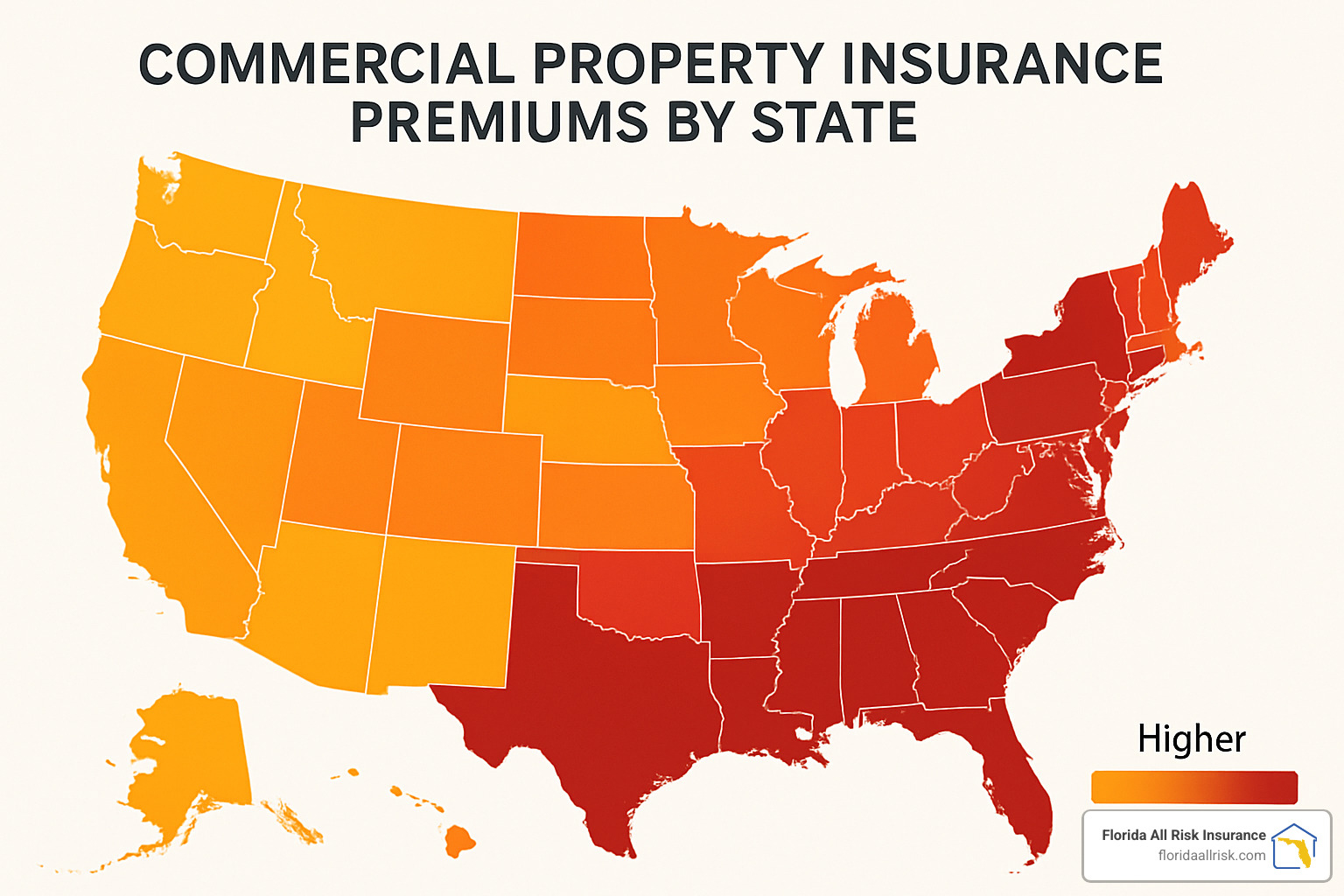
“When clients ask me what they’ll pay for commercial property coverage, my first response is always ‘it depends,'” says our senior underwriter at Florida All Risk Insurance. “Two seemingly identical buildings can have dramatically different premiums based on factors most owners never consider.”
Your property’s location plays perhaps the biggest role in determining your premium. Buildings in hurricane-prone coastal areas, flood zones, earthquake regions, or wildfire corridors naturally cost more to insure. Interestingly, while Florida’s hurricane exposure is significant, our state’s average premium of $1,159 actually runs lower than the national average. This pleasant surprise comes from our robust market of specialized regional carriers and the wide availability of mitigation credits for hurricane-resistant features.
The way your building is constructed significantly impacts your rates too. Insurance companies categorize buildings on a scale from Class 1 (wood frame) to Class 6 (highly fire-resistive materials like concrete and steel). As one property manager told me recently, “When we upgraded from a Class 2 to a Class 4 building, our premium dropped by almost 25%.”
What happens inside your building matters just as much as how it’s built. Office buildings typically enjoy the lowest rates, while restaurants (with their kitchen fire risks), manufacturing facilities (with machinery hazards), and chemical storage properties command substantially higher premiums. One strip mall owner shared, “My premium doubled when we leased a space to a restaurant instead of another retail shop.”
Your local fire department’s capabilities affect your rates more than you might think. The Insurance Services Office assigns every community a Public Protection Classification from 1 (excellent) to 10 (minimal). Buildings in areas with better ratings benefit from lower premiums, sometimes by as much as 30-40%.
Choosing your deductible level gives you direct control over your premium costs. Higher deductibles mean lower premiums but more out-of-pocket expenses when claims occur. In coastal areas like ours, percentage deductibles for wind damage (typically 1-5% of your insured value) have become standard. For a $1 million building, that means you could be responsible for up to $50,000 before insurance kicks in.
The premium differences between states might surprise you. Delaware currently holds the dubious honor of highest average commercial property premiums at $3,257, while Florida’s $1,159 seems like a bargain by comparison. However, this Florida figure often excludes separate windstorm coverage, which many property owners purchase separately through specialty carriers or Citizens Property Insurance Corporation.
Smart property owners can significantly reduce their premiums by qualifying for available credits:
Sprinkler systems can knock 5-15% off your premium while dramatically improving fire safety. Central station alarms connected to monitoring services typically save 2-10%. If you’ve invested in an impact-resistant roof, you could see a 5-20% reduction in your wind premium. Superior construction methods can reduce premiums by 10-30% compared to frame buildings. Bundling policies typically saves 10-15%, and maintaining a claims-free record for 3-5 years can earn you discounts of 5-25%.
“Many commercial property owners leave money on the table by not documenting their building’s protective features,” notes our claims specialist. “We recently helped a client identify over $3,000 in annual premium credits they weren’t receiving simply because their previous agent never documented their sprinkler system and alarm monitoring.”
At Florida All Risk Insurance, we work with you to identify every possible discount while ensuring you maintain the right coverage levels for your valuable commercial property.
Specialized Policies & Endorsements
When it comes to protecting your commercial real estate investments, sometimes a standard policy just doesn’t cut it. That’s where specialized coverage options come into play – they’re designed to address the unique challenges that different property types face.
Builders Risk Insurance has saved countless developers from financial disaster during construction projects. This specialized coverage protects your investment while a property is being built or undergoing major renovations – a time when standard policies typically won’t help you.
“When developing our mixed-use project in downtown St. Petersburg, builders risk coverage was essential,” one local developer told me recently. “When heavy rains damaged partially completed electrical work, the policy covered not only the direct repair costs but also the resulting construction delays.”
Builders risk specifically protects against threats like theft of building materials, damage to temporary structures, and even costs related to project delays. It’s absolutely essential if you’re breaking ground on a new development.
For property owners who lease entire buildings to tenants, Lessor’s Risk Only (LRO) Insurance provides custom protection. Rather than paying for coverages you don’t need, LRO focuses specifically on the landlord’s exposures – covering the building itself and your liability while excluding operational coverages that would be your tenant’s responsibility.
Empty buildings present their own unique challenges, which is why Vacant Property Insurance exists. Most standard policies severely restrict or completely drop coverage after a property sits vacant for 30-60 days. A specialized vacant property policy maintains essential protections against fire, vandalism, and liability while your building is between tenants or undergoing repositioning.
Do you have maintenance equipment that moves between properties? Inland Marine Insurance (despite its nautical-sounding name) covers movable property, equipment, and tools that don’t stay in one location. This fills a critical gap for investors with maintenance crews or mobile offices.
Modern buildings are filled with complex systems, making Equipment Breakdown Coverage increasingly important. Formerly called boiler and machinery insurance, this protection kicks in when mechanical or electrical failures affect your HVAC systems, elevators, electrical panels, or generators – often saving property owners tens of thousands in repair costs.
For older buildings, Ordinance and Law Coverage is particularly valuable. When a covered loss occurs, this endorsement addresses the increased costs of bringing your repaired or rebuilt property up to current building codes – expenses that standard policies typically exclude.
Building Insurance Commercial Lease
At Florida All Risk, we’ve seen how these specialized coverages have saved our clients from potentially devastating losses. The best commercial real estate insurance solution often includes a thoughtful combination of standard coverage and specialized endorsements custom to your specific property type and situation. We’ll help you identify exactly which coverages address your unique exposures without paying for unnecessary protection.
Claim Process Demystified
Let’s face it – filing an insurance claim is probably not on your list of favorite activities. But when disaster strikes your commercial property, understanding how the claim process works can make a world of difference in your recovery experience.
Think of it as a roadmap for when things go sideways. The journey begins the moment you find damage to your property. Prompt notice is absolutely critical – don’t wait! Contact your insurance carrier immediately, even if it’s just water seeping through a ceiling tile. I always tell my clients to document who they spoke with and get that all-important claim number right away.
“The biggest mistake I see property owners make is waiting too long to report damage,” explains our claims specialist at Florida All Risk. “What starts as a small water leak on Friday can become a major mold situation by Monday.”
Your next priority is emergency mitigation – taking reasonable steps to prevent further damage. This might mean placing tarps over a damaged roof, boarding up broken windows, or calling water extraction specialists. Keep every receipt from these emergency services since they’re typically reimbursable under your policy.
Photo documentation is your best friend during this process. Before you touch anything, grab your smartphone and capture the damage from multiple angles. These images become powerful evidence of your loss. Create detailed inventories of damaged contents, and whenever possible, preserve damaged items for the adjuster’s inspection. If you have maintenance records or pre-loss photos, gather those too – they can be incredibly helpful.
The adjuster’s inspection is a pivotal moment in your claim. This insurance representative will visit your property to assess the damage firsthand. I always recommend clients be present during this inspection if possible. The adjuster’s report carries significant weight in determining your settlement, so this is your opportunity to point out all damaged areas and provide your documentation.
For claims involving business interruption, you’ll need to complete a business interruption worksheet. This document helps calculate your financial losses during the recovery period. Be thorough in documenting:
– Your historical revenue and expenses
– Projected lost income during repairs
– Expenses that continue even while closed
– Extra costs incurred to maintain partial operations
When the insurer proposes a settlement amount, remember this isn’t necessarily the final word. If you believe certain damages were overlooked or undervalued, you can (and should) negotiate. Additional documentation or expert opinions can often support your position.
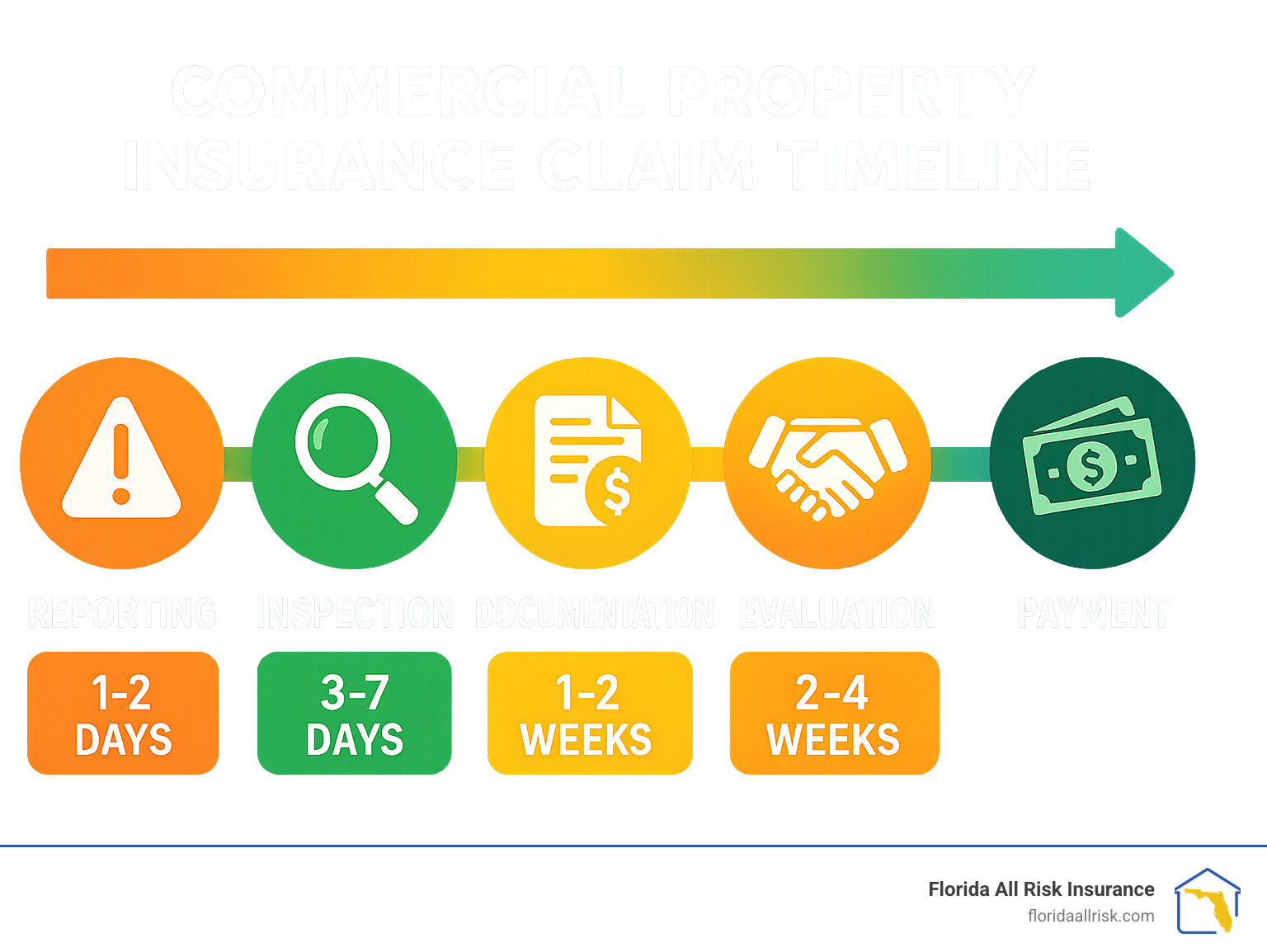
Understanding the difference between Actual Cash Value (ACV) and Replacement Cost Value (RCV) is crucial during settlement. With RCV coverage, insurers typically pay the depreciated value (ACV) initially, then provide the remaining amount when repairs are completed. This “holdback” approach ensures the funds are actually used for restoration rather than pocketed.
Even after repairs begin, stay vigilant. If contractors find additional damage during the restoration process, you can file a supplemental claim for these newly finded issues. Document everything immediately and notify your carrier before proceeding with these additional repairs.
If you disagree with the insurer’s offer, don’t just accept it and move on. Most policies provide a formal appeal process that may include requesting another inspection, providing additional documentation, or invoking the policy’s appraisal clause to resolve valuation disputes. Some situations may call for mediation or arbitration as specified in your policy.
“Having an advocate during the claims process can make a tremendous difference in the outcome,” notes one of our commercial property clients who recently steerd a complex fire claim. “My agent helped me document everything properly and communicate effectively with the adjusters, which ultimately led to a fair settlement.”
At Florida All Risk Insurance, we stand beside our clients throughout the entire claims journey, helping transform a potentially stressful experience into a manageable process with a fair resolution. The best commercial real estate insurance isn’t just about the policy you buy—it’s also about the support you receive when you need it most.
Money-Saving Tips Without Sacrificing Protection
Let’s face it—commercial property insurance can take a big bite out of your investment returns. But there’s good news: you don’t have to choose between quality coverage and affordable premiums. At Florida All Risk Insurance, we’ve helped countless property owners find that sweet spot where protection meets value.
Bundle your policies with a Business Owner’s Policy (BOP) and you’ll typically see your premiums drop by 10-15% compared to buying separate coverages. One of our clients, a small strip mall owner in Tampa, saved nearly $3,000 annually by bundling property and liability coverage. Beyond the savings, a BOP eliminates those dangerous gaps that can occur between standalone policies.
Modern safety systems not only protect your property—they protect your wallet too. Installing comprehensive sprinkler systems can reduce your premiums by 5-15%, while central station fire and burglar alarms might save you another 2-10%.
“My water leak detection system paid for itself in just two years through insurance savings alone,” shares one of our office building clients in St. Petersburg. “And that doesn’t even count the potential water damage it prevented during a holiday weekend when no one was around.”
Taking a thoughtful approach to deductible levels can significantly impact your premium without exposing you to excessive risk. Moving from a $1,000 to $5,000 deductible typically saves 10-20% on premiums, while a $10,000 deductible might reduce costs by up to 30%. The trick is finding the right balance—you’ll want a deductible you could comfortably cover if needed, but high enough to maximize your savings.
Don’t let your policy gather dust! Annual reviews often reveal opportunities for savings that weren’t available when you first purchased coverage. We recently helped a client identify outdated valuations on equipment that had been replaced with more fire-resistant models, resulting in an 8% premium reduction.
Property owners who document their commitment to safety often qualify for additional savings. A formal risk mitigation plan that outlines your approach to maintenance, emergency response procedures, and tenant screening can demonstrate to insurers that you’re a partner in risk reduction, not just a premium payer.
Many carriers offer loyalty rewards that grow more valuable over time. These might include diminishing deductibles (reducing by 20% each claim-free year), increasing claims-free credits, or renewal guarantees that provide peace of mind after isolated claims.
“Insurance savings isn’t about cutting corners—it’s about being strategic,” explains our commercial lines manager. “We recently helped a client with ten properties reduce their premium by 23% while actually improving their coverage. The secret was taking a holistic approach rather than just hunting for the cheapest quote.”
At Florida All Risk Insurance, we see premium reduction as an ongoing partnership. We work alongside our clients to develop multi-year strategies that progressively improve both their risk profile and insurance costs. The result? Robust protection for your valuable assets at a price that makes good business sense.
Frequently Asked Questions about Commercial Real Estate Insurance
What does commercial property insurance typically exclude?
When you purchase a commercial property policy, you might assume you’re covered for everything—but that’s not quite the case. Several important perils fall outside standard coverage:
Flood damage is perhaps the most significant exclusion. No matter how comprehensive your regular policy seems, rising water from any source—including storm surge after hurricanes—isn’t covered. In Florida, where flooding risks are substantial, you’ll need separate coverage through the National Flood Insurance Program or a private flood insurer.
Earthquake and earth movement damage requires separate protection too. This is especially relevant in Florida where sinkholes can threaten properties. While standard policies cover “catastrophic ground cover collapse,” this is much narrower than full sinkhole protection.
“Many of our clients are surprised to learn their policy doesn’t cover sinkholes until we explain the difference between catastrophic collapse and more common sinkhole damage,” explains our claims specialist at Florida All Risk Insurance.
Normal wear and tear isn’t covered either. Your insurer expects you to handle regular maintenance as a normal business expense. The same goes for intentional damage by the policyholder (though vandalism by others typically is covered).
Mold damage often comes with strict limitations—typically small sublimits between $10,000-$25,000 for cleanup. If your property is in a humid climate like Florida, you might want to consider additional coverage.
Terrorism coverage may be limited or excluded unless specifically added under the Terrorism Risk Insurance Act.
Code upgrade costs (officially called “ordinance or law expenses”) aren’t covered unless you add specific endorsements. This becomes particularly important for older buildings that would need significant upgrades to meet current building codes after a partial loss.
How do I value a mixed-use building for coverage?
Mixed-use properties—like those combining retail, office, and residential spaces—present unique valuation challenges. Here’s how to approach this complex task:
First, separate your valuations by occupancy type. A retail space has different construction costs and features than residential units above it. Calculate replacement costs for each section using appropriate data for that specific use.
Don’t forget to account for specialized features in each area. The commercial kitchen in a restaurant space, high-end security systems for retail areas, or amenities in residential sections all have different values and replacement costs.
“When we insured our downtown mixed-use building with ground-floor retail and upper-floor apartments, the most helpful approach was breaking it down by sections,” shares a St. Petersburg property owner. “Each area had unique characteristics that affected its insurance value.”
Consider the different income streams when calculating business interruption coverage. A retail tenant might recover quickly after damage, while restaurant spaces might take longer to restore.
Evaluate tenant improvements carefully. Document who owns which improvements—you or your tenants—to ensure proper coverage responsibility.
For truly complex mixed-use developments, professional appraisers with mixed-use experience provide the most accurate valuations. The investment in proper appraisal typically pays for itself by ensuring you’re neither overinsured (paying too much) nor underinsured (at risk during claims).
Do tenants need their own commercial property insurance?
Yes! Even when you have comprehensive coverage on your building, your tenants should maintain their own commercial property insurance. This creates a complementary protection system where each party covers what they’re responsible for.
Your landlord policy typically covers the building structure, major systems like HVAC and plumbing, common areas, permanently installed fixtures, and any property you use for building maintenance.
Your tenant’s policy should cover their leasehold improvements, business personal property (furniture, equipment, inventory), business income losses specific to their operations, and liability for damage they might cause to your property.
Clear lease agreements prevent coverage disputes. We recommend that your commercial leases require:
- Tenants to carry property insurance for their improvements and contents
- Liability insurance naming you (the landlord) as an additional insured
- Waiver of subrogation provisions to prevent insurance companies from suing either party
- Specific minimum coverage limits appropriate to each tenant’s operations
“The worst time to find unclear insurance responsibilities is after a loss,” notes our commercial specialist at Florida All Risk Insurance. “We recently helped resolve a dispute where a tenant’s malfunctioning refrigeration unit caused water damage to three adjacent spaces. The proper insurance requirements would have prevented months of disagreement.”
As your insurance partner, we help both landlords and tenants structure complementary insurance programs that provide comprehensive protection without expensive overlaps or dangerous gaps in coverage.
Conclusion
Securing the best commercial real estate insurance isn’t just about checking a box for your lender or meeting regulatory requirements. It’s about protecting what you’ve built—both the physical buildings and the financial future they represent.
Throughout this guide, we’ve explored insurance options from national carriers with massive resources to boutique regional providers with specialized knowledge. The right choice for your portfolio depends on your unique properties, risk tolerance, and management approach. There’s no one-size-fits-all solution when it comes to protecting commercial real estate investments.
At Florida All Risk Insurance, we pride ourselves on being your trusted partner in navigating these complex waters. As a St. Petersburg-based independent agency, we offer advantages you won’t find everywhere:
First, we maintain relationships with numerous A-rated insurance companies, giving us the flexibility to match your specific properties with carriers that actually want your business. Not every insurance company likes every type of property—we know which ones will offer the best terms for your particular situation.
Second, we truly understand Florida’s unique challenges. From hurricane exposure to flood zones to our state’s particular legal environment, local expertise matters tremendously in getting the right coverage at the right price.
Third, we take the time to know you and your investment strategy. Before recommending any policy, we want to understand your goals, your comfort with different types of risk, and your long-term plans for your properties.
Finally, when the unfortunate happens and you need to file a claim, we become your advocate. Having someone in your corner during the claims process can make a world of difference in how quickly and fairly your claim is settled.
The commercial property insurance landscape keeps changing. Weather patterns evolve, construction costs fluctuate, and new technologies transform both risks and protections. Working with a knowledgeable advisor ensures your coverage evolves alongside these shifts instead of becoming outdated.

Ready to make sure your commercial investments are properly protected? Reach out to our commercial team for a thorough portfolio review. We’ll look beyond the obvious to identify hidden risks and coverage gaps that could threaten your properties’ resilience when challenges arise.
More info about commercial property coverage
The best commercial real estate insurance isn’t necessarily what costs least—it’s what delivers the most value through appropriate coverage, reasonable deductibles, and responsive service when you need it most. By focusing on this total value rather than just the premium, you’ll build a protection strategy that truly supports your long-term investment success.