

Basic auto insurance Florida: 2025 Ultimate Protection
Why Florida’s Auto Insurance Requirements Are Different
Understanding basic auto insurance Florida requirements is essential, as they differ significantly from most other states. Florida operates under a unique “no-fault” system, a framework designed in the 1970s to streamline injury claims and reduce lawsuits. The core principle is that your own insurance pays for your initial medical bills up to your policy limit, regardless of who caused an accident. This is a stark contrast to the “tort” system used in most states, where the at-fault driver’s insurance is responsible for the injured party’s bills. While the no-fault system aims to provide swift medical payments, it often leads to confusion and can leave drivers dangerously underinsured.
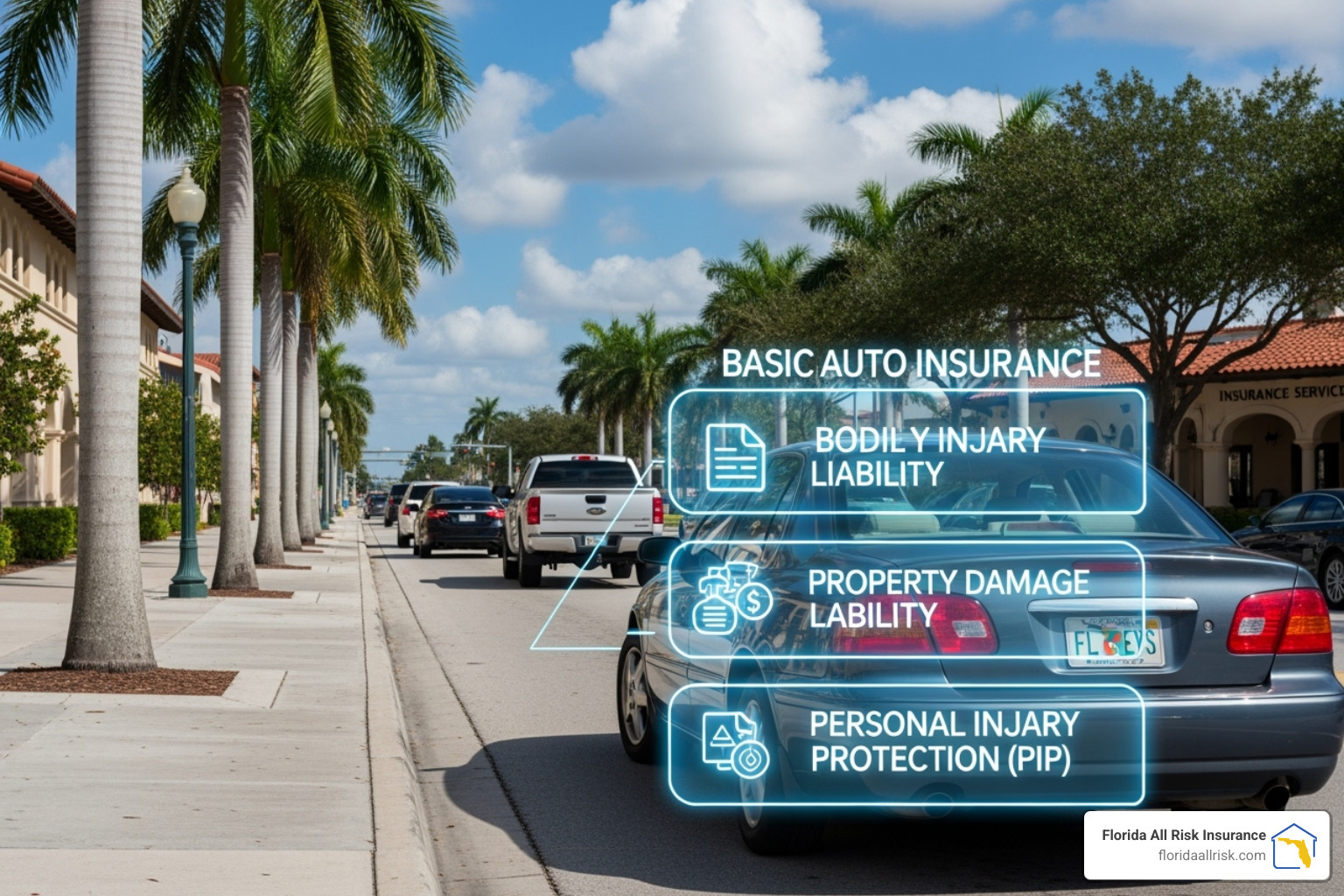
Florida law mandates that all registered vehicles carry:
- $10,000 in Personal Injury Protection (PIP) to cover your medical expenses.
- $10,000 in Property Damage Liability (PDL) to cover damage you cause to others’ property.
Notably, Bodily Injury (BI) Liability is not required for most drivers, a major departure from 47 other states. This omission, combined with Florida’s high insurance costs (averaging over $2,500 annually), makes choosing the right coverage critical. The state’s minimum limits were set decades ago and are grossly insufficient for modern accident costs. A minor fender-bender can easily cause more than $10,000 in damage to a new car, and a single trip to the emergency room can exhaust your PIP benefits, potentially leaving you liable for thousands of dollars. As experienced insurance professionals, we’ve seen that relying solely on the state minimum is a significant financial gamble.

Quick Basic auto insurance Florida terms:
- Liability car insurance Florida
- Uninsured motorist coverage Florida
- Affordable car insurance Florida
What is the Minimum Required Auto Insurance in Florida?
Florida’s “no-fault” auto insurance system means your own insurer is the first to pay for your medical bills after a crash, regardless of who was at fault. This approach is designed to provide immediate medical benefits without waiting for a lengthy fault determination. The core of basic auto insurance Florida requirements are two coverages, making it a “10/10” state:
- Personal Injury Protection (PIP): Minimum $10,000 coverage.
- Property Damage Liability (PDL): Minimum $10,000 coverage.
A crucial rule is the continuous coverage requirement. Any vehicle registered in Florida must remain insured, even if it’s not being driven or is inoperable. Allowing your policy to lapse without surrendering your license plates to a driver license office or tax collector’s office can lead to license and registration suspension for up to three years. For official details, you can visit the Florida Department of Highway Safety and Motor Vehicles website.
Understanding Personal Injury Protection (PIP)
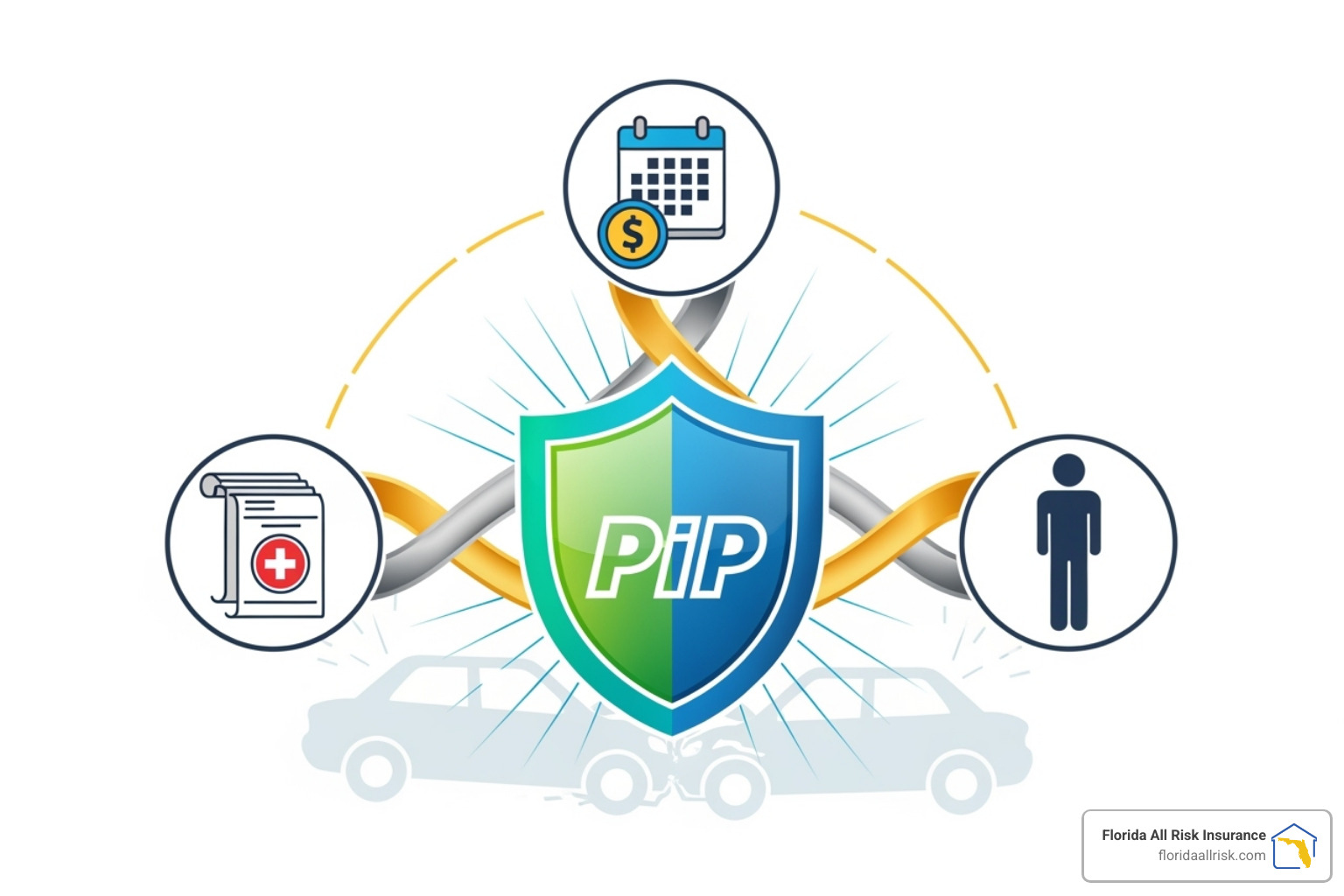
PIP is your primary medical coverage after an accident. It covers you, resident relatives, anyone driving your car with permission, and certain passengers who don’t have their own PIP. It pays for 80% of necessary medical expenses and 60% of lost wages up to your policy limit, typically $10,000. It also includes a $5,000 death benefit.
The 14-Day Rule and EMC: This is critical. You must seek initial medical treatment from a qualified provider within 14 days of an accident to be eligible for PIP benefits. Missing this deadline means you forfeit your right to coverage. Furthermore, to receive the full $10,000 benefit, a medical professional must diagnose you with an “Emergency Medical Condition” (EMC). If your condition is not deemed an EMC, your PIP benefits are capped at just $2,500. This makes prompt and proper medical evaluation essential. Since PIP only covers 80% of medical bills, you are responsible for the remaining 20% out of pocket unless you have additional coverage like Medical Payments (MedPay).
Understanding Property Damage Liability (PDL)
While PIP covers your injuries, PDL covers damage to other people’s property when you are at fault. This is fault-based coverage, meaning it only pays out if you are legally responsible for the damage. This includes damage to other vehicles, buildings, fences, mailboxes, landscaping, and other structures.
The $10,000 minimum limit is dangerously low in today’s world. The average new car costs well over $40,000, and even minor repairs involving modern sensors and cameras can easily exceed $10,000. If you cause an accident with $25,000 in damages, your PDL pays the first $10,000. The other driver’s insurance company will then sue you for the remaining $15,000. If you cannot pay, they can obtain a court judgment against you, leading to wage garnishment, bank account levies, and liens on your property. Because of this severe risk, most insurance professionals recommend carrying PDL limits of at least $50,000 or more.
Beyond the Basics: Optional Coverage for Real-World Protection
Florida’s minimum basic auto insurance Florida requirements of $10,000 for PIP and PDL are a starting point, not a destination. They can be exhausted quickly in a serious accident, leaving you exposed. This is where optional coverages become essential for true financial protection. These coverages fill the gaps left by the state minimums. Key options include:
- Bodily Injury Liability (BIL): Protects you from lawsuits if you injure someone.
- Collision and Comprehensive: Protect your own vehicle from damage.
- Uninsured Motorist (UM): Covers you when an at-fault driver has no or not enough insurance.
- Medical Payments (MedPay): Provides extra medical coverage beyond PIP.
Understanding these Auto Insurance Coverage Options is key to building a policy that provides real-world protection.
Is Bodily Injury Liability (BIL) Required?
Unlike 47 other states, Florida does not require most drivers to carry Bodily Injury Liability (BIL) coverage. BIL protects your assets by paying for another person’s medical bills, lost wages, and pain and suffering if you cause an accident that results in serious injury or death. Without it, you are personally responsible for these costs, which can be financially devastating. BIL is typically sold with split limits, such as $25,000/$50,000. This means the policy would pay up to $25,000 per injured person, with a maximum of $50,000 for all injuries in a single accident. BIL becomes mandatory under Florida’s Financial Responsibility Law if you are convicted of a DUI (requiring limits of at least $100,000/$300,000) or are involved in other serious incidents. This requires filing an SR-22 or FR-44 form with the state. Given the high frequency of injury claims in Florida, most insurance professionals strongly recommend carrying BIL even when it’s not legally required.
Protecting Your Own Vehicle: Collision and Comprehensive
PIP and PDL do not cover damage to your own car. That’s the job of Collision and Comprehensive coverage, often called “full coverage.”
- Collision coverage pays to repair or replace your vehicle after a crash, regardless of who is at fault. This includes hitting another car, an object like a guardrail, or a rollover.
- Comprehensive coverage handles non-collision events. In Florida, this is vital for protection against theft, vandalism, fire, flooding, hail, falling objects, and damage from hurricanes or hitting an animal.
If you finance or lease your vehicle, your lender will require you to have both coverages to protect their investment. When selecting these, you’ll choose a deductible (e.g., $500 or $1,000), which is the amount you pay out of pocket per claim before the insurance pays. A higher deductible lowers your premium, but you should ensure it’s an amount you can comfortably afford. Payments for a total loss are based on the vehicle’s Actual Cash Value (ACV), which is its market value just before the accident, not what you paid for it.
What if the Other Driver is Uninsured?

Florida has one of the highest rates of uninsured drivers in the U.S. (over 20%). If an uninsured or underinsured driver hits you, Uninsured/Underinsured Motorist (UM) coverage is your financial safeguard. It pays for your medical expenses, lost wages, and pain and suffering that exceed your PIP limits—costs the at-fault driver’s non-existent or insufficient BIL should have covered.
Florida law requires insurers to offer stacked UM coverage. This lets you combine the UM limits for all vehicles on your policy. For example, if you have two cars with $50,000/$100,000 in stacked UM, you effectively have $100,000/$200,000 in coverage if you’re hit. You can choose non-stacked UM, which limits coverage to the amount on the specific vehicle in the accident, but you must reject stacked coverage in writing. Given the risks, UM is a critical component of a robust Uninsured Motorist Coverage Florida plan.
Filling the Gaps with Medical Payments (MedPay)
Medical Payments (MedPay) is an optional but highly valuable coverage. It helps pay for medical expenses for you and your passengers after an accident, regardless of fault. Its primary benefit in Florida is that it can cover the 20% of medical bills that PIP doesn’t pay. It can also be used to pay your health insurance deductible. MedPay has no deductible or co-pay of its own. It provides first-dollar coverage up to the limit you select (typically $1,000 to $10,000). It also covers you if you’re injured as a pedestrian or cyclist.
Decoding the High Cost of Florida Car Insurance

If you’ve experienced sticker shock from a basic auto insurance Florida quote, you’re not alone. Florida consistently ranks among the most expensive states for car insurance, with average premiums significantly higher than the national average. Several factors contribute to these high costs: a high frequency of claims, severe weather events like hurricanes, widespread insurance fraud (especially involving PIP), high litigation rates, and the rising cost of vehicle repairs due to advanced technology. The state’s dense population and large number of tourists also contribute to more congested roads and a higher likelihood of accidents. You can learn more about what drives Florida Auto Insurance Rates.
Key Factors That Influence Your Premium
Your insurance rate is a personalized risk assessment. While you can’t change the statewide factors, you can influence the personal ones. Key factors include:
- Driving Record: Tickets, at-fault accidents, and DUIs are the biggest drivers of high premiums. A clean record is your best asset.
- Credit-Based Insurance Score: In Florida, insurers are permitted to use a credit-based score to help determine rates. A better credit history often leads to lower rates.
- Location: Your ZIP code matters. Insurers use “rating territories” based on claims data. Urban areas like Miami and Tampa typically have higher rates than rural ones due to more traffic and theft.
- Vehicle: The make, model, age, safety features, and even color of your car affect your premium. Sports cars cost more to insure than minivans due to higher repair costs and risk profiles.
- Personal Demographics: Your age, marital status, and years of driving experience play a role.
- Annual Mileage: The more you drive, the higher the risk of an accident. Driving less can often lead to lower costs.
- Coverage Choices: Higher limits (e.g., $100,000 PDL vs. $10,000) and lower deductibles increase your premium but offer more protection.
How to Save Money on Your Basic auto insurance Florida
Even with high statewide costs, there are effective ways to lower your premium without sacrificing essential coverage.
- Shop Around: Rates vary significantly between companies for the exact same coverage. An independent agent can compare quotes from multiple carriers to find the best value.
- Ask for Discounts: Always inquire about available discounts. Common ones include multi-policy (bundling auto with home), safe driver, good student, defensive driving courses, and discounts for anti-theft devices or professional affiliations.
- Adjust Your Deductibles: Raising your collision and comprehensive deductibles (e.g., from $500 to $1,000) can lower your premium. Just ensure you can afford the higher out-of-pocket cost in case of a claim.
- Maintain Good Credit: A strong credit history can lead to significant savings over time.
- Pay in Full: Paying your premium annually or semi-annually instead of in monthly installments can often save you money by avoiding service fees.
- Consider Usage-Based Insurance: Many insurers offer telematics programs that track your driving habits (like braking, speed, and time of day) through a mobile app or device. Safe drivers can earn substantial discounts.
We can help you find all the Best Car Insurance Discounts you qualify for.
The Rules of the Road: Registration, Penalties, and Special Cases
Having the right basic auto insurance Florida coverage is just the first step; you must also understand how it connects to vehicle registration and state laws to avoid penalties.
Vehicle Registration and Penalties
To register a vehicle with four or more wheels in Florida, you must first provide proof of Personal Injury Protection (PIP) and Property Damage Liability (PDL) coverage from an insurer licensed in Florida. Once registered, you must carry proof of insurance with you, which can be a physical card or an electronic version on your phone.
Florida enforces its insurance laws strictly. If you are caught driving without the required coverage or let your policy lapse, the state can suspend your driver’s license, license plate, and registration for up to three years. There are no hardship licenses for insurance-related suspensions. To get your license back, you must pay a reinstatement fee ($150 for the first offense, $250 for the second, and $500 for subsequent offenses within three years) and provide proof of new insurance, which may require an SR-22 or FR-44 filing. Beyond state penalties, you are personally liable for all damages in an at-fault accident if you’re uninsured.
Moving to or from Florida: What You Need to Know
Florida’s unique laws require special attention when moving.
- Moving to Florida: If you become a resident (e.g., start a job, enroll kids in school, register to vote), you have 10 days to get a Florida registration for your vehicle. This requires obtaining a Florida driver’s license and securing an auto policy that meets the state’s PIP and PDL requirements.
- Moving from Florida: You must surrender your Florida license plates before you cancel your Florida auto insurance. Canceling first will trigger a coverage lapse in the state’s system and lead to suspension and fines, even if you’ve already moved and registered your car elsewhere.
Understanding Key Terms and Self-Insurance
Navigating Florida insurance involves specific terms:
- A judgment is a court order requiring you to pay damages. If you can’t pay, your license can be suspended.
- An SR-22 is a certificate of financial responsibility filed by your insurer with the state. It’s often required after serious violations like driving without insurance or a DUI to prove you have coverage.
- An FR-44 is similar but specifically for DUI convictions. It requires much higher liability limits: $100,000 per person, $300,000 per accident for Bodily Injury, and $50,000 for Property Damage.
Florida also permits self-insurance for individuals or companies with a net worth of at least $40,000 who can post a surety bond and meet other strict criteria. However, this means you are personally responsible for all accident costs, a significant financial risk. More details are available on Florida’s self-insurance certificate information. For most people, traditional insurance offers far greater protection and peace of mind.
Your Rights and Resources for Basic auto insurance Florida
When dealing with basic auto insurance Florida issues, it’s important to know that state agencies are available to help. The Florida Department of Financial Services (DFS) assists consumers with complaints and questions, while the Florida Office of Insurance Regulation (OIR) oversees insurance companies and rates. The Florida Department of Highway Safety and Motor Vehicles (FLHSMV) handles licensing and registration.
| Issue Type | Best Resource |
|---|---|
| Consumer Complaints | Florida Department of Financial Services (DFS) – Division of Consumer Services |
| Agent/Agency Conduct | Florida Department of Financial Services (DFS) – Division of Consumer Services |
| Understanding Policy/Coverage | Florida Department of Financial Services (DFS) – Division of Consumer Services, Automobile Insurance Toolkit |
| Insurance Company Rates | Florida Office of Insurance Regulation (OIR) |
| Company Financial Health | Florida Office of Insurance Regulation (OIR) |
| Driver Licensing/Registration | Florida Department of Highway Safety and Motor Vehicles (FLHSMV) |
How to File a Complaint or Find Information
If you face a dispute with an insurer—such as a delayed or denied claim—you can file a complaint with the DFS. The DFS acts as a mediator to ensure companies comply with state law and also operates a statewide Consumer Services Helpline that can connect you with a specialist who will walk you through the process. One of the best resources is the state’s Automobile Insurance Toolkit, a comprehensive guide to Florida auto insurance. You can also verify an agent’s license on the DFS website to avoid fraud.
Understanding the Claims Process
Knowing the claims process helps you advocate for yourself. Key points to remember include:
- Report accidents promptly to your insurer to protect your right to coverage. Even a minor delay can complicate your claim.
- Insurers must act in good faith and respond promptly, though Florida law doesn’t set a specific deadline for settling auto claims. If you feel an insurer is unfairly delaying or denying your claim, this may constitute “bad faith.”
- Your insurer may request an Independent Medical Exam (IME) for PIP claims to verify your injuries and treatment are necessary and related to the accident.
- A vehicle may be declared a total loss if repair costs exceed about 80% of its actual cash value (ACV). You have the right to question the valuation and provide your own evidence of your car’s worth. If you have a loan, the settlement goes to the lender first; if you owe more than the car’s value, you are responsible for the difference unless you have Gap Insurance.
- You have the right to choose your repair shop. While insurers may recommend shops in their network, they cannot force you to use one.
- You must be informed if your insurer plans to use after-market parts for repairs instead of Original Equipment Manufacturer (OEM) parts.
Frequently Asked Questions about Basic Auto Insurance in Florida
Here are concise answers to the most common questions we hear about basic auto insurance Florida.
What happens if I get into an accident and only have basic PIP and PDL coverage?
If you only have minimum coverage and cause an accident, you face significant financial risk. Your $10,000 PDL will cover damage to the other party’s property up to that limit, but you are personally liable for any amount over that. Your $10,000 PIP covers 80% of your own medical bills (and only up to $2,500 without an EMC diagnosis). Crucially, you have no coverage for the other person’s injuries, leaving you exposed to a lawsuit for their medical bills, lost wages, and pain and suffering. You also have no coverage for damage to your own vehicle.
Is it illegal to drive without Bodily Injury Liability (BIL) in Florida?
For most drivers, it is not illegal to drive without BIL coverage, as Florida is one of only two states that doesn’t mandate it for everyone. However, BIL becomes mandatory if you are convicted of a DUI or found at fault in an accident causing injury. Driving without BIL is a major financial risk, as you would be personally responsible for severe injury claims that can amount to hundreds of thousands of dollars.
How can I prove I have car insurance during a traffic stop?
Florida law allows you to provide proof of insurance in two ways: you can show a physical insurance card issued by your insurer, or you can display an electronic version on your smartphone. Both are legally valid. Many drivers use their insurer’s mobile app for convenience. It’s a good idea to also save a screenshot of your digital card to your phone’s photos as a backup in case you don’t have cell service.
What is the difference between PIP and Medical Payments (MedPay)?
PIP is mandatory and covers 80% of your medical bills and 60% of lost wages, but it has limitations (14-day rule, EMC requirement). MedPay is optional, has no deductible, and can be used to cover the 20% gap left by PIP and other out-of-pocket medical costs. Think of it as a valuable supplement to PIP.
What is an SR-22 versus an FR-44?
Both are certificates of financial responsibility filed by your insurer with the state. An SR-22 is required for various serious violations (like driving without insurance) and proves you have at least the state minimum coverage. An FR-44 is specifically for DUI convictions and requires much higher liability limits ($100,000/$300,000/$50,000), making it more expensive.
How does a hurricane claim work for my car?
A hurricane claim for your car is typically handled under your Comprehensive coverage. This covers damage from flooding (storm surge), wind, and falling objects (like trees or debris). It does not cover damage if you drive into a flooded area after the storm. If your car is a total loss, the payout is based on its Actual Cash Value (ACV) right before the storm.
Conclusion: Driving Forward with Confidence
Navigating basic auto insurance Florida requires understanding that the state’s 10/10 PIP/PDL minimum is often inadequate for real-world accidents. Optional coverages like Bodily Injury Liability (BIL) and Uninsured Motorist (UM) are vital for protecting your financial future. By being an informed consumer, you can manage the high costs of Florida insurance and secure the right protection.
For drivers in St. Petersburg and across Florida, expert guidance can simplify this process. As an independent agency, Florida All Risk Insurance compares options from multiple carriers to find a policy that balances coverage and cost.
Explore your auto coverage options today and get a personalized quote!
Contact Us
Ready to find basic auto insurance Florida coverage that truly protects you? The team at Florida All Risk Insurance is here to help you steer the state’s unique requirements and find an affordable, comprehensive policy.
As an independent agency in St. Petersburg, we work for you, not the insurance companies. We provide personalized service and access to multiple carriers to find the best solution for your needs.
Get in touch with us today:
Florida All Risk Insurance
Saint Petersburg, FL
Phone: (727) 800-4740
Email: [email protected]

