

Auto insurance reviews Florida: 2025 Smart Savings
Why Florida’s Auto Insurance Market Is Unlike Anywhere Else
Auto insurance reviews Florida drivers rely on reveal a challenging landscape that’s uniquely complex and expensive. Florida drivers often pay significantly more for full coverage auto insurance than the national average. The state’s no-fault insurance laws, frequent severe weather, and a high rate of uninsured motorists create a perfect storm of factors that drive up costs and complicate coverage decisions.
The Sunshine State presents unique challenges that make shopping for auto insurance more critical than in most other states. Florida is one of only two states that doesn’t require bodily injury liability coverage, leaving drivers vulnerable to significant financial exposure. Add in the state’s hurricane risks, heavy tourist traffic, and a high uninsured motorist rate, and you quickly understand why careful research is essential.
Whether you’re a new resident or just looking for better value, understanding this market can save you money while ensuring you have adequate protection. I’m Jason Miller, and with over 20 years of experience, my team at Florida All Risk Insurance specializes in helping drivers find policies that balance comprehensive protection with competitive pricing.
Why is Car Insurance in Florida So Expensive?
If you’ve ever wondered why your Florida car insurance premium is so high, you’re not alone. Auto insurance reviews Florida drivers share consistently highlight cost as a major complaint. A unique and potent combination of factors creates a “perfect storm” for high premiums in the Sunshine State, making it one of the most expensive places in the country to insure a vehicle.
-
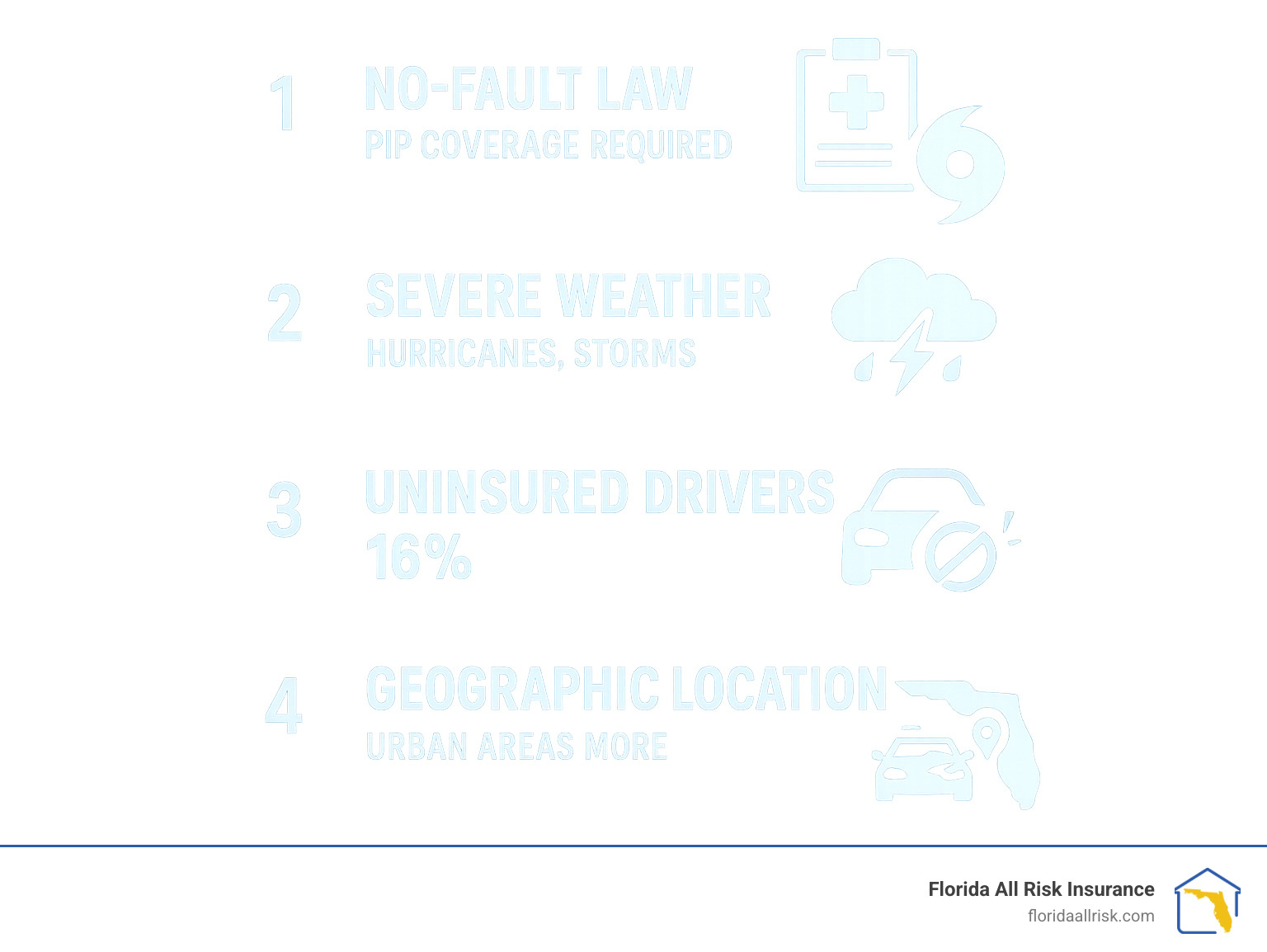
No-Fault System and Rampant Litigation: Florida’s no-fault law requires all drivers to carry Personal Injury Protection (PIP) to cover their own initial medical bills. While intended to speed up payments, this system has become a magnet for fraud and litigation. Dishonest medical clinics and attorneys exploit the system, leading to inflated claims. Furthermore, parties can still sue for significant injuries once a certain threshold is met, leading to high legal defense costs for insurers that are ultimately passed on to all consumers through higher premiums.
-
Severe and Frequent Weather: The state’s geography makes it exceptionally vulnerable to costly weather events. It’s not just the headline-grabbing hurricanes that cause billions in vehicle damage; it’s also the frequent, severe thunderstorms that bring hail and flash floods. Florida leads the nation in lightning strikes, and its low-lying coastal areas are increasingly susceptible to storm surge and tidal flooding. This high frequency of weather-related events leads to a massive volume of comprehensive claims, forcing insurers to price policies to account for these predictable, high-cost disasters.
-
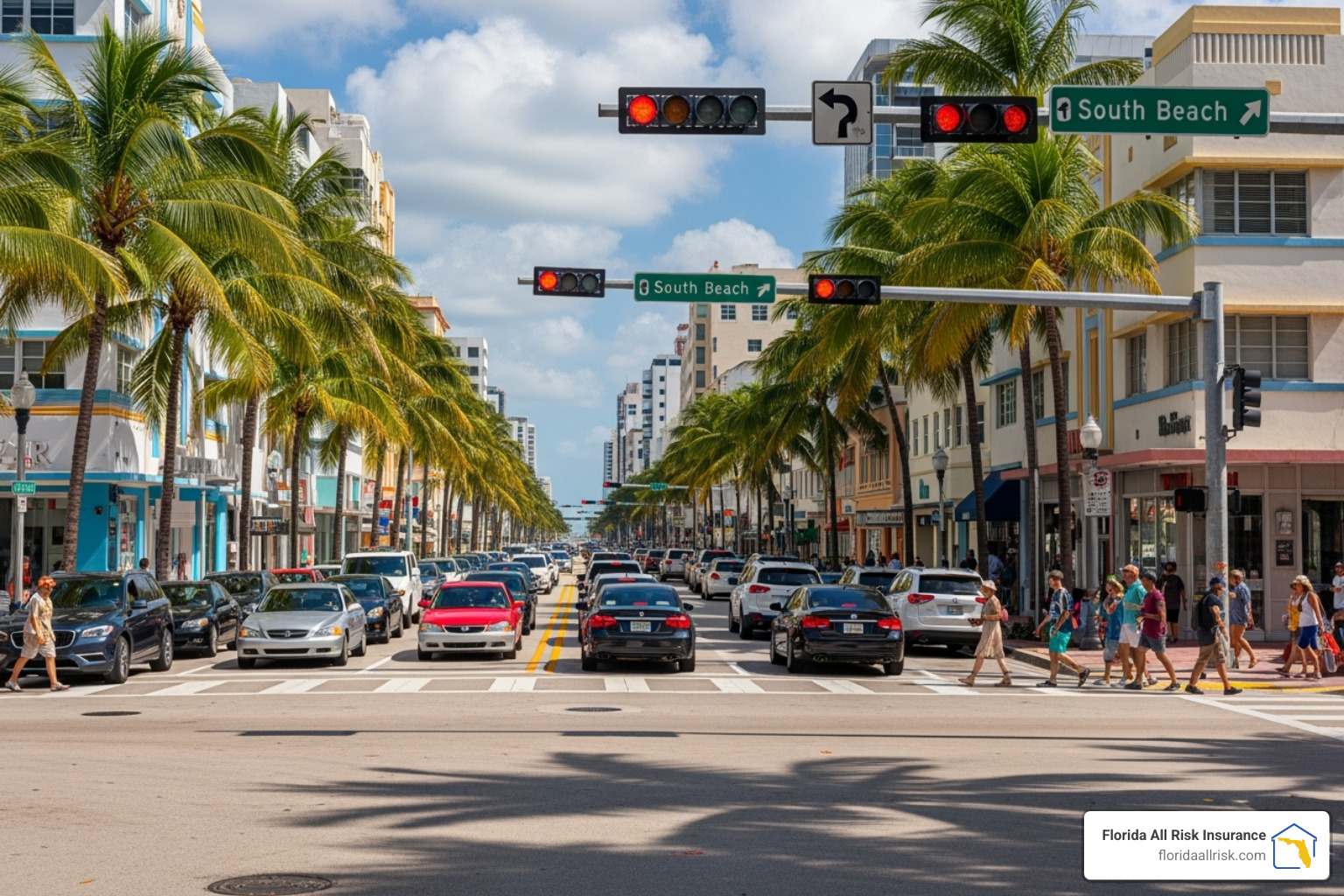
Population Density, Tourism, and Congestion: Florida is the third most populous state and a top global tourist destination. This results in incredibly congested roadways, particularly along the I-95, I-4, and I-75 corridors. The mix of local commuters, commercial trucks, seasonal residents (“snowbirds”), and tourists unfamiliar with the roads creates a high-risk environment with a greater frequency of accidents. Insurers must factor this liftd daily risk into their rates, especially in urban centers like Miami, Orlando, and Tampa.
-
A High Rate of Uninsured Drivers: With approximately 16% of Florida drivers operating vehicles without insurance, the financial burden falls on those who follow the law. When an insured driver is hit by an uninsured one, the insured driver’s own policy (specifically Uninsured Motorist coverage) must cover the costs. This creates a vicious cycle: high insurance costs lead some to risk driving uninsured, which in turn increases the risk for everyone else and drives premiums even higher.
-
Pervasive Fraud and High Theft Rates: Florida consistently ranks among the top states for vehicle theft, which directly increases the cost of comprehensive coverage. Beyond theft, the state battles organized insurance fraud on multiple fronts. This includes everything from staged accidents and inflated medical billing under PIP to the infamous widespread windshield replacement scams where contractors pressure drivers into unnecessary replacements. These fraudulent activities add billions to insurers’ costs, a burden that is distributed across all policyholders’ premiums.
Understanding these interconnected factors is the first step to navigating the market. They explain the high costs and underscore the critical importance of making smart coverage decisions to protect yourself on Florida’s uniquely challenging roads.
Understanding Florida’s Car Insurance Requirements
Navigating Florida’s car insurance laws can be confusing, and simply meeting the state minimums can leave you dangerously exposed. This section breaks down the legal necessities, explains what “no-fault” really means, and highlights the valuable optional coverages you need for comprehensive financial protection.
Florida’s Minimum Coverage: What You Need to Drive Legally
To register and operate a vehicle legally in Florida, you must maintain two types of coverage continuously:
- Personal Injury Protection (PIP): A minimum of $10,000. As the cornerstone of Florida’s no-fault system, PIP covers your own medical expenses and lost wages after an accident, regardless of who is at fault.
- Property Damage Liability (PDL): A minimum of $10,000. This covers damage you cause to another person’s property, such as their vehicle, a fence, or a building.
It is critical to maintain this coverage without any gaps. According to the Florida Department of Highway Safety and Motor Vehicles requirements, a lapse in coverage can result in the suspension of your driver’s license and vehicle registration, along with hefty reinstatement fees.
What “No-Fault” Insurance Really Means for You
“No-fault” means you turn to your own insurance company first to cover initial medical costs through your PIP coverage. This is designed to provide quick payment for injuries without waiting for a lengthy fault determination. However, the system has a major catch: the $10,000 PIP benefit is not guaranteed. Under Florida law, PIP will only cover 80% of medical bills and 60% of lost wages. Furthermore, unless a doctor, osteopath, dentist, or advanced registered nurse practitioner declares you have an “Emergency Medical Condition” (EMC), your PIP benefits are capped at just $2,500. A single emergency room visit can easily exceed this, leaving you responsible for the rest. For severe injuries, you can still pursue a claim against the at-fault driver, but this is where having your own robust coverage becomes vital.
Beyond the Basics: Optional Coverages for Real Protection
Florida’s minimum requirements are dangerously insufficient to protect you from significant financial risk. Auto insurance reviews Florida drivers post online are filled with cautionary tales from those who only carried minimum coverage. Consider these crucial optional coverages:
- Bodily Injury Liability (BIL): This is arguably the most important coverage you can buy. Since it’s not required, many drivers don’t have it. BIL protects your personal assets (your home, savings, and future wages) if you cause an accident that seriously injures or kills someone else. It covers their medical bills, lost income, and pain and suffering. Without it, you could face a lawsuit that leads to financial ruin.
- Uninsured/Underinsured Motorist (UM/UIM): With so many uninsured drivers in Florida, this coverage is essential. It protects you and your family if you’re hit by a driver with no insurance or not enough insurance to cover your medical expenses and lost wages.
- Stacked vs. Non-Stacked UM: If you insure multiple vehicles, you’ll be asked to choose between “stacked” and “non-stacked” UM. Stacked UM allows you to combine the coverage limits for each vehicle, providing a much higher total benefit for a slightly higher premium. Non-stacked coverage keeps the limits separate and is cheaper, but offers less protection.
- Collision: Covers the cost to repair or replace your own car after an accident with another vehicle or object (like a pole or tree), regardless of fault.
- Comprehensive: Covers non-collision events that are very common in Florida, such as theft, vandalism, fire, hail, flooding, hurricane damage, and hitting an animal.
- Medical Payments (MedPay): This optional coverage helps pay for medical expenses after PIP is exhausted. It can cover the 20% that PIP doesn’t, as well as health insurance deductibles and co-pays.
- Other Options: Rental reimbursement provides a rental car while yours is being repaired after a covered claim. Roadside assistance covers towing and labor for breakdowns. Gap insurance covers the difference between what you owe on a car loan and the car’s actual cash value if it’s totaled.
Decoding Your Premium: Factors That Influence Your Florida Car Insurance Rate
Insurance carriers use a complex algorithm with dozens of data points to calculate your premium, all designed to predict your likelihood of filing a claim. While auto insurance reviews Florida drivers share often focus on the final price, understanding what drives that price can empower you to take control of your costs. Here are the key elements that determine your rate in the Sunshine State.
Your Driving Profile and History
- Driving Record: This is the most significant factor you can control. A clean record with no at-fault accidents or moving violations will always result in the lowest rates. A single speeding ticket can raise your premium by 20% or more, while a major violation like a DUI or reckless driving conviction can double it and place you in a high-risk category for years.
- At-Fault Accidents: If you cause an accident, expect your rates to increase significantly at your next renewal. This surcharge typically remains on your policy for three to five years, as you are now statistically more likely to be in another accident.
- Age and Driving Experience: Statistics show that young, inexperienced drivers have the highest accident rates. Premiums are highest for teenagers and gradually decrease with age and a proven history of safe driving, with the most significant drops typically occurring around age 25.
- Marital Status: In many states, including Florida, married drivers often receive slightly lower rates. Actuarial data shows that married individuals tend to file fewer claims than their single counterparts.
Your Vehicle and Location
- Vehicle Make and Model: The car you drive matters. High-performance sports cars, luxury vehicles, and trucks with high repair costs or theft rates are more expensive to insure. Conversely, a modest sedan with a good safety rating and inexpensive parts will cost less to cover.
- Your ZIP Code: Location is a primary rating factor. Premiums vary dramatically across Florida. Urban areas with high population density, more traffic congestion, and higher rates of accidents, theft, and fraud (like Miami, Hialeah, or Tampa) will always have higher base rates than quieter, rural areas or retirement communities.
- Annual Mileage: The less you drive, the lower your risk of an accident. If you have a short commute, work from home, or are a retiree, you may qualify for a low-mileage discount.
Your Policy and Financial Choices
- Coverage Limits and Deductibles: The amount of coverage you choose directly impacts your premium. Opting for higher liability limits (e.g., $100,000/$300,000 for Bodily Injury) will cost more than the state minimum but provides critical financial protection. Choosing a higher deductible for Collision and Comprehensive coverage (e.g., $1,000 instead of $500) will lower your premium, but you must be able to comfortably pay that amount out-of-pocket if you file a claim.
- Credit-Based Insurance Score: In Florida, insurers are permitted to use a credit-based insurance score to help determine rates. This is not the same as your FICO score, but it is derived from your credit history. Statistical data indicates a correlation between how a person manages their financial affairs and their likelihood of filing claims. A better score can lead to a significantly lower premium.
- Continuous Insurance Coverage: Maintaining insurance without any lapses is crucial. A gap in your coverage, even for a few days, signals higher risk to insurers and will almost always result in more expensive premiums when you purchase a new policy.

Understanding these factors empowers you to manage your insurance costs by maintaining a clean record, choosing your vehicle wisely, and making informed policy and financial decisions.
Top Strategies for Saving Money on Your Florida Auto Policy
While Florida’s auto insurance premiums are undeniably high, there are numerous proven ways to lower your costs without sacrificing essential protection. Auto insurance reviews Florida drivers share consistently show that the savviest customers are proactive and take advantage of every available opportunity to save. Combining smart shopping with responsible habits is key.
Smart Shopping and Policy Management
- Shop Around Annually: This is the single most effective way to save money. Insurance rates are not static; they change constantly. The company that was cheapest for you last year may not be competitive this year. Get quotes from multiple carriers at least once a year, or whenever you have a major life change (move, buy a new car, get married).
- Bundle Your Policies: If you are a homeowner or renter, bundling your auto and home or renters insurance with the same provider is one of the easiest ways to get a significant discount, often between 10% and 25%.
- Pay in Full or Use EFT: If your budget allows, paying your six-month or annual premium in one lump sum can help you avoid monthly installment fees. Many companies also offer a small discount for setting up automatic payments from your bank account (EFT).
- Review Your Coverage Periodically: Don’t just set and forget your policy. As your car ages, its value depreciates. If you have an older car that is paid off and worth only a few thousand dollars, it may no longer be cost-effective to pay for full coverage (Collision and Comprehensive). Compare the annual cost of this coverage to your car’s value to make an informed decision.
Discounts and Driving Habits
- Maintain a Clean Driving Record: This is the foundation of low rates. Avoiding accidents, speeding tickets, and other traffic violations is the best long-term strategy for keeping your premiums down.
- Ask About All Available Discounts: You won’t get a discount you don’t ask for. Inquire about every possible price break, including:
- Good student (for young drivers with a “B” average or better)
- Defensive driving course completion
- Vehicle safety features (anti-lock brakes, airbags, daytime running lights)
- Anti-theft devices (car alarms, tracking systems)
- Professional affiliations or alumni groups
- Paperless billing
- Consider Telematics (Usage-Based Insurance): If you are a safe and low-mileage driver, a telematics program could save you up to 40%. These programs use a smartphone app or a small device plugged into your car to track your driving habits (like hard braking, rapid acceleration, mileage, and time of day). Good driving behavior is rewarded with substantial discounts.
- Choose a Higher Deductible: As mentioned earlier, increasing your comprehensive and collision deductible from a standard $500 to $1,000 or more will immediately lower your premium. Just be certain you have the higher amount saved and accessible in case you need to file a claim.
- Improve Your Credit Score: Since insurers in Florida use a credit-based insurance score, taking steps to improve your credit over time can lead to lower premiums in the long run.

By proactively combining these strategies, you can take meaningful control over your insurance costs and make Florida’s high premiums much more manageable.
How to Approach Auto Insurance Reviews Florida Drivers Can Trust
When you dive into auto insurance reviews Florida drivers share, the volume of opinions can be overwhelming. Choosing the right provider isn’t just about the cheapest price; it’s about finding a partner who will be there when you need them. Here’s a framework for evaluating insurers.
Looking Beyond the Price Tag: What to Look for in a Provider
A low premium is meaningless if the insurer fails you during a claim. Look for these key qualities:
- Financial Stability: Check ratings from A.M. Best to ensure the company is financially sound and can pay claims, especially after a major event like a hurricane.
- Customer Service and Claims Process: How does the company treat its customers? Reviews that mention a fast, fair, and straightforward claims process are a strong positive indicator. Good service is crucial when you’re stressed after an accident.
- Digital Tools: A user-friendly mobile app for managing your policy, paying bills, and filing claims can add significant convenience.
- Local Agents: While digital tools are great, the personalized advice and support of a local agent who understands the Florida market can be invaluable.
Understanding Customer Satisfaction and Complaint Data
To get a clear picture, use objective data alongside personal reviews:
- J.D. Power Ratings: These annual surveys provide a comprehensive look at customer satisfaction across pricing, billing, claims, and service.
- NAIC Complaint Index: The National Association of Insurance Commissioners (NAIC) complaint index shows how many complaints a company receives relative to its size. A score below 1.0 is better than average.
- Reading Reviews Critically: Look for trends, not isolated horror stories. If many reviews mention the same problem (e.g., slow claims), it’s a red flag. Pay close attention to feedback about the claims experience.
The Value of an Independent Agent for Your Auto Insurance Reviews Florida
Working with an independent agent can simplify your search for the right coverage. Unlike a captive agent who works for a single company, an independent agent represents multiple carriers.
An independent agent, like our team at Florida All Risk Insurance, offers several advantages:
- Access to More Options: We shop the market for you, comparing rates and coverages from numerous companies to find the best fit.
- Personalized, Unbiased Advice: Our loyalty is to you, not an insurance company. We provide advice custom to your specific needs and budget.
- Local Expertise: As a St. Petersburg agency, we have deep knowledge of the Florida market and know which carriers perform well in our state.
- Claims Assistance: If you need to file a claim, we act as your advocate, guiding you through the process. This support can make a stressful situation much more manageable.
Frequently Asked Questions About Florida Auto Insurance
Florida’s unique and often confusing insurance landscape generates many questions. Here are straight, detailed answers to some of the most common queries we hear from drivers in the Sunshine State.
What is the average cost of car insurance in Florida?
On average, Florida drivers pay around $4,210 per year for full coverage and about $1,136 per year for minimum coverage. However, these are just statewide averages. Your actual rate will depend heavily on your specific location (Miami will be far more expensive than a rural town), driving record, vehicle type, coverage choices, credit history, and more. It’s not uncommon for quotes for the same driver to vary by thousands of dollars between carriers, which is why shopping around is so critical. Auto insurance reviews Florida drivers share often highlight these significant price differences.
Do I need more than the state minimum coverage in Florida?
Yes, absolutely. Relying solely on Florida’s minimum coverage is one of the biggest financial risks a person can take. The required $10,000 for PIP and $10,000 for property damage can be exhausted in even a minor-to-moderate accident. Most importantly, Florida does not require bodily injury liability coverage. This means if you cause an accident that injures someone, you are personally responsible for their medical bills, lost wages, and pain and suffering. This can easily lead to a lawsuit that puts your assets, home, savings, and future earnings at risk. Buying adequate liability coverage is about protecting your financial future, not just meeting the legal minimum to drive.
Can I get car insurance in Florida with a bad driving record?
Yes, but it will be more expensive and may require extra steps. If you have multiple accidents or violations, insurers will classify you as a high-risk driver. For serious violations like a DUI, you will be required by the state to file an FR-44 form, which certifies that you carry liability limits much higher than the standard requirements. For other violations, you might need an SR-22. While many standard insurers may decline to cover you, some companies specialize in high-risk or “non-standard” insurance. An independent agent is an excellent resource for finding these carriers. Over time, as you maintain a clean driving record for three to five years, your rates will improve significantly.
How does a hurricane affect my car insurance?
Once a tropical storm or hurricane watch/warning is issued for your area, insurance companies will place a “binding restriction” on new policies and coverage changes. This means you cannot purchase new comprehensive coverage or lower your deductibles to protect your car from the incoming storm. This is why it is essential to review your policy and ensure you have comprehensive coverage before hurricane season begins on June 1st. If your car is damaged by flooding, wind, or falling objects during the storm, the claim would be filed under your comprehensive coverage.
Will my rates go up if I file a claim for a cracked windshield?
In Florida, state law requires insurers to waive the deductible for windshield repairs or replacements if you have comprehensive coverage. While this means you won’t have an out-of-pocket cost for the repair itself, it doesn’t mean it’s entirely “free.” The rampant fraud associated with this law has dramatically increased costs for insurers, which they pass on to all customers through higher comprehensive premiums. While a single windshield claim is unlikely to raise your individual rates, the widespread use (and abuse) of this benefit contributes to why everyone’s rates in Florida are so high.
Conclusion: Securing Your Peace of Mind on Florida’s Roads
Navigating Florida’s auto insurance market can feel like a labyrinth, with its unique no-fault laws, high costs, and susceptibility to severe weather. However, by understanding the factors that influence your rates, knowing what coverage truly protects you, and employing smart shopping strategies, you can transform this challenge into an opportunity to secure comprehensive, yet affordable, protection.
The right policy isn’t just about finding the lowest price; it’s about finding the best value – a balance of adequate coverage, reliable customer service, and efficient claims handling, all at a competitive premium. It’s about securing your peace of mind on Florida’s busy roads.
As an independent agency, our team at Florida All Risk Insurance is dedicated to helping you steer these choices to find a policy that fits your life and budget. We’re here to offer personalized advice, compare options from a wide range of carriers, and ensure you’re adequately protected, so you can enjoy the Sunshine State with confidence.
Find the right auto coverage for you.
Contact Us
Florida All Risk Insurance
Address: Saint Petersburg, FL

