
Auto Insurance for Young Drivers in Florida

Understanding how to protect a brand-new driver without breaking the family budget can feel overwhelming. The purpose of this guide is to explain the process, walk you through the real-world numbers, and share proven strategies that Florida families can use to keep both premiums and stress to a minimum.
Florida’s auto insurance landscape is notoriously complex, creating a perfect storm of high costs. Our no-fault system requires every driver to carry Personal Injury Protection (PIP), but it doesn’t mandate Bodily Injury Liability—a crucial coverage that protects you financially if you injure someone else. Compounding this risk is the fact that Florida has one of the highest rates of uninsured drivers in the nation, with some estimates suggesting over 20% of motorists are on the road without proper coverage. Then there are the unique environmental risks; from the sudden, torrential downpours that cause flash floods to the annual threat of hurricanes, the potential for non-accident-related vehicle damage is exceptionally high. Add a 16-year-old with a freshly printed license to this mix and, suddenly, the stakes for having robust, comprehensive coverage become even higher.
Reading tip: If you’re short on time, skim the “Ultimate Guide to Lowering Costs” section first. It contains a quick checklist you can start using today.
Why Young Drivers Face Higher Insurance Costs

Auto insurance for young drivers is significantly more expensive than coverage for experienced drivers. Understanding the reasons behind these high costs can help families make informed decisions about protection and savings.
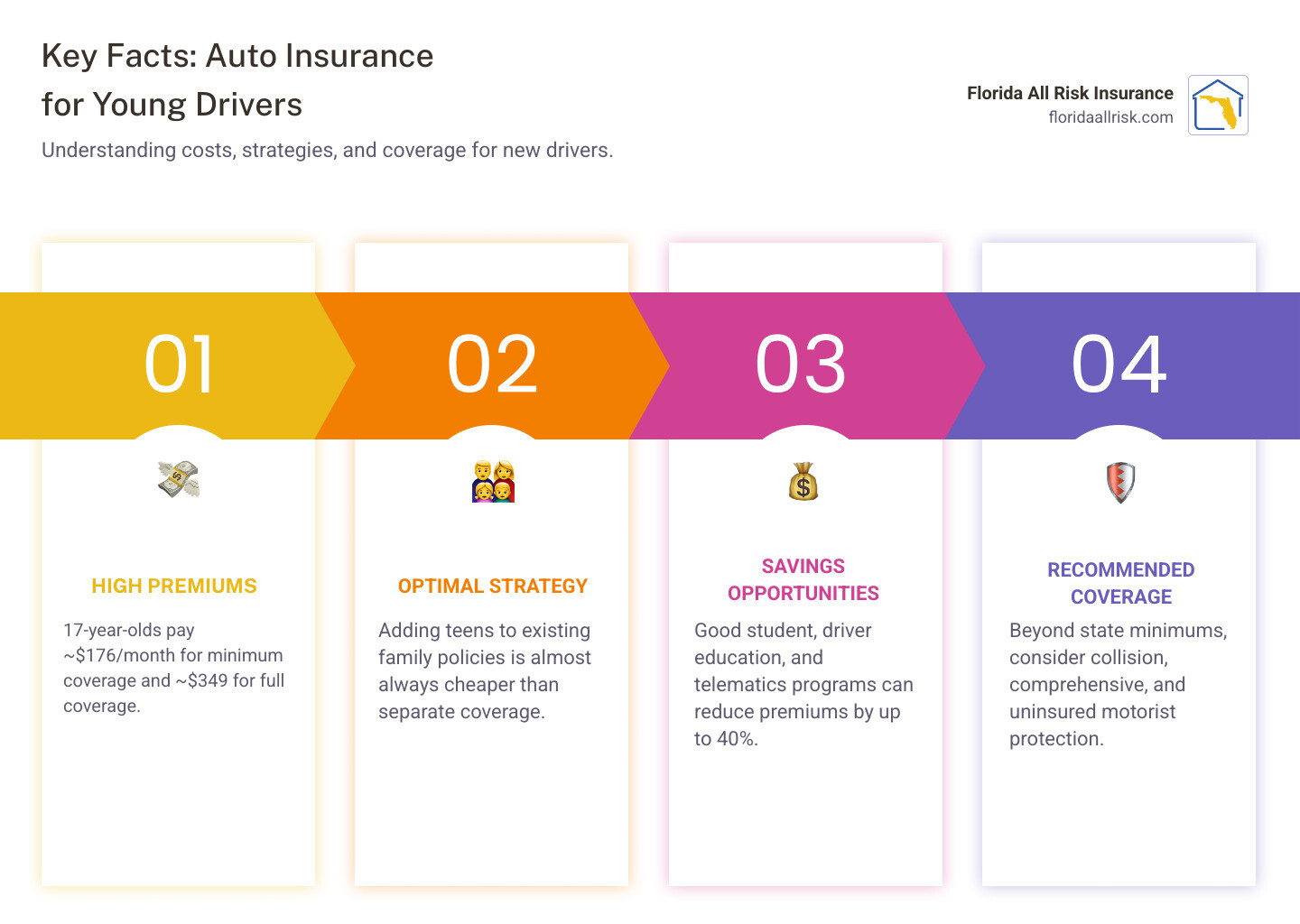
Quick Facts on Young Driver Insurance:
- Average Cost: A 17-year-old may pay around $176 monthly for minimum coverage or $349 for full coverage.
- Best Strategy: Add teens to a family policy instead of getting separate coverage.
- Key Savings: Discounts for good grades, driver education, and telematics can lower premiums significantly.
- Essential Coverage: Consider collision, comprehensive, and uninsured motorist protection beyond state minimums.
The statistics tell a clear story. According to the CDC, motor vehicle crashes are the leading cause of death for U.S. teens. Drivers aged 16 to 19 have higher rates of accidents and violations, with fatal crashes occurring nearly three times more often per mile driven than for older drivers. This lack of experience translates directly into higher premiums, sometimes increasing a family’s insurance costs by 30% or more when adding a teen driver.
Several factors influence these costs beyond age. Your teen’s grades, the type of vehicle they drive, your location in Florida, and the coverage levels you choose all play important roles. The good news is that rates typically decrease as teens gain experience and demonstrate safe driving habits.
I’m Jason Miller, and with over 20 years of experience helping Florida families steer auto insurance for young drivers, I’ve seen how the right approach can make coverage both affordable and comprehensive. My team at Florida All Risk Insurance specializes in finding competitive rates while ensuring your new driver has the protection they need.
Auto insurance for young drivers helpful reading:
Why Are Premiums So High for Young Drivers?

Parents are often shocked by the high cost of insuring a teen driver, but the reason is simple: risk. Insurance companies aren’t being unfair to teenagers; they are pricing policies based on statistics that show young drivers are far more likely to be involved in accidents than experienced drivers.
The Statistical Risk of Inexperience
Insurance companies view teen drivers as high-risk, and the data supports this. Accident and violation rates are highest among the 16-19 age group. This isn’t because teens are intentionally reckless, but because they lack the behind-the-wheel time to develop the judgment that comes with experience.
This isn’t just about a lack of practice; it’s rooted in biology. The part of the brain responsible for rational decision-making, impulse control, and assessing long-term consequences—the prefrontal cortex—doesn’t fully mature until the mid-twenties. This developmental stage means teenagers are more prone to underestimating dangerous situations, succumbing to peer pressure, and getting distracted by a text message or friends in the car. Insurers are not just pricing for a lack of driving skill; they are pricing for a scientifically-backed, higher propensity for risk-taking behavior.
When unexpected situations arise, experienced drivers have a mental database of similar scenarios to draw from, while new drivers are often encountering them for the first time. The statistics are sobering: according to the IIHS, teens aged 16-19 are nearly three times more likely per mile driven than drivers aged 20 and older to be in a fatal crash. Furthermore, at-fault accident rates for teens are about 30% higher than for older drivers, meaning the insurer is more likely to pay out claims.
Key Factors That Influence Your Teen’s Insurance Rate
While inexperience is the biggest factor, several other elements influence the cost of auto insurance for young drivers:
- Location: Florida has unique insurance laws and higher accident rates in metro areas like St. Petersburg. For more details, see Auto Insurance Rates Florida.
- Age: The younger the driver, the higher the rate. Premiums are based on data showing accident frequency decreases with each year of age and experience.
- Gender: Statistically, young males have higher accident rates, which can lead to slightly higher premiums.
- Vehicle Type: This is a factor you can control. Safer, modest vehicles cost less to insure than sports or luxury cars.
- Coverage Levels: Higher coverage means higher premiums but also better protection against the high costs of a serious accident.
- Annual Mileage: More time on the road increases risk, so some insurers offer discounts for lower mileage.
- Driving Record: Tickets and at-fault accidents will raise rates significantly.
- Credit Score: On family policies, the parent’s credit-based insurance score can affect the premium.
- Policy Structure: Adding a teen to an existing family policy is almost always cheaper than a separate one.
Will Rates Decrease Over Time?
The good news is that auto insurance for young drivers gets cheaper over time. As drivers gain experience and maintain a clean record, rates will fall.
- Age Milestones: Rates typically drop at ages 19, 21, and especially 25, when drivers are no longer considered part of the highest-risk group.
- Experience: Every year your teen drives without an accident or ticket helps build a positive driving history, which insurers reward with lower rates.
- Good Driver Rewards: Many insurers offer discounts for maintaining a clean record for a specific period, such as three or five years.
Safe driving habits are a long-term investment. A clean record established early can lead to rates dropping by 50% or more by the time a driver reaches their mid-twenties.
The Ultimate Guide to Lowering Auto Insurance for Young Drivers

While initial quotes for auto insurance for young drivers can be high, there are many effective ways to save. The key is being proactive and informed. From your teen’s report card to the car in your driveway, nearly every choice can impact your premium.
Strategy 1: Leverage Florida’s Graduated Driver Licensing (GDL) Laws
Florida’s GDL program is designed to help teens gain driving experience under lower-risk conditions. Understanding and strictly enforcing these rules is not just a legal requirement; it’s a powerful signal to insurers that your family prioritizes safety. The program has three stages:
- Learner’s License (Permit) Stage: At age 15, teens can get a learner’s permit after passing vision and knowledge exams. They must always be accompanied by a licensed driver at least 21 years old in the front passenger seat. For the first three months, driving is limited to daylight hours. After that, they can drive until 10 p.m.
- Intermediate License Stage (Ages 16-17): After holding a permit for one year without any convictions, a 16-year-old can get an intermediate license. This allows for unsupervised driving, but with strict limitations. 16-year-olds cannot drive between 11 p.m. and 6 a.m. unless accompanied by a 21+ licensed driver or driving to/from work. For 17-year-olds, the restriction is between 1 a.m. and 5 a.m. Passenger restrictions also apply and are a key factor in reducing distracted driving accidents.
- Full Privilege License (Age 18+): At 18, GDL restrictions are lifted, and the driver has a full, unrestricted license.
Adhering to these GDL laws is a foundational step in building a safe driving record, which is the single most important factor in lowering insurance rates over time.
Strategy 2: Maximize Every Available Discount
Insurance discounts are often overlooked, but they can lead to significant savings. Some combinations can reduce premiums by up to 40%.
- Good Student Discount: If your teen maintains a B average (3.0 GPA) or higher, insurers see them as more responsible, which can earn you a discount of up to 15%.
- Driver Education Courses: Approved driver’s ed and defensive driving courses not only make your teen safer but can also lower your rates.
- Telematics Programs: These usage-based programs track driving habits via a smartphone app or a small device plugged into the car. The technology uses GPS and accelerometers to monitor behaviors like hard braking, rapid acceleration, speeding, and time of day. Safe driving is rewarded with significant discounts, with some drivers saving 20% or more. It also provides a great coaching tool for parents to review driving performance with their teen.
- Bundling: Combining your auto insurance with homeowners or renters policies for a multi-policy discount is a simple way to save.
- Multi-Car Discount: Insuring multiple vehicles on one policy provides substantial savings and is another reason to add your teen to your family policy.
- Anti-Theft Devices: Alarms or tracking systems can earn you a modest discount.
For more information, check out Florida Car Insurance Discounts and Best Car Insurance Discounts.
Strategy 3: Make Smart Policy Decisions
How you structure your policy can have a huge impact on your budget.
The golden rule is to add your teen to your family policy. This is usually the difference between affordable coverage and financial stress. Your teen benefits from your driving history, credit score, and existing discounts. While a 17-year-old might pay around $176 monthly for minimum coverage on their own, adding them to a family policy typically costs far less. A separate policy only makes sense in rare cases, such as if the teen drives a luxury vehicle or if parents have serious driving violations.
Adjusting your coverage provides another way to save. Raising your deductibles can lower monthly premiums, but ensure you can cover the higher out-of-pocket cost if an accident occurs. For older, less valuable cars, you might consider dropping collision and comprehensive coverage.
Finally, comparing quotes from multiple insurers is crucial. As an independent agency, we handle this for you, accessing multiple carriers to find the best balance of coverage and cost. For more details, see Cheap Auto Insurance Quotes Florida and Auto Insurance Deductible Options.
Strategy 4: The Critical Role of Vehicle Choice and Driving Habits
The car your teen drives and how they drive it are foundational to their insurance costs.
Vehicle selection is where parents have significant control. Cars with high safety ratings and advanced safety features cost less to insure. On the other hand, sports cars and luxury vehicles are budget-killers due to high repair costs and their association with riskier driving. Older, reliable vehicles with a lower market value are your best bet for keeping premiums manageable.
Safe driving habits are the best long-term strategy. A parent-teen driving contract is an excellent tool to set clear expectations. Key points to include are:
- GDL Compliance: A pledge to strictly follow all state-mandated curfew and passenger restrictions.
- Zero Distractions: An absolute ban on using a cell phone (hand-held or hands-free) while driving. Set rules for interacting with the radio or navigation.
- Financial Responsibility: An agreement on who pays for tickets, deductibles, or any premium increase after a violation or at-fault accident.
- Academic Standards: Tying driving privileges to maintaining good grades, linking back to the Good Student Discount.
- Impairment Rules: A zero-tolerance policy for driving under the influence of alcohol, drugs, or even when overly tired.
Every safe mile your teen drives is an investment in their future insurance rates. For more safety resources, visit IIHS Teen Driver Info.
Choosing the Right Coverage for Your Teen Driver

When insuring a young driver, it’s tempting to choose the cheapest option. However, minimum coverage may not adequately protect your family’s financial future in a serious accident. Understanding your options is key to balancing affordability with real protection.
Understanding Basic vs. Recommended Auto Insurance for Young Drivers
Florida’s state minimums are just a starting point. Legally, you must carry Personal Injury Protection (PIP), which covers your own medical expenses, and Property Damage Liability (PDL), which covers damage you cause to someone else’s property. Notably, Florida doesn’t require Bodily Injury Liability (BIL) for all drivers. This is a critical gap, as you could be held personally responsible for injuries you cause in an accident without it. For more details, see Liability Car Insurance Florida.
Why Minimums May Not Be Enough
Serious accidents can easily exceed minimum coverage limits, leaving families financially exposed. Imagine your teen accidentally runs a red light in a busy St. Petersburg intersection, causing a three-car accident. The damage to the other two vehicles is $15,000 and $25,000 respectively. Your $10,000 PDL limit is exhausted almost immediately, leaving you personally liable for the remaining $30,000 in property damage. Now, imagine one of the other drivers was seriously injured. Without Bodily Injury Liability coverage, their medical bills, lost wages, and potential lawsuit could put your family’s home, savings, and future earnings at risk. State minimums also don’t cover damage to your own vehicle if your teen is at fault, which could be a devastating out-of-pocket expense.
Essential Coverages to Consider for Maximum Protection
These coverages can be the difference between a manageable incident and a financial disaster:
- Collision Coverage: Pays for damage to your car from an accident with another vehicle or object, regardless of fault. This is essential if your teen’s car has significant value.
- Comprehensive Coverage: Protects against non-collision events like theft, vandalism, fire, falling objects, and weather damage like hurricanes.
- Uninsured/Underinsured Motorist (UM/UIM) Coverage: This is arguably the most critical coverage for any Florida driver. With over 20% of Florida drivers being uninsured, the risk of being hit by someone with no way to pay for your injuries or vehicle damage is alarmingly high. UM/UIM coverage steps in to cover your medical bills and lost wages when the at-fault driver can’t. When purchasing UM, you’ll often have the choice between ‘stacking’ and ‘non-stacking.’ Stacked coverage allows you to combine the UM limits for multiple vehicles on your policy, providing a much higher payout limit in a severe accident. While it costs slightly more, stacked UM offers a powerful layer of financial protection.
- Medical Payments (MedPay): Works with PIP to help cover medical expenses for you and your passengers, including deductibles and co-pays.
- Gap Insurance: If you’ve financed or leased your teen’s car, this is critical. It pays the difference between what you owe and the car’s value if it’s totaled.
- Roadside Assistance and Rental Car Coverage: These add-ons provide help for flat tires or breakdowns and offer transportation while your car is being repaired.
For a complete look at your options, check out Auto Insurance Coverage Options. An experienced independent agent can help you find the right balance of coverage to protect your family.
Comparing Insurance Options for Young Drivers
While Florida All Risk Insurance is an independent agency that can shop multiple carriers for you, it’s helpful to understand what to look for in an insurer — and how a few of the brands you see advertised every day compare.
Spotlight on Major Competitors
State Farm, GEICO, Progressive, and Allstate are four of the largest auto insurers operating in Florida. While all offer the standard coverages, their approaches to pricing and serving young drivers differ:
- State Farm: Known for its Steer Clear® program, State Farm offers app-based driver training that can shave up to 15% off a teen’s premium after successful completion. They operate through a large network of dedicated agents, offering a personal touch, but base rates for very young drivers can still be on the higher side compared with other carriers.
- GEICO: Often competitive on price for minimum-coverage policies, GEICO’s discounts are stackable — good student, defensive driving, and multi-vehicle can all apply. The trade-off is that some customers report less-personalized service from the company’s centralized call centers, as they do not use local agents.
- Progressive: A pioneer in telematics with its Snapshot® program, Progressive often offers competitive rates for drivers willing to prove their safe habits. They provide a Name Your Price® tool and extensive online resources, but like other large direct writers, the service experience can be less personal.
- Allstate: Offers several teen-specific programs, including their Drivewise® telematics app and the “Smart Student Discount.” Allstate operates primarily through a network of local agents, which can provide a more personalized experience, but you are limited to only Allstate’s products. Their rates can sometimes be higher, but available discounts can make them competitive for some families.
Because pricing algorithms change frequently, no single insurer is “cheapest” for every family. Independent agencies like ours continuously compare quotes — including from State Farm, GEICO, Progressive, Travelers, and specialty carriers — to be certain you are not leaving money on the table.
What to Look for in an Insurer
When comparing options for auto insurance for young drivers, it’s clear that not all insurers are the same. Some offer better base rates, while others provide innovative programs for teens. Understanding these differences is key to choosing the right policy for your family.
- Financial Stability: Your insurer must be able to pay claims. We only work with carriers that have strong financial ratings from agencies like A.M. Best.
- Customer Service: Look for insurers with 24/7 claims reporting and a reputation for handling claims efficiently. Online reviews can provide valuable insight.
- Digital Tools: Convenient mobile apps and online account management are essential for accessing ID cards, making payments, and filing claims.
- Discount Programs: Seek out companies that offer robust savings opportunities like good student discounts and driver’s education credits.
- Telematics Programs: These usage-based insurance programs can provide substantial savings for teens who demonstrate safe driving habits.
For additional background data, the Insurance Information Institute’s teen driving portal and the NHTSA teen driving safety resources both provide up-to-date statistics and safety recommendations that can help you evaluate coverage needs.
For more on evaluating insurers, see the National Association of Insurance Commissioners’ consumer resources.
Working with an independent agency means we evaluate these factors across multiple carriers for you, doing the legwork to find the perfect match for your family’s needs and budget.
Frequently Asked Questions about Auto Insurance for Young Drivers
Here are answers to the most common questions we hear from families about auto insurance for young drivers.
Is it cheaper to add a teen to a family policy or for them to get their own?
In almost all cases, adding a teen to an existing family policy is significantly cheaper. They benefit from your established driving record, credit score, and any multi-car or bundling discounts you already have. A separate policy for a teen is usually cost-prohibitive and only makes sense in rare situations, like if the parents have a poor driving record or the teen owns a high-value sports car.
What is the youngest age a person can get car insurance?
A minor (under 18) cannot legally enter into an insurance contract on their own. However, a teen must be added to a parent’s policy as soon as they receive their learner’s permit or driver’s license. Check with your insurer about their specific requirements to ensure there are no gaps in coverage.
Do I have to add my teen driver to my car insurance policy?
Yes, absolutely. Insurers require you to list all licensed drivers in your household on your policy. Failing to do so is considered misrepresentation and can have severe consequences. If an unlisted teen has an accident, your insurer could deny the claim, leaving you personally responsible for all damages, and may even cancel your policy.
What happens to our car insurance when my teen goes to college?
This is a great question, and the answer depends on whether they take a car with them. If your teen attends a college over 100 miles from home and does not take a car, you may qualify for a significant “student away at school” discount. They remain on the policy and are fully covered when they drive at home during breaks. If they do take a car to campus, you must update the policy with the new garaging address. This could increase or decrease your premium depending on the risk profile of the college town. Always inform your insurer to avoid coverage gaps.
Should my teen be listed as a primary or occasional driver on a car?
You must list them accurately based on their usage. The “primary” driver is the person who uses a specific vehicle most often. If your teen has their own car, they must be listed as its primary driver. If they are simply sharing family cars, they can often be listed as an “occasional” or “secondary” driver on the policy, which is usually cheaper. Misrepresenting the primary driver to get a lower rate is a form of insurance fraud and can lead to a claim being denied.
Does the color of my teen’s car affect their insurance rate?
This is a common myth that we can definitively bust. The color of a vehicle has absolutely no impact on insurance premiums. Insurers are concerned with the car’s make, model, year, body type, engine size, safety ratings, and repair costs—not its paint job. A red sports car costs more to insure because it’s a high-performance sports car, not because it’s red.
How can I help my teen become a safer driver?
Helping your teen become a safer driver is the best investment you can make. Enroll them in a certified driver’s education course, set clear rules about curfews and passengers, and forbid phone use while driving. Consider using a telematics program to provide feedback on their habits. Most importantly, lead by example and model the safe driving behavior you want them to adopt.
What should I do if my teen gets a ticket or is involved in an accident?
Stay calm and take the right steps. Notify your insurance company immediately after any accident to begin the claims process. This is also a good time to review your policy and consider increasing your liability coverage. Encourage your teen to take a defensive driving course, which can sometimes help with insurance rates and reinforces safe habits. Use the incident as a learning opportunity to discuss what happened and how to prevent it in the future.
Your Partner in Protecting Your New Driver
Navigating auto insurance for young drivers can be complex, but you don’t have to do it alone. Understanding the risks, finding discounts, choosing the right vehicle and coverage, and encouraging safe driving habits are key to protecting your teen affordably. Working with a trusted professional makes the process much easier.
As an independent insurance agency in St. Petersburg, Florida, Florida All Risk Insurance compares quotes from multiple top-rated carriers to find the perfect balance of coverage and cost for your family. We do the shopping for you, ensuring you get competitive rates and the right protection for your new driver on Florida’s roads.
Ready to explore your options and find affordable auto insurance for young drivers? Contact us today for a personalized quote and expert advice.
Contact Us
Florida All Risk Insurance
Our office is conveniently located in St. Petersburg, FL. Please contact us via our website or call our office for a personalized consultation and to get directions.
Email: [email protected]
Authoritative Outbound Links:
- CDC: Teen Drivers – Risk Factors{:target=”_blank”}
- National Association of Insurance Commissioners: Consumer Resources{:target=”_blank”}

