

Why Auto Insurance for Families Is Essential for Florida Households
Auto insurance for families is more than just a legal requirement—it’s a comprehensive protection strategy that safeguards your loved ones and your financial future. When you’re shopping for family auto insurance, you’re looking for coverage that protects multiple drivers and vehicles under one policy, often at a lower cost than separate policies.
Key benefits of family auto insurance include:
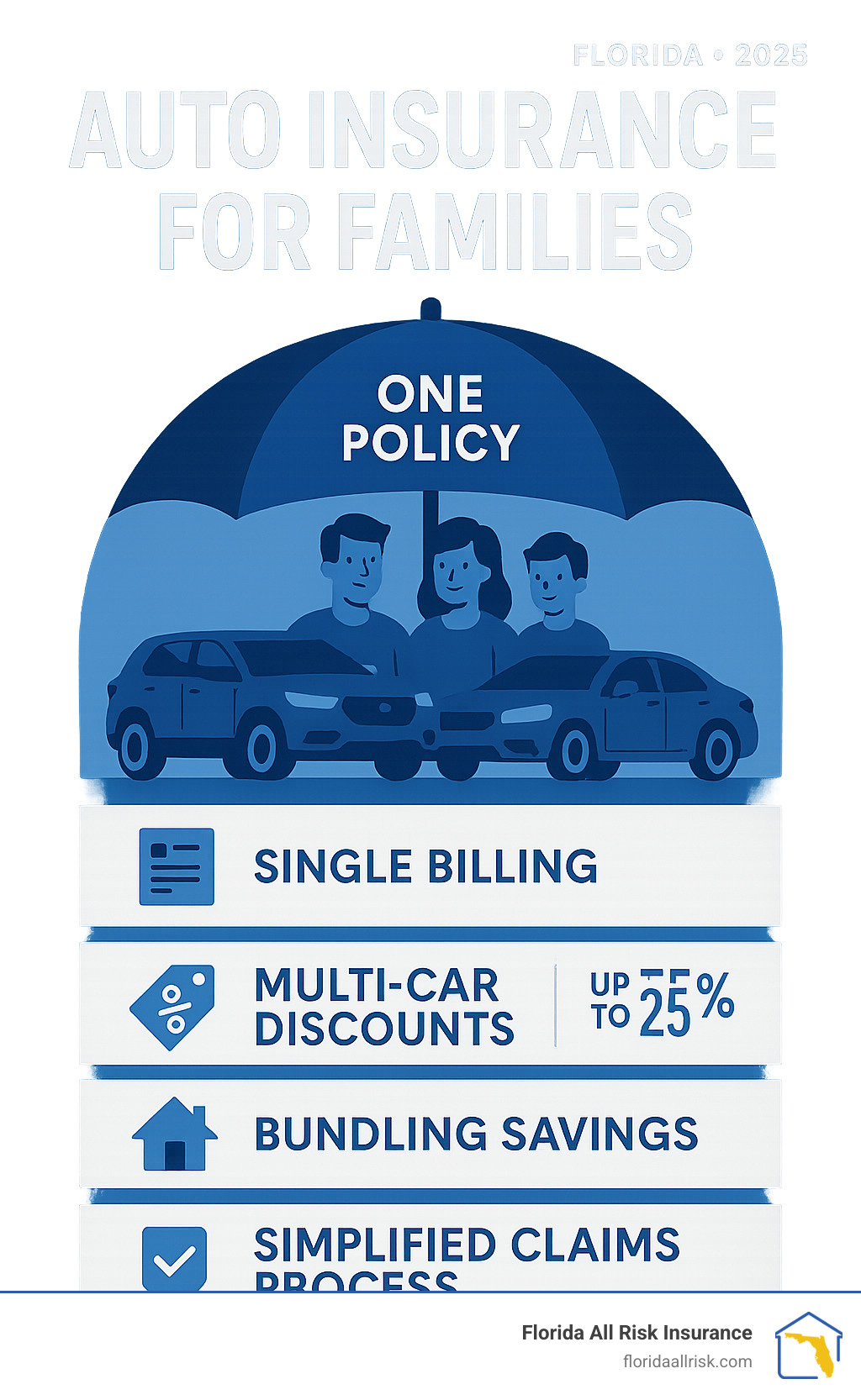
- Multi-car discounts of 5–25 % when insuring multiple vehicles
- Simplified management with one bill and renewal date
- Bundling opportunities with home insurance for additional savings
- Consistent coverage across all family members
- Lower costs for teen drivers compared to separate policies
Family auto insurance works by listing all licensed household members as drivers on your policy. This includes spouses, teen drivers, college students, and any other relatives living in your home who drive your vehicles. While adding family members—especially young drivers—can increase your premiums by 50–150 %, the multi-car and family discounts typically make it far more affordable than purchasing separate policies.
The most important decision is choosing adequate coverage levels. Florida’s no-fault insurance laws require Personal Injury Protection (PIP) and Property Damage Liability, but families should strongly consider adding Bodily Injury Liability and Uninsured/Underinsured Motorist coverage to protect against drivers who lack sufficient insurance.
What is Family Auto Insurance and How Does It Work?
Family auto insurance isn’t a single product; it’s a strategy. You list every driver and vehicle in your household under one policy, usually through a multi-car plan or by adding extra drivers to an existing policy. That single contract simplifies bills and, in most cases, lowers your total premium.
Who Needs to Be on the Policy?
Any licensed driver who lives with you and has routine access to a family vehicle should be listed. Leaving someone off can create coverage gaps.
- Spouses/Partners – Almost always cheaper and simpler on one policy.
- Teens – Rates jump, but it is still far less than buying them a separate policy.
- College Students – If they’re away at school without a car, keep them as “occasional” drivers and ask for a student-away discount.
- Other Household Drivers – Elderly parents, siblings, or a nanny who uses your vehicle regularly.
Pros & Cons of a Single Family Policy
Pros
- One renewal date and one bill
- 5–20 % multi-car savings (often more when you bundle home + auto)
- Consistent coverage limits for every driver
- One claims department to deal with
Cons
A high-risk driver (multiple tickets, recent DUI, etc.) can raise the rate for everyone. In rare cases, placing that driver on a separate policy may be cheaper—your independent agent can run both options.
Most Florida households still find the advantages far outweigh the drawbacks, especially when discounts are stacked.
The Financial Impact of Adding Family Members

Adding or removing a driver tweaks the risk profile—and therefore the price—of your policy every single time. Below is what actually drives those swings in cost and why a seemingly small life change (say, a college grad finally buying their own car) can ripple across the whole household.
The Teen-Driver Effect
According to the Centers for Disease Control and Prevention (CDC), teen drivers are nearly three times more likely than drivers aged 20 + to be involved in a fatal crash. Insurers price for that liftd risk.
- Premium spike: Florida parents typically see a 50 – 150 % jump when a 16-year-old joins the policy.
- Still cheaper than a solo policy: Keeping the teen on the family plan usually saves several thousand dollars per year.
- Rates fall with age & a clean record: Expect noticeable relief around age 25 if violations are avoided.
The state’s own crash data echo the CDC findings. The Florida Department of Highway Safety and Motor Vehicles reports that motorists aged 15–19 account for a disproportionate share of serious accidents each year, reinforcing why carriers are so strict with their pricing models.
The Senior-Driver Effect
Just as adding a teen driver impacts rates, so can adding an elderly parent to your policy. While seniors often have decades of driving experience and safe driver discounts, age-related changes in vision, hearing, or reaction time can increase their risk profile in the eyes of an insurer. Premiums may see a slight increase for drivers over 70. However, keeping them on a family policy is almost always more affordable than a separate policy. Furthermore, encouraging them to take a mature driver safety course can often offset any age-related premium adjustments and provide an additional discount.
Other Cost Drivers
- Driving records – Tickets and at-fault accidents for any family member raise the collective premium.
- Vehicle choice – A modest sedan costs less to insure than a high-horsepower sports car.
- Credit-based insurance scores – Florida allows them; better credit often means better rates. In Florida, insurers use a credit-based insurance score (CBIS), which is different from your FICO score. It predicts the likelihood of you filing a claim. Factors like payment history, outstanding debt, and length of credit history are key. A family with a strong, established credit profile can see significantly lower premiums, sometimes saving hundreds of dollars annually compared to a family with a poor or limited credit history.
- ZIP code – Urban St. Petersburg rates differ from quieter suburbs due to theft and crash statistics.
Working with an independent agent lets you see how each variable affects the bottom line so you can decide where to trim costs—and where you shouldn’t.
Opening Up Savings: Key Florida Discounts
Families qualify for some of the industry’s richest discounts. Ask your agent to apply every one that fits your situation.
- Multi-car – Insure two or more vehicles at the same address and save 5 %–25 %.
- Multi-policy (bundle) – Add homeowners, renters, or flood insurance for another 10 %–25 % off both policies.
- Good student – A “B” average (3.0 GPA) can shave up to 15 %—sometimes more—from the teen’s share.
- Safe driver – Three to five years with no tickets or claims open ups 5 %–25 % in savings.
- Defensive-driving course – Young drivers and seniors can earn additional cuts after an approved class.
- Vehicle safety features – Airbags, anti-lock brakes, and anti-theft devices all help lower costs.
- Pay-in-full / Autopay – Small but easy savings for families who pay the six-month or annual premium upfront or set up automatic drafts.
Stacking just three of these discounts routinely saves Florida households $500–$800 per year.
Building Your Family’s Safety Net: Coverage That Matters
Meeting Florida’s legal minimums is rarely enough to protect a growing household. Layering the right coverages creates a true financial shield.
Required in Florida
- Personal Injury Protection (PIP) – Pays up to $10,000 of your own medical expenses regardless of fault.
- Property Damage Liability (PDL) – Covers damage you cause to another person’s property.
Strongly Recommended for Families
- Bodily Injury Liability (BIL) – Protects your assets if you injure someone else and they sue. BIL is arguably the most important coverage for protecting your family’s assets. If you cause an accident that injures someone, their medical bills, lost wages, and legal fees could quickly exceed hundreds of thousands of dollars. Without adequate BIL, your savings, home, and future earnings are at risk. Family policies should consider limits of at least $100,000 per person and $300,000 per accident (written as 100/300).
- Collision – Repairs or replaces your vehicle after a crash.
- Comprehensive – Covers theft, fire, vandalism, hail, and other non-collision losses.
- Uninsured/Underinsured Motorist (UM/UIM) – A must-have in a state where, per the Insurance Information Institute, roughly one in five drivers carries no liability insurance at all. This coverage is your family’s defense against irresponsible drivers. If an uninsured driver hits you, UM/UIM pays for your family’s medical bills, lost income, and pain and suffering. Carrying UM/UIM limits that match your own Bodily Injury Liability limits is a critical strategy for financial protection.
Optional Coverages for Family Peace of Mind
Beyond the core protections, several optional coverages offer significant convenience and value for busy families:
- Rental Reimbursement: If your family’s primary vehicle is in the shop after a covered claim, this coverage pays for a rental car, ensuring school runs, commutes, and errands aren’t disrupted.
- Roadside Assistance/Towing: Provides 24/7 help for flat tires, dead batteries, lockouts, or emergency towing. For a family with multiple drivers, including teens, this is an inexpensive way to ensure no one is ever left stranded.
- GAP Insurance: If you have a loan or lease on a newer vehicle, GAP (Guaranteed Asset Protection) coverage pays the difference between the car’s actual cash value and the amount you still owe if it’s totaled. This prevents you from owing thousands on a car you can no longer drive.
Choosing appropriate limits is where an independent agent adds real value—helping you avoid over-buying while making sure a single accident doesn’t jeopardize college funds or retirement.
Smart Shopping & Claim Basics

How to Compare Quotes Quickly
- Know your numbers – Gather drivers’ licenses, VINs, and a five-year driving history for everyone.
- Decide on deductibles & limits before you shop so you can compare apples to apples.
- Work with an independent agent – An agent can pull rates from multiple carriers in one go, presenting the best blend of price and protection.
- Review annually – Life changes (a teen leaves for college, you pay off a car, etc.) can open new savings.
What to Do After a Crash
- Stay safe first – Move out of traffic and check for injuries.
- Call 911 if anyone is hurt or damage exceeds $500 (Florida law).
- Swap information – Names, addresses, insurance details; stay calm and never admit fault at the scene.
- Document – Photos of damage, skid marks, street signs, and license plates help tell the story later.
- Contact your insurer ASAP – The sooner a claim is opened, the faster repairs and medical bills get handled.
Frequently Asked Questions
Is it cheaper to keep all cars on one policy?
Almost always. Multi-car discounts plus simplified billing generally beat any benefit of splitting policies.
Can my adult child stay on my insurance?
Yes—if they live in your home and regularly drive a family vehicle. Once they move out and title a car in their own name, they need their own policy.
How much will a single ticket raise our rate?
Minor speeding tickets may cause a modest bump; a DUI or reckless-driving conviction can raise premiums 30 %–50 % or prompt non-renewal. Some insurers offer first-incident forgiveness—ask your agent.
How much can we really save with multi-car insurance?
Data from major carriers show average Florida households save $400–$700 a year when two or more vehicles share one policy.
What about college students?
If they’re 100 + miles away without a car, list them as an “occasional driver” and request the student-away discount to cut costs while keeping coverage for holidays and summer break.
Protect Your Family with the Right Partner
Choosing the right auto insurance for families is a vital step in protecting your family’s financial future. By understanding how family policies work, actively seeking out discounts, and selecting the right coverage, you can build a comprehensive safety net that provides peace of mind on every journey.
As an independent insurance agency, Florida All Risk Insurance can be your most valuable partner in this process. We help you steer the options from numerous carriers to find the perfect fit for your family’s unique needs and budget. Our personalized service and access to a wide range of carriers ensures you get custom coverage and competitive rates.
The research consistently shows that families benefit most from:
- Multi-car policies with discounts ranging from 5-25%
- Bundling home and auto insurance for additional savings up to 25%
- Proper coverage selection including adequate liability limits and uninsured motorist protection
- Working with experienced agents who understand Florida’s unique insurance landscape
Ready to ensure your pack is protected? Contact us today to review your options and get a personalized quote for your family. We’ll help you find the right balance of coverage and savings to protect what matters most.
Get a quote for your family’s auto coverage

Contact Us
Florida All Risk Insurance
Address: 6231 1st Ave S, St. Petersburg, FL 33707
Email: [email protected]
Advanced Strategies to Keep Premiums in Check Long Term
Even after you’ve stacked basic discounts, there are still levers you can pull to control the cost of family auto insurance over the long haul. Below are research-backed tactics you can adopt today to keep premiums from creeping up year after year.
1. Accept Telematics—But Understand the Fine Print
Usage-based or telematics programs place a small device in the vehicle (or use a mobile-phone app) to record real-time driving data such as speed, braking patterns, and mileage. Carriers then reward safer habits with significant discounts—sometimes 20 % or more.
- Best for: Families with new drivers you want to monitor or households with multiple low-mileage vehicles.
- Watch out for: Some programs only offer initial sign-up savings and can raise rates at renewal if the data suggest risky habits. Read the contract carefully.
2. Opt for Higher Deductibles—But Bank the Difference
Jumping from a $500 to a $1,000 deductible on Collision and Comprehensive may shave 10 – 15 % off the premium. The key is to deposit the savings into an emergency fund so you’re never stuck without cash after a claim.
3. Be Strategic About Vehicle Choices
Every minivan or SUV on your driveway comes with its own insurance footprint. High-performance engines, luxury parts, or even hard-to-find body panels can spike repair costs and, in turn, premiums. Before you buy, run the VIN through your agent’s rating software. You might find that the slightly less-loaded trim level saves hundreds per year in insurance alone.
4. Schedule Teen Driver Training Early
Multiple studies from the National Highway Traffic Safety Administration show that structured driver-education programs reduce crash risk by reinforcing defensive-driving techniques and hazard recognition. Many Florida insurers respond by offering an additional 5 – 10 % discount when proof of course completion is supplied.
5. Calendar a Mid-Policy Review—Not Just at Renewal
Most households wait for the renewal packet to make changes. A twice-yearly review lets you capture savings faster when:
- A student leaves for college without a car (qualifies for a student-away discount).
- You pay off a vehicle loan and decide to drop GAP coverage.
- Mileage patterns shift because of a new remote-work schedule.
6. Maintain (or Improve) Your Credit Profile
Florida permits carriers to use credit-based insurance scores when calculating rates. Paying bills on time, keeping credit-card utilization low, and periodically checking your report for errors can quietly save hundreds per year without touching any coverage limits.
7. Bundle With Non-Auto Policies—But Review Both Sides of the Deal
Bundling auto with homeowners, renters, or umbrella coverage can yield a combined 10 – 25 % discount. Yet a super-cheap auto rate paired with an overpriced home premium is no bargain. Ask your agent for a net-of-bundle comparison so you’re sure the total package truly saves money.
8. Re-Shop the Market After Major Life Events
Marriage, divorce, a teen getting licensed, or even moving two ZIP codes over can all alter your risk profile. Carriers weigh these events differently, so a provider that was competitive last year might not be the best fit today. An independent broker can pull fresh quotes quickly—often without another hard credit inquiry.
9. Know When to File (and When to Pay Out of Pocket)
Small claims—think a $600 scratch on the bumper—may cost more in future surcharges than the repair itself. Use the following rule of thumb:
- File a claim: Any time someone is injured, another party is involved, or the damage exceeds two times your deductible.
- Pay cash: Minor cosmetic damage that won’t threaten the vehicle’s safety or resale value.
Careful claim management preserves valuable accident-free and safe-driver discounts, keeping your long-term premiums in check.
By layering these advanced strategies on top of the foundational advice outlined earlier, Florida families can confidently manage their auto-insurance budgets without sacrificing the robust protection their loved ones deserve.

