

Why Understanding Your Deductible Options Matters
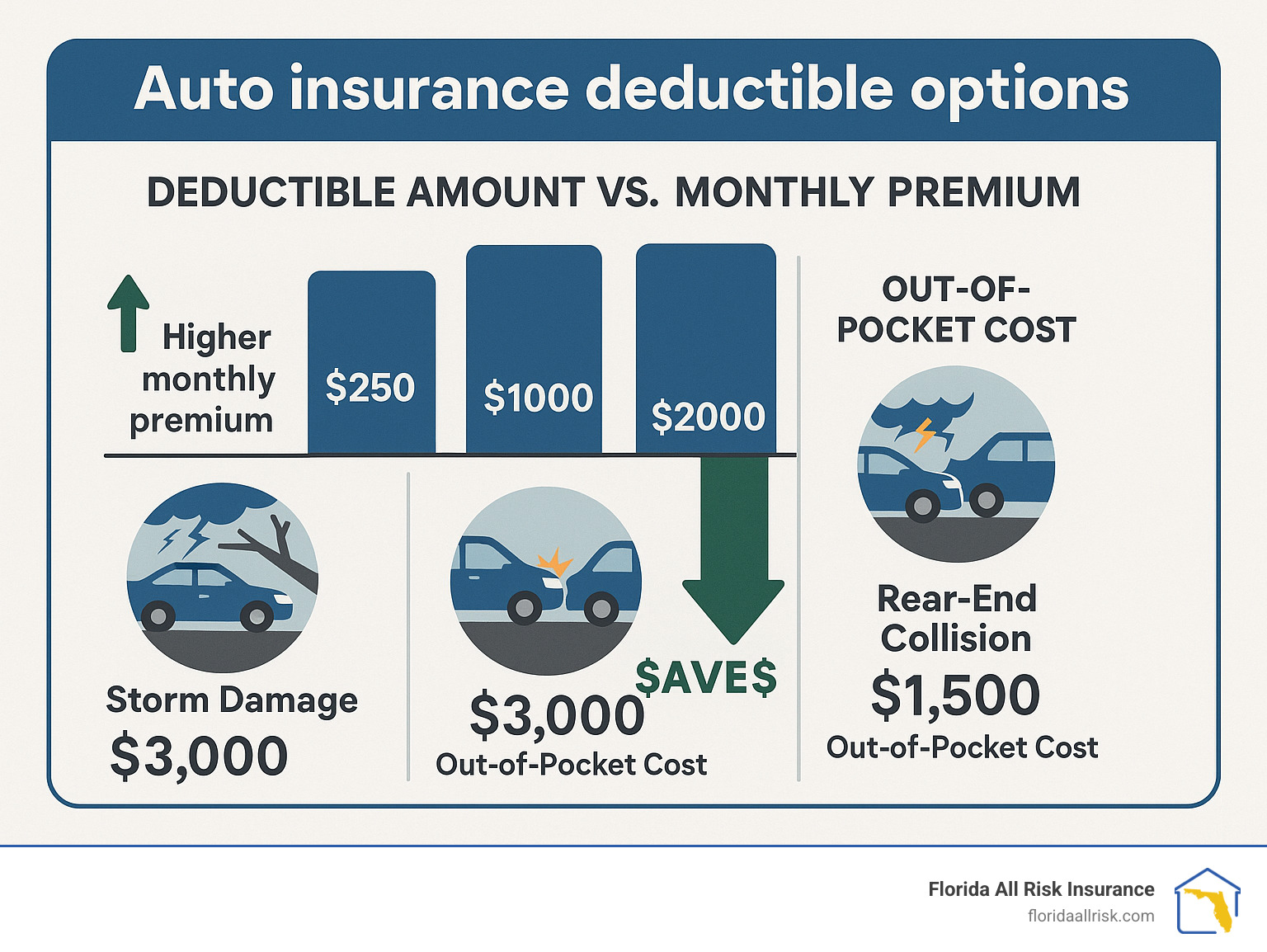
Auto insurance deductible options come in many forms, and choosing the wrong one can cost you hundreds or even thousands of dollars when you need coverage most. Here are the main deductible choices available to Florida drivers:
- High deductibles ($1,000-$2,000): Lower monthly premiums but higher out-of-pocket costs
- Low deductibles ($250-$500): Higher monthly premiums but less money needed upfront after an accident
- Split deductibles: Different amounts for collision vs. comprehensive coverage
- Vanishing deductibles: Programs that reduce your deductible over time with claim-free driving
- Deductible waivers: Special situations where you pay $0 (like windshield repairs)
Your deductible is the amount you pay out of pocket before your insurance kicks in to cover the rest. With $500 being the most common choice, deductibles typically range from $250 to $2,000. The key trade-off is simple: higher deductibles mean lower monthly premiums but more money needed when filing a claim.
Think of it as risk-sharing between you and your insurer. When you choose a higher deductible, you’re telling your insurance company “I’ll handle the smaller repair bills myself” in exchange for paying less each month.
As Jason Miller with over 20 years of Florida insurance experience, I’ve helped thousands of drivers steer auto insurance deductible options that fit their budget and risk tolerance. My goal is making sure you understand exactly what you’re signing up for before an accident happens.
Simple guide to Auto insurance deductible options terms:
– Auto insurance coverage options
– Best car insurance discounts
– Liability car insurance Florida
Auto Insurance Deductible Basics
Here’s what every Florida driver needs to know: your auto insurance deductible is simply the amount you pay out of your own pocket before your insurance company covers the rest of your claim. It’s that straightforward – but the details matter more than you might think.
The “per-claim rule” is crucial to understand. Every time you file a separate claim, you’ll pay your deductible again. So if a hurricane damages your car in September and you get rear-ended in December, that’s two deductibles you’ll need to pay – not just one for the year.
Most Florida drivers go with a $500 deductible because it strikes a nice balance between affordable monthly premiums and manageable out-of-pocket costs. But your auto insurance deductible options typically range from $250 all the way up to $2,000.
What Is a Deductible and How Does It Work?
Think of your deductible as your “entry fee” for getting your insurance company involved. When something happens to your car, you pay this fixed dollar amount first, then your insurer handles the rest of the repair bill.
Let’s say you’re driving through downtown St. Petersburg and someone rear-ends you, causing $3,000 in damage. With a $500 deductible, you pay $500 and your insurance covers the remaining $2,500.
But here’s where it gets tricky – if that same fender-bender only caused $400 in damage, you’d pay the entire amount yourself since it’s less than your deductible. Your insurance wouldn’t pay a penny.
Total-loss math works differently. If your car is worth $15,000 and gets completely totaled, your insurer pays you the full value minus your deductible. So with a $1,000 deductible, you’d receive a check for $14,000.
Which Coverages Carry Deductibles?
Not all parts of your auto insurance policy include deductibles, and understanding which ones do can save you from unpleasant surprises when filing a claim.
Collision coverage kicks in when your vehicle hits another car, crashes into an object, or rolls over. Comprehensive coverage handles all those non-collision headaches – theft, vandalism, fire, falling tree branches, and storm damage. Given our hurricane seasons and afternoon thunderstorms, comprehensive claims are pretty common around here.
Uninsured motorist property damage sometimes includes a deductible, protecting you when someone without insurance damages your car. Personal injury protection (PIP) – which Florida law requires us all to carry – often has a deductible for medical expenses and lost wages too.
Here’s something important for anyone financing or leasing their vehicle: lender requirements typically mandate both collision and comprehensive coverage, meaning you’ll need deductibles for both. Many lenders also set caps on how high your deductible can be – usually maxing out at $1,000.
The good news? Liability coverage never has a deductible. When you’re at fault and your insurance pays for someone else’s damages, you won’t owe anything out of pocket beyond your regular premiums.

Auto Insurance Deductible Options
When it comes to auto insurance deductible options, Florida drivers have more flexibility than many realize. Think of it like choosing your comfort level with financial risk – some folks sleep better knowing they’ll only pay $250 out of pocket after an accident, while others prefer pocketing the monthly savings and handling larger repair bills themselves.
High deductibles of $1,000 or more can slash your monthly premiums by $50 to $100 compared to standard $500 deductibles. That’s real money back in your pocket every month. But here’s the catch: when that Florida thunderstorm drops a tree branch on your car, you’ll need that full deductible amount ready to go.
On the flip side, low deductibles between $100 and $500 mean you’re never caught off guard by a massive repair bill. You’ll pay more each month in premiums, but you’ll have peace of mind knowing an accident won’t drain your savings account.
Here’s where things get really interesting – split deductibles let you mix and match based on your specific risks. Maybe you choose a $250 comprehensive deductible because Florida weather is unpredictable, but opt for a $1,000 collision deductible since you’re a careful driver.
Some insurers offer vanishing deductible programs that reward safe driving by reducing your deductible $50 to $100 each claim-free year. And don’t forget about deductible waivers – Florida has some great windshield laws that might let you replace that cracked glass without paying anything out of pocket.
High vs. Low: Pros, Cons & Premium Impact
Let’s talk real numbers here. Choosing a higher deductible isn’t just about saving money – it’s about understanding what you’re trading off.
With high deductibles, you could save anywhere from $300 to $1,200 annually on your premiums. That’s significant money that could go toward building an emergency fund or paying down debt. High deductibles work especially well if you drive an older car where a total loss might actually be preferable to expensive repairs.
But high deductibles require discipline. You need that $1,000 or $2,000 sitting in your bank account, ready to go when disaster strikes.
Low deductibles flip the equation. You’ll pay more monthly, but when your teenager backs into a mailbox or hail damages your roof, you’re only out a few hundred dollars instead of a couple thousand. This makes particular sense for new drivers, people on tight budgets, or anyone living in high-crime areas.
Research shows that drivers who never file claims save over $1,000 annually with high deductibles. But file just one claim, and those savings start disappearing fast.
Mixing & Matching Deductibles by Coverage
Here’s a strategy many smart Florida drivers use – they don’t pick the same deductible for everything. Instead, they customize based on what’s most likely to happen.
Consider choosing a lower comprehensive deductible around $250 since Florida weather can be brutal. Between hurricanes, hail storms, and falling tree branches, comprehensive claims happen more often here than in many other states. Plus, Florida’s windshield replacement laws might waive your deductible entirely for glass damage.
At the same time, you might select a higher collision deductible of $1,000 since you have more control over collision accidents through careful driving. This split strategy acknowledges that while you can’t control the weather, you can control how safely you drive.
Your location matters too. If you’re commuting daily through downtown St. Petersburg or Tampa, collision risks increase with heavy traffic. But if you’re in a rural area with secure parking, you might feel comfortable with higher deductibles across the board.
Just remember that if you’re financing or leasing your vehicle, your lender might cap your deductibles at $1,000 maximum.

Choosing the Right Deductible Amount
Picking the right deductible isn’t about finding the “perfect” number – it’s about finding the one that won’t keep you awake at night worrying about money. After two decades helping Florida drivers steer auto insurance deductible options, I’ve learned that the best deductible is one you can actually afford to pay without breaking into a sweat.
Let’s start with the reality check nobody wants to talk about: Can you actually come up with your deductible amount in 24-48 hours? Not in a few weeks when you get your tax refund, but right now. Repair shops don’t offer payment plans, and rental car companies want their money upfront.
Your emergency fund tells the real story here. If your emergency fund is looking more like an emergency puddle, stick with lower deductibles until you build up those reserves. There’s no point saving $30 a month on premiums if you can’t handle a $1,000 repair bill.
Vehicle value creates some interesting math that surprises many drivers. If your trusty 2015 sedan is worth about $8,000 and you’re carrying a $2,000 deductible, you’re only getting $6,000 if it gets totaled. Sometimes that makes sense, sometimes it doesn’t – it depends on how much you’re saving monthly.
Here’s something that might sound obvious but gets overlooked: your driving history matters. If you’ve filed two claims in the past three years, you’re statistically more likely to file another one. That doesn’t make you a bad driver, but it does make lower deductibles a smarter financial choice.
Your daily driving reality shapes everything too. Commuting through downtown Tampa every day creates different risks than driving country roads in Polk County twice a week.
For personalized guidance on balancing coverage with costs, check out our Auto Insurance Coverage Options and Auto Insurance Rates Florida resources.
When a Higher Deductible Makes Sense
Higher deductibles can be brilliant financial moves – when they fit your situation. The key is having both the financial cushion and the risk profile that makes them work in your favor.
Older vehicle owners often find the sweet spot with higher deductibles. If your car is worth $8,000 or less, you’re entering territory where total losses become more likely than expensive repairs.
The strong emergency fund factor can’t be overstated. Drivers sitting on $10,000+ in savings can treat a $1,500 deductible as an inconvenience rather than a crisis. They’re banking on saving more in premiums over time than they’ll pay in occasional deductibles – and the math usually works out.
Low-mileage drivers have statistics on their side. If you’re working from home and putting 8,000 miles a year on your car instead of 15,000, your accident exposure drops significantly. Retirees and remote workers often find that higher deductibles make perfect sense for their lifestyle.
Secure parking changes the game for comprehensive coverage. Parking in a garage or gated community dramatically reduces your theft and vandalism risk.
When to Stick With a Lower Deductible
Sometimes paying more monthly is the smartest financial decision you can make. Lower auto insurance deductible options provide crucial protection when your situation calls for financial predictability over premium savings.
New vehicle owners face a different cost structure entirely. Modern cars use expensive OEM parts and require specialized repair techniques. What looks like minor damage can easily hit $3,000-5,000 in repair costs.
Tight budgets make the choice clear. If coming up with $1,000 quickly would mean skipping rent or borrowing from family, choose the lower deductible. The extra $40-60 monthly is insurance against financial disaster, not just car repairs.
Teen and new drivers create special circumstances that experienced drivers sometimes forget. Young drivers don’t just have more accidents – they have dramatically more accidents. We’re talking 2-3 times the claim frequency of experienced drivers.
Urban commuting through Florida’s major metro areas changes your risk profile significantly. Daily driving through Tampa, Orlando, or Miami traffic exposes you to aggressive drivers, distracted tourists, and stop-and-go conditions that breed fender-benders.
Florida’s weather patterns deserve special mention. If you live in a hurricane-prone area or can’t garage your vehicle during storm season, lower comprehensive deductibles become valuable protection.

Paying & Managing Your Deductible
Nobody wants to think about paying deductibles until they’re standing in a repair shop parking lot after an accident. Understanding the payment process ahead of time removes one stress from an already challenging situation.
When you need repairs, you’ll typically pay your deductible directly to the repair shop when picking up your vehicle. The shop handles the paperwork with your insurance company and bills them for the remaining repair costs.
Some situations work differently. If you pay the full repair bill upfront – maybe you used a shop outside your insurer’s network – your insurance company will reimburse you for everything above your deductible amount.
Total loss situations handle deductibles differently. Your insurer simply deducts your deductible from the settlement check. If your car is worth $12,000 and you have a $500 deductible, you’ll receive a check for $11,500.
Here’s something that catches many drivers off guard: each separate incident triggers your deductible. File three claims in one year, and you’ll pay three deductibles.
Changing your deductible mid-term is usually possible. Most insurers allow you to adjust your auto insurance deductible options anytime by calling or logging into your account online. Changes typically take effect on your next billing cycle.
Deductible waivers apply in certain situations. Some insurers waive deductibles for windshield repairs, recognizing that Florida’s roads can be tough on glass. Others offer vanishing deductible programs that reduce your deductible each year you remain claim-free.
For more detailed information about how deductibles work in different scenarios, check out this scientific research on claim frequency and our guide to Uninsured Motorist Coverage Florida.
Do You Pay if Not at Fault?
This question keeps many Florida drivers awake at night, and honestly, the answer isn’t as straightforward as it should be. Whether you pay your deductible when someone else causes an accident depends on how your claim gets processed.
If you file with your own insurance first – which often happens for faster service – you’ll initially pay your deductible. Don’t panic though. When the other driver is clearly at fault, your insurer will pursue something called subrogation. Basically, they’ll go after the at-fault driver’s insurance company to recover what they paid out, including your deductible.
Successful subrogation means you get your deductible back. This process typically takes 30 to 90 days, depending on how cooperative the other insurance company decides to be.
The ideal scenario happens when the at-fault driver’s insurance accepts liability immediately. They’ll pay your repair costs directly without involving your deductible at all.
Disputed fault situations get messier. If both drivers claim the other was at fault, you’ll likely pay your deductible initially. If the investigation later determines the other driver was responsible, you’ll get your deductible refunded.
Uninsured at-fault drivers present the worst-case scenario. You’ll pay your deductible and might never get it back, since there’s no insurance company to collect from. This is exactly why uninsured motorist coverage is so important in Florida.
Lender & Lease Rules Affecting Deductibles
Financing or leasing your vehicle means someone else has a financial stake in your car, and they’re not shy about protecting their investment. Lenders typically limit your deductible choices to ensure their collateral stays properly protected.
Most lenders cap deductibles at $1,000 for both collision and comprehensive coverage. Some luxury vehicle lenders get even stricter, requiring $500 maximum deductibles.
Gap insurance adds another wrinkle to deductible management. If you have gap coverage, it pays the difference between your car’s actual value and what you still owe on the loan. However, your primary insurance deductible still applies first.
Lease agreements often mandate even lower deductibles since you’re expected to return the vehicle in good condition. Some lease contracts require $500 or lower deductibles to ensure any damage gets properly repaired with quality parts.
The bottom line? Check your loan or lease agreement before adjusting your deductibles. That money you save on premiums isn’t worth violating your financing terms.
Frequently Asked Questions about Deductibles
Let’s tackle the most common questions we hear from Florida drivers about auto insurance deductible options. These situations come up more often than you’d think, and knowing the answers ahead of time can save you both money and stress.
What happens if repairs cost less than my deductible?
Here’s a scenario that catches many drivers off guard: your car gets keyed in a parking lot, and the paint repair costs $350. If you have a $500 deductible, you’re paying that entire $350 out of your own pocket – your insurance won’t contribute a penny.
While this might feel frustrating at first, it’s actually working in your favor. You’re keeping your claims history spotless, which helps maintain lower premiums at renewal time.
Can I change my deductible after buying a policy?
Absolutely! You can adjust your deductible anytime by giving your insurance company a quick call. The change typically kicks in on your next billing cycle, and your monthly premium will adjust up or down accordingly.
Here’s the catch though – you cannot change your deductible retroactively. If you rear-end someone on Monday and then try to lower your deductible on Tuesday, you’re stuck with whatever deductible was active when the accident happened.
Are there situations where my deductible is waived?
Yes, and these situations can save you hundreds of dollars when they apply. Windshield repairs are the most common deductible waiver – many comprehensive policies let you fix chips or replace your entire windshield without paying anything out of pocket.
Not-at-fault accidents often result in waived deductibles, but only when the other driver’s insurance accepts full responsibility quickly. If there’s any dispute about fault, you might initially pay your deductible and get it refunded later through subrogation.
Some insurers offer vanishing deductible programs that reduce your deductible by $50-100 each year you stay claim-free. After several years of safe driving, your deductible could disappear entirely.
Always check your policy documents or call your agent to confirm which deductible waivers apply to your coverage.
Conclusion
Choosing the right auto insurance deductible options is like finding the perfect pair of shoes – it needs to fit your budget, lifestyle, and the roads you travel every day. After helping thousands of Florida drivers steer these decisions, I’ve learned that the “perfect” deductible isn’t about following rules or industry averages. It’s about honest self-assessment and smart financial planning.
The sweet spot lies in balancing what you can afford monthly against what you can handle when that unexpected call comes from a tow truck driver. Most Florida drivers gravitate toward $500 deductibles because they offer reasonable premium savings without requiring a massive emergency fund. But your situation might call for something completely different.
Maybe you’re a new driver in Tampa who needs the security of a $250 deductible, or perhaps you’re a seasoned driver with substantial savings who benefits from a $1,500 deductible. The beauty of today’s insurance market is that you can mix and match deductibles across coverages – choosing lower amounts for Florida’s frequent weather claims while going higher on collision coverage.
Here’s what I tell every client: the best deductible is one you can pay without losing sleep. If writing a $1,000 check would stress your budget or force you to skip necessary repairs, that deductible is too high regardless of the premium savings. Your insurance should provide peace of mind, not create new anxieties.
At Florida All Risk Insurance, we’ve seen how the right deductible choice can save drivers thousands over time – both in premiums and in financial stress during difficult moments. Whether you’re dealing with St. Petersburg’s afternoon thunderstorms or navigating the tourist-heavy traffic of our beautiful coastal communities, your deductible should work for your real life, not against it.
Take time to build that emergency fund, honestly assess your driving patterns, and remember that you can always adjust your deductibles as your financial situation evolves. The goal isn’t finding the cheapest option – it’s finding the smartest one for your circumstances.
Ready to find your perfect fit? Our team provides personalized guidance that goes beyond just quoting numbers. Visit our Car Insurance Quotes Florida page to find how the right deductible strategy can protect both your vehicle and your financial future in the Sunshine State.

