

1099 Workers Comp Conundrum: Navigate Risks
The Growing Need for 1099 Workers’ Comp Coverage
1099 workers comp has become one of the most confusing aspects of modern employment law. If you’re searching for clarity on this topic, here’s what you need to know right away:
Key Facts About 1099 Workers’ Comp:
- General Rule: True independent contractors are NOT covered by their client’s workers’ compensation insurance
- Major Exception: Many states require coverage for 1099 contractors in high-risk industries like construction
- Business Risk: Companies hiring uninsured contractors may be liable for their injuries and face severe penalties
- Contractor Protection: Independent contractors can purchase their own workers’ comp policies for financial security
- State Variations: Requirements vary dramatically by state – Florida has particularly strict construction industry rules
The rise of the gig economy has created a storm of confusion. With nearly 21% of the U.S. workforce now consisting of 1099 contractors, a significant insurance gap leaves millions of workers vulnerable and creates liability risks for the businesses that hire them.
The stakes are high, especially in Florida, where construction companies face strict liability rules. A single injury involving an uninsured contractor can lead to massive daily penalties and full liability for medical costs and lost wages.
For contractors, the risks are just as serious. Personal health insurance often excludes work-related injuries, exposing you to catastrophic medical bills. Furthermore, many clients now require proof of workers’ compensation coverage before hiring.
With decades of experience helping Florida businesses steer complex coverage requirements, we’ve seen how 1099 workers comp issues can devastate unprepared contractors and employers. Our expertise in Florida’s unique insurance landscape helps clients understand and properly address their workers’ compensation needs.

Decoding Worker Status: 1099 Contractor vs. W-2 Employee
Getting worker classification right is essential for protecting your business and understanding your legal obligations. When it comes to 1099 workers comp, knowing whether someone is a true independent contractor or an employee makes all the difference.
The gig economy has blurred traditional employment lines, but government agencies like the IRS have specific criteria to prevent misclassification. Getting this wrong can cost you thousands in penalties, back taxes, and insurance premiums.
The W-2 Employee
A W-2 employee is a traditional worker. The Internal Revenue Service (IRS) defines an employee as someone whose work is controlled by the employer—not just what work gets done, but how it’s done. The employer withholds income, Social Security, and Medicare taxes and pays its share of these taxes. Most W-2 employees also get benefits like health insurance and paid time off.
Crucially for 1099 workers comp: if someone is your W-2 employee, you are almost certainly required by state law to provide workers’ compensation insurance for them.
The 1099 Independent Contractor
Independent contractors are self-employed. According to the IRS, a business only controls the end result of a contractor’s work, not the process. These professionals handle their own taxes, including self-employment tax, and are responsible for their own insurance. If you pay them $600 or more in a year, you’ll send them a Form 1099-NEC.
The key differences are clear when viewed side by side:
| Factor | W-2 Employee | 1099 Independent Contractor |
|---|---|---|
| Control | Employer directs how, when, and where work is done. | Worker controls how and when work is completed. |
| Taxes | Employer withholds income & FICA taxes. | Worker is responsible for self-employment taxes. |
| Benefits | Often eligible for health insurance, PTO, retirement plans. | Not eligible for employer-provided benefits. |
| Tools/Equipment | Employer typically provides necessary tools. | Worker typically uses their own tools and equipment. |
| Workers’ Comp | Employer is required to provide coverage. | Generally not covered by client’s policy. |
| Financial Risk | Limited financial risk; receives a steady paycheck. | Bears risk of profit or loss on a project. |
The IRS Test: Key Factors for Determining Classification
There’s no single formula for determining worker status. Instead, the IRS looks at the entire relationship, grouping evidence into three categories to understand the degree of control. Misclassifying an employee can have significant consequences.
Behavioral Control examines who directs and controls the work. This includes the level of instruction given (e.g., when and where to work, what tools to use) and the degree of training provided. More control points toward an employee relationship.
Financial Control looks at the business aspects. Key factors include whether the worker has a significant investment in their own equipment, covers their own expenses, can realize a profit or loss, and how they are paid (e.g., hourly vs. a flat project fee). More financial independence suggests a contractor.
Relationship of the Parties considers how both sides perceive their arrangement. This includes written contracts, the provision of employee-type benefits (like insurance or vacation pay), the permanency of the relationship, and whether the services are a key aspect of the company’s regular business.
If you’re still unsure, you or the worker can file Form SS-8, Determination of Worker Status for Purposes of Federal Employment Taxes and Income Tax Withholding, with the IRS. They will review the situation and provide an official determination.
The Legal Maze of 1099 Workers’ Comp Requirements
Navigating 1099 workers comp requirements can be complex. While businesses generally don’t need to cover true independent contractors, the reality is a patchwork of state-specific rules that can easily trap unprepared business owners.
What’s legal in one state might lead to serious trouble in another. This isn’t a minor inconvenience—it’s a costly risk for businesses and contractors alike.
When Businesses MUST Cover 1099 Contractors
Many states have decided that certain work is too dangerous to leave unprotected, regardless of a worker’s classification. The question becomes not just “Are they a 1099 contractor?” but also “What kind of work are they doing?”
High-risk industries, especially construction, top the list of exceptions. Due to the inherent dangers, many states now require construction companies to cover everyone on their job sites, including subcontractors.
Florida is particularly strict. According to Florida Statute 440, construction businesses with even one employee must carry workers’ compensation. This requirement often extends to subcontractors. A general contractor becomes responsible for ensuring any uninsured subcontractor is covered, or they face personal liability for injuries. This makes having the right Small Business Insurance in Florida absolutely critical.
The concept of prime contractor liability is standard in many states. If a general contractor hires a subcontractor without their own workers’ comp policy, the general contractor’s insurance becomes responsible for that subcontractor’s injured workers. This leads to higher audit premiums and explains why most experienced contractors demand a valid Certificate of Insurance before hiring.
State-Specific Nuances for 1099 Workers’ Comp
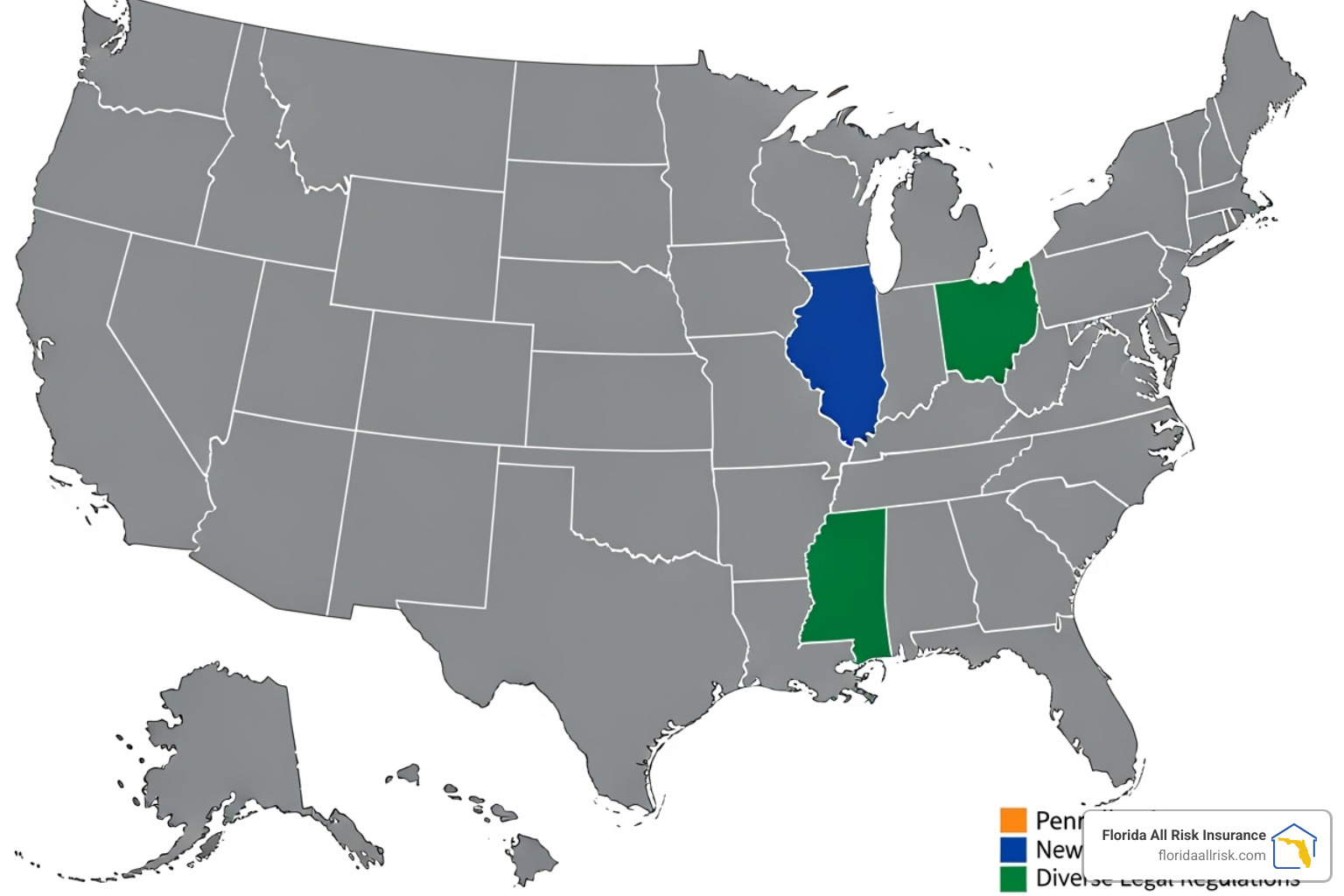
Image: Map highlighting states with varying workers’ comp laws. (Alt text: US map with highlighted states for workers’ comp law differences)
The rules for 1099 workers comp change dramatically across state lines.
Florida heavily regulates the construction industry. Beyond construction, non-construction businesses with four or more employees must also carry coverage, establishing a clear threshold for when protection is mandatory.
New York uses a broad definition of “employee” for workers’ comp, and penalties for non-compliance can reach $2,000 for each 10-day period.
Pennsylvania treats intentional misclassification to avoid premiums as a third-degree felony, with fines up to $15,000 and potential jail time of up to seven years.
Oklahoma fines businesses $1,000 per day for failing to provide required coverage.
Monopolistic states—Ohio, North Dakota, Washington, and Wyoming—require businesses to purchase workers’ compensation insurance directly from a state-operated fund, eliminating the private insurance market.
The message is clear: before hiring a contractor or working in a new state, you must investigate the specific local laws. Assumptions can be devastating.
The High Stakes of Misclassification: Risks for Businesses
The temptation to classify workers as contractors to save money is real, but whether intentional or accidental, getting worker classification wrong can financially destroy your business. A single finding of misclassification often triggers a domino effect of audits and investigations from multiple agencies, each with its own set of penalties.
Severe Penalties and Financial Consequences
Imagine a state agency reclassifies your contractors as employees. Suddenly, you’re facing a financial avalanche.
- Back Taxes: The employer becomes liable for their share of unpaid Social Security and Medicare taxes, plus penalties and interest.
- Workers’ Compensation Penalties: This is often the biggest blow. If a misclassified and uninsured employee gets injured, the business is personally liable for all medical bills and lost wages. On top of this, states levy massive fines for failing to carry required insurance, which can accumulate daily. In states like Pennsylvania, intentional misclassification can even lead to felony charges and prison time.
- Other Liabilities: You could also face liability for unpaid overtime under federal labor laws and claims for employee benefits. Standard Business Liability Insurance typically does not cover these statutory penalties.
The Impact on Your Insurance and Reputation
Even without a government audit, misclassification creates hidden risks that can explode unexpectedly.
- Nightmare Insurance Audits: When your workers’ comp insurer audits your payroll and finds payments to uninsured subcontractors, they will add those payments to your payroll and charge you the full premium retroactively. This can result in a surprise bill for tens of thousands of dollars.
- Damaged Claims History: If an uninsured contractor gets hurt and your policy pays the claim, it damages your experience modifier for years, increasing your future insurance premiums.
- Difficulty Finding Insurance: Carriers dislike the unpredictable liability of businesses that hire uninsured contractors. They may refuse to renew your policy or decline to offer coverage, making insurance harder and more expensive to obtain.
- Reputation Damage: Lawsuits from misclassified workers become public record. In today’s connected world, a reputation for cutting corners on worker protections can drive away clients, contractors, and employees.
The irony is that businesses misclassifying workers to save money often end up spending far more than they would have on proper classification and 1099 workers comp coverage. A short-term saving tactic becomes a long-term financial disaster.
Protecting Yourself: Insurance Solutions for the 1099 Contractor
As an independent contractor, you are your own business, which means you’re responsible for your own protection. While 1099 work offers freedom, it also carries real risks. Fortunately, there are smart, affordable ways to protect yourself that can also help your business grow.
Think of insurance as an investment in your professional reputation and peace of mind. Securing your own coverage positions you as a serious, professional contractor that clients want to hire.
The Benefits of Securing Your Own 1099 Workers’ Comp Policy
Getting your own 1099 workers comp policy is one of the smartest business decisions a contractor can make. Here’s why:
- Financial Protection: If you’re injured on the job, workers’ comp covers medical bills and provides disability benefits to replace lost income, preventing a financial catastrophe.
- Better Opportunities: Most large companies and general contractors require a Certificate of Insurance (COI) for workers’ comp. Having a policy opens the door to more and better-paying jobs.
- Competitive Advantage: Arriving with insurance in place demonstrates professionalism and reliability, making you a more appealing choice than uninsured competitors.
- Affordable Peace of Mind: For many professions, premiums can be surprisingly affordable. According to recent industry data, the median monthly price for workers’ comp through major carriers was just $67. It’s an essential part of a comprehensive strategy, alongside General Liability Insurance for Small Business.
Workers’ Comp vs. Health Insurance: A Critical Distinction
Never assume your personal health insurance will cover work-related injuries. This is a dangerous and costly mistake. Most health insurance policies specifically exclude injuries sustained during employment. If your insurer pays a claim and later finds it was work-related, they can demand full reimbursement from you through a process called subrogation.
Workers’ compensation is the only insurance designed to handle work-related incidents. It’s not a backup plan; it’s your primary defense. For more details, the National Association of Insurance Commissioners provides comprehensive guidance on these fundamentals.
Other Protective Measures for Independent Contractors
A layered approach to protection is best. Consider these additional measures:
- Disability Insurance: Personal disability policies can supplement workers’ comp and cover illnesses or injuries that occur outside of work.
- Business Structure: Forming an LLC or S-Corporation can create a legal barrier between your personal assets and business liabilities.
- Emergency Fund: A savings of 3-6 months of living expenses provides a buffer for unexpected downtime.
- Expert Advisors: Understanding Why You Should Work With an Independent Insurance Agency can help you find the right, cost-effective coverage. Independent agents offer access to multiple carriers and can help you steer the complexities of contractor insurance.
Thinking like a business owner means recognizing that proper protection isn’t an expense—it’s an investment in your success.
Frequently Asked Questions about 1099 Workers’ Comp
When it comes to 1099 workers comp, contractors and business owners alike have plenty of questions. Let me walk you through the most common concerns I hear from clients here in Florida and across the country.
Do I receive a 1099 form for workers’ compensation payments?
Here’s some good news for your tax situation: generally, no. The IRS doesn’t consider workers’ compensation benefits for wage replacement or medical care to be taxable income. This means you won’t receive a 1099 form for these payments, and you don’t need to report them on your tax return.
However, there’s a small catch to be aware of. If your settlement includes other components beyond basic workers’ comp benefits – such as interest payments or punitive damages from a lawsuit – those specific portions may be taxable and could trigger a 1099-MISC form.
Think of it this way: the core workers’ comp benefits that replace your lost wages and cover your medical bills are meant to make you whole after an injury, not to provide additional income. That’s why the IRS treats them differently than regular earnings.
Can I get a “ghost policy” if I’m a sole proprietor with no employees?
Absolutely, and this is actually a common solution for many Florida contractors. A “ghost policy,” also known as a minimum premium policy, is designed specifically for business owners who have no employees but need to show proof of workers’ compensation coverage.
These policies serve a very specific purpose: providing a Certificate of Insurance (COI) to satisfy client contractual requirements. Since there’s no employee payroll to cover, ghost policies are typically quite inexpensive – often just a few hundred dollars annually.
But here’s the crucial detail many contractors miss: a ghost policy typically excludes the business owner from coverage. It’s essentially a paper policy that proves you have insurance for your clients’ peace of mind, but it won’t pay benefits if you personally get injured on the job.
If you actually want coverage for yourself as the business owner, you’ll need to specifically request that option and pay the additional premium. This distinction has caught many sole proprietors off guard when they needed coverage most.
What happens if I hire a subcontractor? Am I responsible for their workers’ comp?
This is where things can get expensive quickly, and the answer is: you very well could be. In most states, including Florida, if you hire a subcontractor who doesn’t have their own workers’ compensation insurance, you become responsible for them if they get injured on your job.
Here’s how this typically unfolds: Let’s say you’re a general contractor who hires an uninsured painter. That painter falls off a ladder and breaks their leg. Even though they’re technically a 1099 contractor, your workers’ comp policy becomes the primary coverage for their medical bills and lost wages.
This scenario creates a double financial hit. First, you’re liable for their injuries and medical costs. Second, during your annual insurance audit, your carrier will find you paid this uninsured subcontractor and will charge you the full premium for their work – retroactively.
That’s why requiring a valid Certificate of Insurance from every subcontractor isn’t just smart business – it’s essential financial protection. Most experienced contractors won’t even start a conversation with a sub who can’t provide proof of their own 1099 workers comp coverage.
The bottom line is simple: always verify that your subcontractors carry their own policies before they set foot on your job site. It protects both of you and keeps your insurance costs predictable.
Conclusion: Navigating the Conundrum with Confidence
The world of 1099 workers’ comp is undeniably complex, but it doesn’t have to be a source of anxiety. By understanding the fundamental principles, you can protect your business, your finances, and your future. The key takeaways are simple: classification is paramount, state laws are king, the risks of misclassification are severe, and proactive coverage is the smartest strategy for both businesses and contractors.
Whether you are a business owner in Saint Petersburg ensuring compliance when hiring contractors, or a sole proprietor in Florida looking to secure your first policy, knowledge is your most powerful tool. Don’t leave your business or your livelihood to chance.
Ready to secure your protection and gain peace of mind? Get a personalized workers’ comp quote online in minutes and take the first step toward a safer, more secure business today.
Have questions or need expert guidance? Contact the advisors at Florida All Risk Insurance for clear, personalized help with your insurance needs.
Contact Us
Whether you’re a contractor seeking your first 1099 workers comp policy or a business owner navigating Florida’s complex insurance requirements, the team at Florida All Risk Insurance is here to help. We understand that insurance decisions can feel overwhelming, especially when the stakes are so high for your business and financial security.
Our experienced professionals have helped thousands of Florida businesses and independent contractors find the right coverage at competitive rates. As an independent agency, we work with multiple insurance carriers to ensure you get the best protection for your specific needs and budget.
Don’t wait until it’s too late. Every day without proper coverage puts your business and personal assets at risk. The good news? Getting a quote is easier than you might think, and our team makes the process as straightforward as possible.
Florida All Risk Insurance
10225 Ulmerton Rd, Largo, FL 33771
Phone: (727) 577-4900
Email: [email protected]
We’re proud to serve clients throughout the Tampa Bay area and across Florida, from Saint Petersburg to Miami and everywhere in between. Our local expertise combined with our independent agency approach means you get personalized service with access to the widest range of coverage options.
Ready to protect what you’ve worked so hard to build? Give us a call today or visit our website to learn more about how we can help secure your business’s future.

